Multiple Integrals
Double and triple integrals for mass, area, and volume; iterated integrals and Fubini's theorem; non-rectangular regions; and polar, cylindrical, and spherical coordinates with their Jacobians.
- 5 min
- 8 steps
- 3 questions
- Lesson 7 of 36
In this lesson
- The Double Integral
- Iterated Integrals and Fubini’s Theorem
- Non-Rectangular Regions
- A Worked Example
- Triple Integrals
- Changing Coordinates
- Why Engineers Care
Picking up where you left off.
A single-variable definite integral \(\int_a^b f(x)\,dx\) accumulates a quantity along an interval — most familiarly, the signed area under a curve. Multiple integrals extend that same accumulation idea to functions of two or more variables, letting you measure volumes, total mass, and averages over regions of the plane or space. If you are comfortable with definite integrals and partial derivatives, the leap is smaller than it looks: a multiple integral is still a limit of sums, just over a region instead of an interval.
The Double Integral
For a function \(f(x,y)\) defined on a region \(R\) in the plane, the double integral is written
Geometrically, when \(f\ge 0\), this is the volume of the solid lying above \(R\) and below the surface \(z=f(x,y)\). The construction mirrors the single-variable case: partition \(R\) into small pieces of area \(\Delta A\), pick a sample point \((x_i,y_i)\) in each, form the sum \(\sum_i f(x_i,y_i)\,\Delta A\) of box volumes, and take the limit as the pieces shrink 1. More generally, \(\iint_R f\,dA\) is the accumulated value of \(f\) over the region, whatever \(f\) represents physically.
Quick check
With f = 1 it gives the area; dividing first moments by mass gives the centroid.
Iterated Integrals and Fubini’s Theorem
Evaluating that limit directly is impractical. Fubini’s theorem rescues us: over a rectangle \(R=[a,b]\times[c,d]\), the double integral equals an iterated integral, computed one variable at a time,
Work from the inside out. The inner integral \(\int_c^d f(x,y)\,dy\) treats \(x\) as a constant and integrates in \(y\), producing a function of \(x\); the outer integral then integrates that result in \(x\). When \(f\) is continuous, the order may be swapped (integrate in \(x\) first, then \(y\)) without changing the answer 1. Notice the symmetry with partial differentiation: just as \(\partial/\partial y\) holds \(x\) fixed, the inner integral integrates in \(y\) with \(x\) held fixed.
Quick check
Choose the order that makes the limits or the antiderivatives easier.
Non-Rectangular Regions
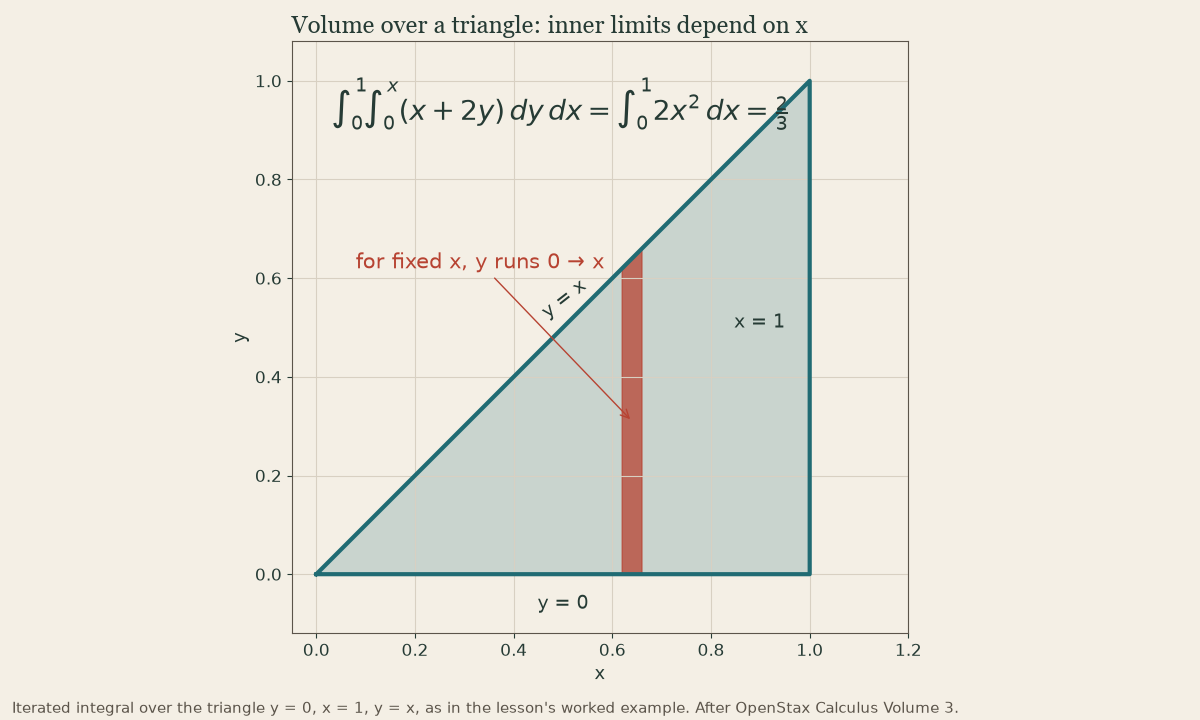
Real regions are rarely rectangles. If \(R\) is bounded below and above by curves \(y=g_1(x)\) and \(y=g_2(x)\) for \(x\) in \([a,b]\), the inner limits become functions of \(x\):
The inner (variable) limits describe how the region’s vertical extent changes as \(x\) moves; the outer (constant) limits sweep across the region. Sketching \(R\) first is the surest way to read off correct limits 1.
A Worked Example
Find the volume under \(f(x,y)=x+2y\) over the triangle \(R\) bounded by \(y=0\), \(x=1\), and \(y=x\). For a fixed \(x\) in \([0,1]\), \(y\) runs from \(0\) up to \(x\):
Inner integral in \(y\):
Outer integral in \(x\):
The volume is \(2/3\). A useful check: integrating the constant function \(f=1\) over \(R\) gives the area of \(R\), here \(\tfrac12\), confirming the limits describe the intended triangle.
Triple Integrals
The same logic extends to three variables. For \(f(x,y,z)\) over a solid region \(E\),
is evaluated as a triply iterated integral, with the innermost limits possibly depending on the outer variables. Setting \(f=1\) yields the volume of \(E\); a general \(f\) accumulates that quantity throughout the solid 1.
Changing Coordinates
When a region or integrand has circular symmetry, polar coordinates simplify the work. Substituting \(x=r\cos\theta\), \(y=r\sin\theta\), the area element is not \(dr\,d\theta\) but
so \(\iint_R f\,dA=\iint f(r\cos\theta,r\sin\theta)\,r\,dr\,d\theta\). The extra factor \(r\) accounts for the fact that polar “grid cells” grow wider as they move away from the origin 1. For triple integrals, cylindrical coordinates add a \(z\)-axis (element \(r\,dr\,d\theta\,dz\)) and spherical coordinates suit ball-like regions (element \(\rho^2\sin\phi\,d\rho\,d\phi\,d\theta\)).
These factors are instances of one idea: the Jacobian. Any change of variables \((x,y)=T(u,v)\) rescales area by the absolute value of the determinant of the matrix of partial derivatives, \(\left|\partial(x,y)/\partial(u,v)\right|\), so \(dA=\left|\partial(x,y)/\partial(u,v)\right|\,du\,dv\). For polar coordinates that determinant works out to exactly \(r\) 1.
Quick check
The extra r is the Jacobian; forgetting it is the classic error.
Why Engineers Care
Multiple integrals turn local quantities into totals. If \(\rho(x,y)\) is a surface mass density, the total mass of a plate is \(\iint_R \rho\,dA\); for a solid of density \(\rho(x,y,z)\), the mass is \(\iiint_E \rho\,dV\). Setting density to \(1\) recovers pure area or volume. The centroid (center of mass) follows from density-weighted integrals such as \(\bar{x}=\frac{1}{M}\iint_R x\,\rho\,dA\). These centroid and mass computations feed directly into statics — locating centers of gravity, computing distributed loads, and (with an extra distance-squared factor) moments of inertia.
Lesson complete
Nice work.
Sources for this lesson
- 1Calculus, Volumes 1–3. OpenStax (Rice University). verifiedOpen (CC BY-NC-SA) calculus text. Vol 1 functions/limits/derivatives/integrals; Vol 2 integration/series; Vol 3 multivariable and vector calculus. Cited at: Vol 3, Ch. 5.