Second-Order Linear ODEs
Constant-coefficient second-order ODEs: the characteristic equation, overdamped, critically damped, and underdamped responses, the mass-spring-damper and RLC circuit, and forced response and resonance.
- 6 min
- 6 steps
- 3 questions
- Lesson 13 of 36
In this lesson
- From First Order to Second Order
- Homogeneous, Particular, and the General Solution
- The Characteristic Equation
- The Three Cases
- The Mass-Spring-Damper and the RLC Circuit
- Forced Response and Resonance
Picking up where you left off.
From First Order to Second Order
Having solved first-order equations, the natural next step is the second-order linear ODE with constant coefficients:
where \(a\), \(b\), and \(c\) are constants (\(a \neq 0\)) and \(f(t)\) is a given forcing function. This single template describes an enormous range of physical systems, because it is the equation of anything that can oscillate: masses on springs, pendulums for small swings, and electrical circuits. The appearance of the second derivative \(y''\) is what makes oscillation possible — it is the term that lets a system overshoot, swing back, and ring 1.
Homogeneous, Particular, and the General Solution
Because the equation is linear, its solution splits cleanly into two pieces. The homogeneous equation sets the forcing to zero:
Its solutions \(y_h\) describe how the system behaves on its own, with no external push — the natural response. A particular solution \(y_p\) is any single function that satisfies the full equation with \(f(t)\) present. The general solution to the forced equation is then their sum:
This works because the equation is linear: adding any homogeneous solution to a particular one still satisfies the full equation, since the homogeneous part contributes zero on the right-hand side. The homogeneous piece \(y_h\) carries the two arbitrary constants needed to match initial conditions (position and velocity), while \(y_p\) pins down the response to the forcing 1.
The Characteristic Equation
To solve the homogeneous constant-coefficient case, guess an exponential \(y = e^{rt}\). Then \(y' = r e^{rt}\) and \(y'' = r^2 e^{rt}\). Substituting and factoring out the never-zero \(e^{rt}\) leaves the characteristic equation:
This is an ordinary quadratic, and its roots determine the behavior of the system entirely. By the quadratic formula, the discriminant \(b^2 - 4ac\) sorts the outcome into three cases 1.
The Three Cases
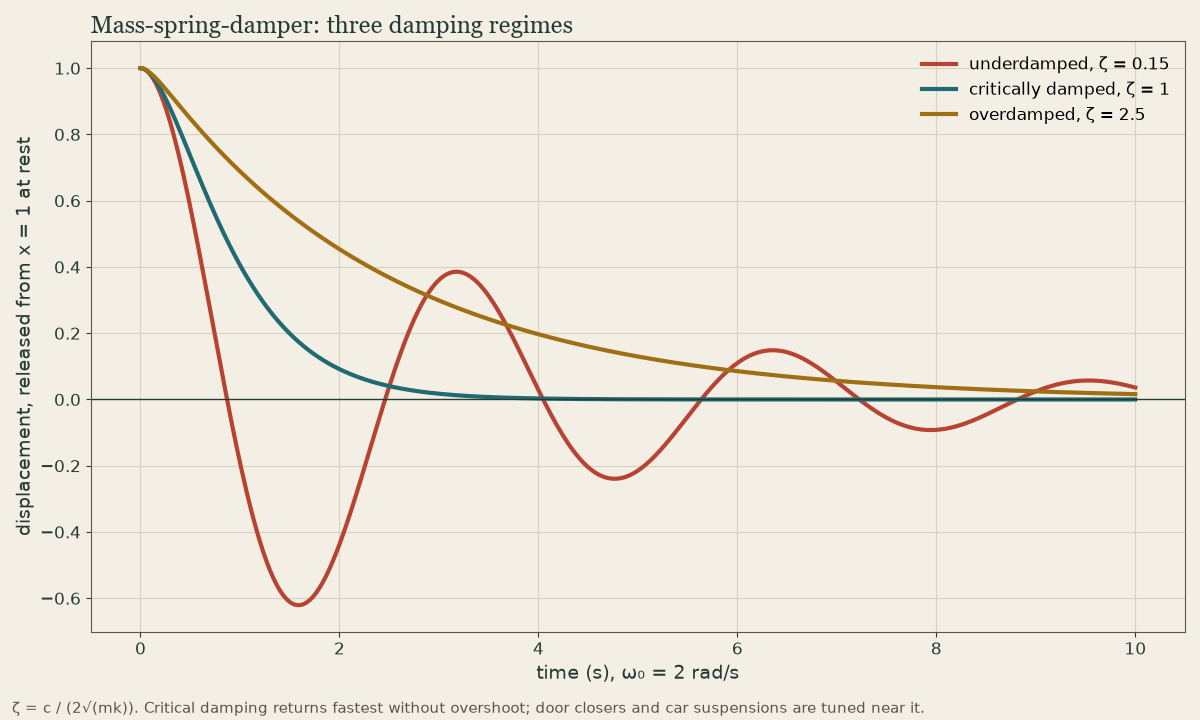
Distinct real roots (overdamped). When \(b^2 - 4ac > 0\), there are two different real roots \(r_1\) and \(r_2\), both negative for a stable system. The general homogeneous solution is
Both terms decay exponentially with no oscillation. The system slides back to equilibrium sluggishly — this is the overdamped regime, like a door closer that eases shut.
Repeated root (critically damped). When \(b^2 - 4ac = 0\), the formula gives a single root \(r = -b/(2a)\). One exponential is not enough for a second-order equation, so a second independent solution is supplied by multiplying by \(t\):
This is critical damping — the fastest possible return to equilibrium without overshooting. It is the dividing line engineers target when they want a quick, clean settle.
Complex conjugate roots (underdamped). When \(b^2 - 4ac < 0\), the roots are complex: \(r = \alpha \pm i\beta\), with \(\alpha = -b/(2a)\). Using Euler’s formula, the real-valued general solution becomes
Here the system genuinely oscillates at angular frequency \(\beta\), inside a decaying envelope \(e^{\alpha t}\) (with \(\alpha < 0\) for a stable system). This is the underdamped case — the ringing, bouncing behavior we associate with springs and circuits 1.
Quick check
Real distinct roots: overdamped; a repeated root: critical.
The Mass-Spring-Damper and the RLC Circuit
The canonical engineering example is the mass-spring-damper. A mass \(m\) on a spring of stiffness \(k\), with a damper of coefficient \(c\), obeys
Matching this to the characteristic equation, the natural frequency (the rate it would oscillate with no damping) is \(\omega_0 = \sqrt{k/m}\), and the damping is set by \(c\). Light damping gives underdamped ringing; heavy damping gives an overdamped crawl; the exact balance gives critical damping.
The same equation governs the series RLC circuit, with inductance \(L\) playing the role of mass, resistance \(R\) the role of the damper, and \(1/C\) the role of spring stiffness:
This parallel is why a mechanical engineer and an electrical engineer can share the same toolbox — the mathematics of oscillation is identical 1.
Quick check
A stiffer spring raises it; more mass lowers it.
Forced Response and Resonance
When \(f(t)\) is present, the system also exhibits a forced response captured by \(y_p\). If the forcing is periodic and its frequency approaches the natural frequency \(\omega_0\), the amplitude can grow dramatically — this is resonance, the effect that lets a small periodic push build a large swing and that engineers must design against in bridges and structures.
To find \(y_p\) for common forcings, two standard methods apply: the method of undetermined coefficients, which guesses a form matching \(f(t)\) (polynomial, exponential, sinusoid) and solves for its coefficients, and variation of parameters, a more general technique that works for any continuous \(f(t)\). Either way, the full solution remains \(y = y_h + y_p\): the natural response fades, and the forced response is what persists 1.
Quick check
Engineers detune structures and add damping to avoid it.
Lesson complete
Nice work.
Sources for this lesson
- 1