Momentum and Collisions
Momentum and Newton's second law in momentum form, impulse and why stretching an impact lowers the force, conservation of momentum, elastic and inelastic collisions, center of mass, and recoil and hammer blows worked out.
- 6 min
- 9 steps
- 3 questions
- Lesson 18 of 36
In this lesson
- Linear Momentum
- Newton’s Second Law in Momentum Form
- Impulse and the Impulse-Momentum Theorem
- Conservation of Momentum
- Collisions: Elastic and Inelastic
- Worked Example: A Perfectly Inelastic Collision
- The Center of Mass
- Recoil and hammer blows
Picking up where you left off.
Energy is one great conserved quantity of mechanics; momentum is the other. Where energy is a scalar that tracks the capacity to do work, momentum is a vector that tracks “quantity of motion” in a definite direction. Together they let you analyze interactions — collisions, explosions, recoils — where the internal forces are complicated or unknown, simply by accounting for what goes in and what comes out.
Linear Momentum
The linear momentum of a particle of mass \(m\) moving with velocity \(\vec v\) is
It points in the same direction as the velocity, and its SI unit is the kilogram-meter per second (\(\text{kg}\cdot\text{m/s}\)). Because it is a vector, momentum has components, and each component is conserved independently — a fact that makes two- and three-dimensional problems tractable 1.
Newton’s Second Law in Momentum Form
Newton originally framed his second law not as \(\vec F = m\vec a\) but in terms of momentum:
The net external force on an object equals the time rate of change of its momentum 1. When the mass is constant this reduces to the familiar \(\vec F = m\,d\vec v/dt = m\vec a\). The momentum form is more general, however: it still holds when mass itself changes with time, as for a rocket burning fuel.
Impulse and the Impulse-Momentum Theorem
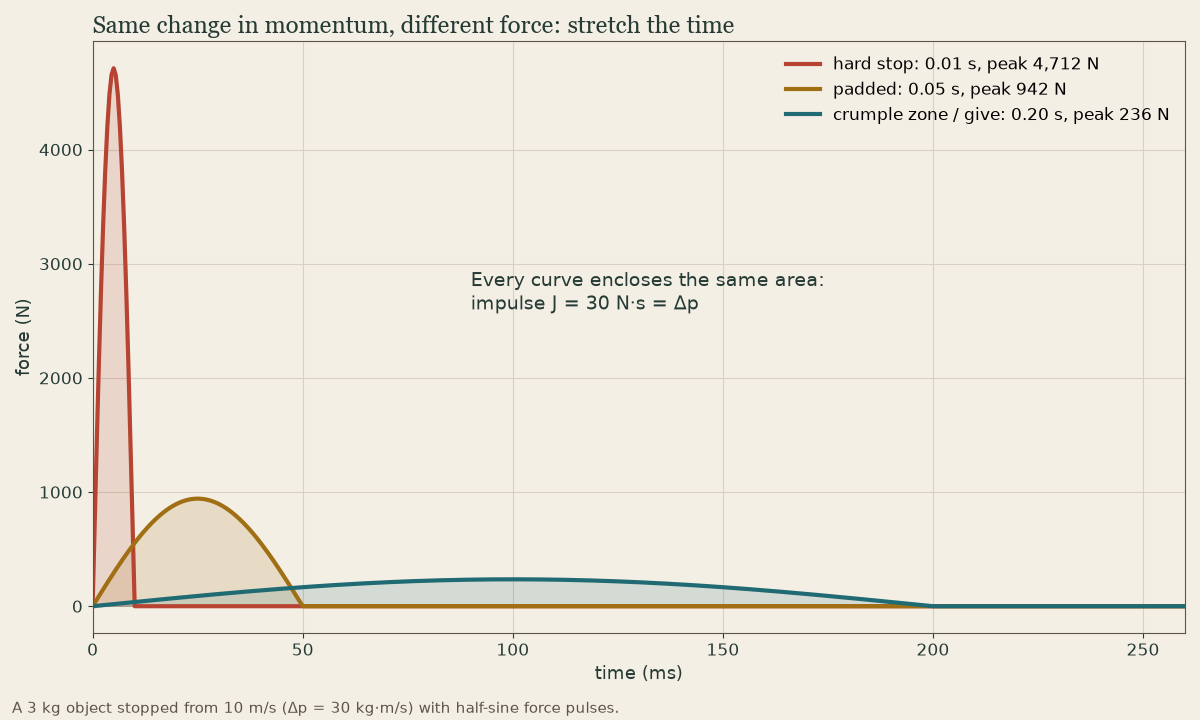
Rearranging the second law gives \(\vec F\,dt = d\vec p\). Integrating over the duration of an interaction defines the impulse \(\vec J\):
This is the impulse-momentum theorem: the impulse delivered by the net force equals the change in momentum 1. The integral captures the total “push” — how hard, for how long.
This explains a family of everyday designs. A fixed change in momentum \(\Delta \vec p\) can be produced by a large force over a short time or a small force over a long time. If a car must stop, its momentum change is set by its mass and speed; a crumple zone extends the collision time, and because \(\vec F_{\text{avg}} = \Delta \vec p / \Delta t\), a longer \(\Delta t\) means a smaller average force on the occupants. The same logic explains airbags, padded landing surfaces, and the follow-through in a tennis swing, which keeps the racket in contact longer to deliver more impulse.
Quick check
F_avg = Δp/Δt; a longer Δt means a smaller average force.
Conservation of Momentum
Consider an isolated system — two or more objects that interact only with each other, with no net external force. By Newton’s third law, when object A pushes on object B, object B pushes back on A with an equal and opposite force at every instant. The internal forces therefore come in canceling pairs, so the net internal force on the system is zero. With no external force either, \(\sum \vec F = 0\), and the second law gives
The total momentum of an isolated system is conserved 1. Conservation thus follows directly from the third law: equal-and-opposite internal forces produce equal-and-opposite impulses, so whatever momentum one object gains, the others lose.
Collisions: Elastic and Inelastic
Collisions are classified by what happens to kinetic energy, which momentum conservation alone does not constrain:
- Elastic collisions conserve total kinetic energy as well as momentum (e.g., idealized billiard balls, atomic-scale collisions).
- Inelastic collisions conserve momentum but not kinetic energy; some energy is converted to heat, sound, or deformation. A perfectly inelastic collision is the extreme case in which the objects stick together and move with a common final velocity 1.
Momentum is conserved in every collision of an isolated system, regardless of type, which is what makes it such a powerful tool.
Quick check
The coupled railroad cars lost about 40% of their kinetic energy while momentum stayed exact.
Worked Example: A Perfectly Inelastic Collision
A railroad car of mass \(m_1 = 12{,}000\ \text{kg}\) rolls at \(v_1 = 3.0\ \text{m/s}\) and couples to a stationary car of mass \(m_2 = 8{,}000\ \text{kg}\). Find their common velocity after coupling.
No net external horizontal force acts during the brief coupling, so momentum is conserved. Taking the initial direction as positive,
Solving for the final velocity,
The coupled cars move off at \(1.8\ \text{m/s}\) in the original direction. A quick check confirms the collision is inelastic: the initial kinetic energy is \(\tfrac12(12{,}000)(3.0)^2 = 54{,}000\ \text{J}\), while the final kinetic energy is \(\tfrac12(20{,}000)(1.8)^2 = 32{,}400\ \text{J}\). About \(21{,}600\ \text{J}\) — roughly 40% — is lost to deformation, heat, and sound, yet momentum is exactly conserved.
The Center of Mass
These results have a unifying interpretation. The total momentum of a system equals the total mass times the velocity of its center of mass, \(\vec p_{\text{total}} = M\vec v_{\text{cm}}\). For an isolated system, since \(\vec p_{\text{total}}\) is constant, the center of mass moves at constant velocity no matter how violently the parts interact 1. In the collision above, the center of mass of the two cars glides along at \(1.8\ \text{m/s}\) before and after coupling, undisturbed by the messy internal forces of the impact.
Recoil and hammer blows
Rifle recoil: a 9.7 g (150 grain) bullet leaving at 860 m/s carries \(0.0097 \times 860 \approx 8.3\) kg·m/s of momentum. The rifle and shooter system started at rest, so a 3.6 kg (8 lb) rifle must recoil with the opposite momentum: \(8.3 / 3.6 \approx 2.3\) m/s. The powder gases add some more. A heavier rifle recoils slower with the same momentum and much less kinetic energy, since \(KE = p^2/2m\).
Hammers and mallets: a steel hammer on a nail stops in about a millisecond, so even a modest momentum change makes a large peak force that drives the nail. A rawhide, wooden, or dead-blow mallet stretches the contact time, lowering the peak force so it seats a joint or a chisel without marring or splitting. Same idea as the crumple zone, used for the opposite reason.
Quick check
Total momentum stays zero: 0.0097 × 860 / 3.6 ≈ 2.3 m/s.
Lesson complete
Nice work.
Sources for this lesson
- 1University Physics, Volumes 1–3. OpenStax (Rice University). verifiedOpen calculus-based physics. Vol 1 mechanics; Vol 2 thermodynamics and electricity & magnetism; Vol 3 optics & modern physics. Cited at: Vol 1, Ch. 9.