Work, Energy, and Power
Work as force along displacement, kinetic and potential energy, the work-energy theorem, conservative versus nonconservative forces, conservation of mechanical energy, power, and sizing a winch or motor from first principles.
- 6 min
- 9 steps
- 3 questions
- Lesson 17 of 36
In this lesson
- A Second Way to Solve Mechanics Problems
- Work Done by a Force
- Kinetic Energy and the Work-Energy Theorem
- Potential Energy
- Conservative and Nonconservative Forces
- Conservation of Mechanical Energy
- Worked Example: Speed at the Bottom of a Ramp
- Sizing a job with energy and power
- Power
Picking up where you left off.
A Second Way to Solve Mechanics Problems
So far you have analyzed motion with Newton’s second law: find the forces, compute the acceleration, then integrate to get velocity and position. That approach always works, but it can be laborious — especially when the force varies along the path or when you only care about the state of a system at two instants, not the details in between. The energy method offers an alternative. Instead of tracking the full time history of forces, it relates scalar quantities at the start and end of a process. When only the endpoints matter, this is often dramatically simpler 1.
Work Done by a Force
Work measures how much a force contributes to a change in motion along a displacement. For a force \(\vec F\) acting over a path, the work is the line integral
The dot product is what matters: only the component of force along the displacement does work. A force perpendicular to the motion (such as the normal force on a sliding block, or the tension on a mass in uniform circular motion) does zero work.
For a constant force acting over a straight displacement of magnitude \(d\), the integral collapses to
where \(\theta\) is the angle between the force and the displacement. Work is a scalar, measured in joules (1 J = 1 N·m), and it can be positive, negative, or zero depending on \(\cos\theta\) 1.
Quick check
W = Fd cos θ and cos 90° = 0, so the normal force on a sliding block does no work.
Kinetic Energy and the Work-Energy Theorem
A moving mass carries kinetic energy,
also measured in joules. The central result connecting work and motion is the work-energy theorem: the net work done by all forces on an object equals the change in its kinetic energy,
This follows directly from Newton’s second law integrated over displacement, so it carries no new physics — but it repackages the dynamics into a form that bypasses acceleration entirely. If you know the net work, you know the change in speed 1.
Potential Energy
Some forces let us account for work with a stored energy that depends only on position. Lifting a mass \(m\) by a height \(h\) against gravity stores gravitational potential energy
and stretching or compressing an ideal spring by a displacement \(x\) from its natural length stores elastic potential energy
where \(k\) is the spring constant. Only changes in potential energy are physically meaningful, so you are free to choose the reference point (for example, \(h=0\)) wherever it is convenient 1.
Conservative and Nonconservative Forces
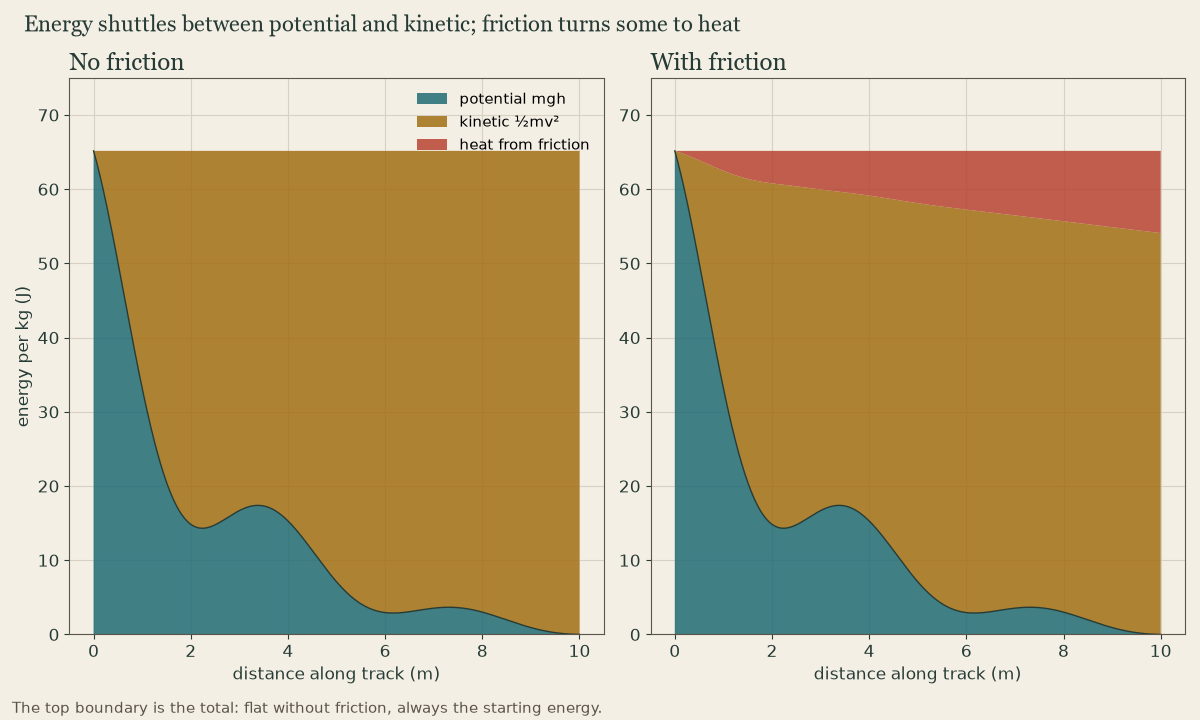
A force is conservative if the work it does between two points is independent of the path taken — equivalently, the work it does around any closed loop is zero. Gravity and ideal spring forces are conservative, which is exactly why we can define a potential energy for them. Friction and air drag are nonconservative: the work they do depends on the path length, and they always remove mechanical energy, converting it to heat. You cannot define a single-valued potential energy for such forces 1.
Conservation of Mechanical Energy
Define the total mechanical energy as
When the only forces doing work are conservative, \(E\) is constant:
Energy simply shuttles back and forth between kinetic and potential forms. When nonconservative forces such as friction act, they dissipate mechanical energy, and the balance becomes
where \(W_{nc}\) (negative for friction) is the work done by the nonconservative forces 1.
Worked Example: Speed at the Bottom of a Ramp
A block of mass \(m\) is released from rest at the top of a frictionless ramp of height \(h\). What is its speed at the bottom?
By the force method you would resolve gravity along the incline, find the acceleration, and integrate — and the answer would depend on the ramp angle. The energy method ignores the path entirely. Only conservative forces (gravity; the normal force does no work) act, so mechanical energy is conserved:
With \(v_i=0\) the mass cancels and
The speed depends only on the drop height, not on the ramp’s shape or steepness. This is why engineers reach for energy methods: when the endpoints are all that matter, a problem that looks geometrically messy in terms of forces becomes a one-line balance of scalars 1.
Quick check
Energy conservation ignores the path; mass cancels.
Sizing a job with energy and power
Energy and power turn vague effort into numbers.
- Winching a log: lifting a 500 kg log 3 m up a bank stores \(mgh = 500 \times 9.8 \times 3 \approx 14.7\) kJ. Doing it in 30 s needs at least \(14{,}700 / 30 \approx 490\) W, about two-thirds of a horsepower (1 hp = 746 W), before friction and losses.
- Stacking firewood: lifting about 1,500 kg of wood 1 m is also roughly 15 kJ, or about 3.5 food calories. The work against gravity is small; the fatigue comes from the muscles’ low efficiency and from repeated bending.
- Human output: a person sustains on the order of 100 W of mechanical work for long periods, which is why a hand winch or a block and tackle trades force for distance rather than creating energy.
A block and tackle with four supporting strands cuts the pull to a quarter of the load but makes you haul four times as much rope: the work, force times distance, is unchanged (less friction).
Quick check
mgh/t = 500 × 9.8 × 3 / 30 ≈ 490 W.
Power
Often we care not just about how much work is done but how fast. Power is the rate of doing work,
measured in watts (1 W = 1 J/s). The second form shows that delivering power requires both force and velocity in the same direction — a motor that exerts force but produces no motion delivers no power. Power ratings tell an engineer how quickly a machine can transfer energy, which sets the size of motors, engines, and brakes 1.
Lesson complete
Nice work.
Sources for this lesson
- 1University Physics, Volumes 1–3. OpenStax (Rice University). verifiedOpen calculus-based physics. Vol 1 mechanics; Vol 2 thermodynamics and electricity & magnetism; Vol 3 optics & modern physics. Cited at: Vol 1, Ch. 7; Vol 1, Ch. 8.