The Laplace Transform
Turning linear ODEs into algebra: the Laplace transform, why differentiation becomes multiplication by s, a short transform table, a worked solution, and the transfer function.
- 5 min
- 7 steps
- 3 questions
- Lesson 14 of 36
In this lesson
- Why Transform an Equation?
- The Definition
- The Key Idea: Differentiation Becomes Multiplication
- A Short Table of Transforms
- Linearity
- The Method, with a Worked Example
- The Transfer Function and a Look Ahead
Picking up where you left off.
Why Transform an Equation?
Solving a linear ordinary differential equation (ODE) directly means working with derivatives, which are inherently a calculus operation. The Laplace transform offers a different strategy: instead of attacking the differential equation in the time domain, you translate it into a new domain where the same problem becomes algebra. Once you solve the algebraic problem, you translate the answer back. This detour is worthwhile because algebra — adding, multiplying, and factoring — is far easier to automate and reason about than differentiation, especially when initial conditions and discontinuous inputs are involved 1.
This algebraic reformulation is also the gateway to control systems and circuit analysis, where engineers routinely describe how a system responds to inputs using transforms rather than time-domain calculus.
The Definition
The Laplace transform of a function \(f(t)\), defined for \(t \ge 0\), is
The transform takes a function of time \(t\) and produces a new function \(F(s)\) of a complex variable \(s\). The exponential factor \(e^{-st}\) acts as a weighting that, for \(s\) large enough, forces the integral to converge for a broad class of functions. We write \(\mathcal{L}\{f\}=F\) and, going the other way, \(\mathcal{L}^{-1}\{F\}=f\) for the inverse transform 1.
The Key Idea: Differentiation Becomes Multiplication
The single property that makes the Laplace transform powerful for ODEs is how it handles derivatives. Integrating the definition by parts gives the differentiation rule
A derivative in time becomes multiplication by \(s\) in the new domain, with the initial value \(f(0)\) folded in automatically. Applying the rule twice yields the second-derivative version,
Because each derivative turns into a power of \(s\), a linear ODE with constant coefficients becomes a polynomial equation in \(s\). The initial conditions \(f(0)\) and \(f'(0)\) enter the algebra directly, so there is no separate step of fitting constants of integration at the end 1.
Quick check
L{y’} = sY(s) - y(0): initial conditions come along automatically.
A Short Table of Transforms
In practice you rarely compute the defining integral by hand. Instead you rely on a table of standard pairs together with the rules below.
| \(f(t)\) | \(F(s)=\mathcal{L}\{f(t)\}\) |
|---|---|
| \(1\) | \(\dfrac{1}{s}\) |
| \(e^{at}\) | \(\dfrac{1}{s-a}\) |
| \(\sin\omega t\) | \(\dfrac{\omega}{s^2+\omega^2}\) |
| \(\cos\omega t\) | \(\dfrac{s}{s^2+\omega^2}\) |
| \(t^n\) | \(\dfrac{n!}{s^{n+1}}\) |
Each entry holds on the region of \(s\) where the defining integral converges 1.
Quick check
Valid for s > a.
Linearity
The transform is linear: for constants \(a\) and \(b\),
This follows immediately from the linearity of the integral, and the inverse transform is linear in the same way. Linearity is what lets you build the transform of a complicated expression from the table entries one term at a time, and later split a complicated \(F(s)\) into simpler pieces to invert.
The Method, with a Worked Example
The procedure has three steps:
- Transform every term of the ODE, using the differentiation rule to absorb the initial conditions.
- Solve algebraically for \(F(s)\).
- Invert \(F(s)\) back to \(f(t)\), usually by rewriting it with partial fractions so each piece matches a table entry.
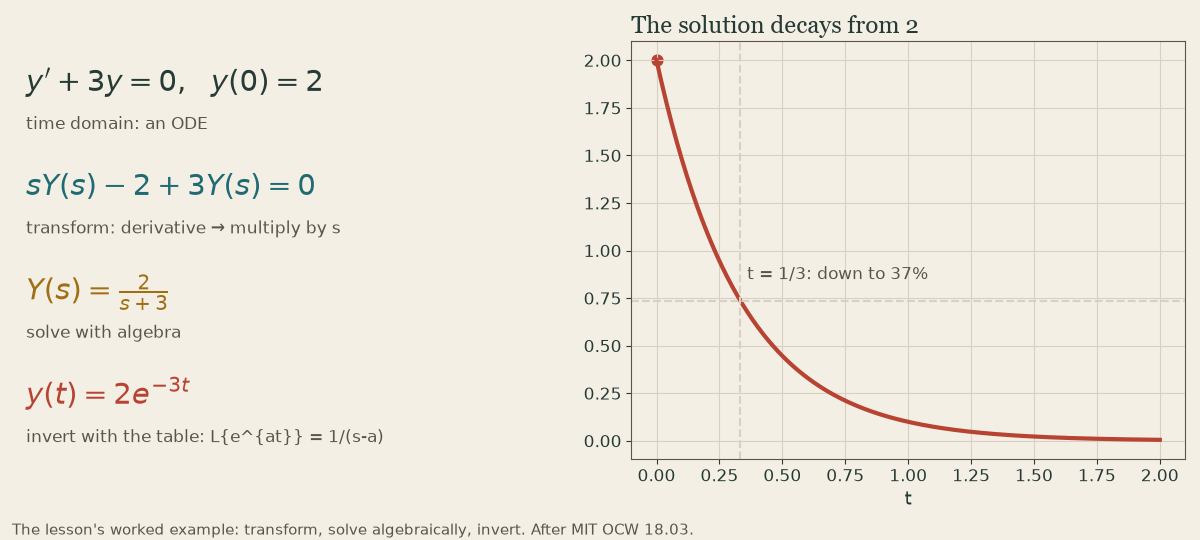
Consider the initial value problem
Transform both sides. Using the differentiation rule, \(\mathcal{L}\{y'\}=sY(s)-y(0)=sY(s)-2\), so
Now solve algebraically for \(Y(s)\):
Finally invert. The table entry \(\mathcal{L}\{e^{at}\}=\frac{1}{s-a}\) matches with \(a=-3\), so
You can check that this satisfies both the equation and the initial condition. With a more elaborate right-hand side, the only added work is a partial-fraction decomposition before consulting the table 1.
The Transfer Function and a Look Ahead
The method becomes especially clean for a system driven by an input. Suppose an input \(u(t)\) produces an output \(y(t)\) through a linear, constant-coefficient system, with all initial conditions zero. Transforming the governing ODE gives a relation of the form \(Y(s)=H(s)\,U(s)\). The factor
is the transfer function: the ratio of the output transform to the input transform, depending only on the system itself, not on the particular input.
This is the reason the Laplace transform is foundational for the control systems course to come, as well as for circuit analysis. A transfer function captures everything about how a system reshapes the inputs it receives — its stability, its resonances, its response speed — in a single algebraic expression. Engineers analyze and design feedback loops, filters, and amplifiers by manipulating \(H(s)\), then transforming back only at the end. The algebraic detour you learned here for solving a single IVP turns out to be the working language of an entire engineering discipline 1.
Quick check
Its poles - the roots of the denominator - set stability and response speed.
Lesson complete
Nice work.
Sources for this lesson
- 1