Vector Calculus: Divergence, Curl, and Integral Theorems
Vector fields and the del operator, divergence and curl, line integrals and conservative fields, surface integrals and flux, and the theorems of Green, Stokes, and Gauss.
- 5 min
- 6 steps
- 3 questions
- Lesson 8 of 36
In this lesson
- Vector fields and the del operator
- Divergence and curl
- Line integrals and conservative fields
- Surface integrals and flux
- The integral theorems
Picking up where you left off.
So far you have differentiated and integrated scalar quantities — numbers that vary from point to point. Vector calculus extends those tools to vector fields, which assign a vector to every point in space. With partial derivatives, the gradient, and multiple integrals already in hand, you have everything needed to assemble the operators and theorems that describe how fields flow, swirl, and accumulate. This machinery is not abstract for its own sake: it is the native language of electromagnetism and fluid dynamics, which you will meet later.
Vector fields and the del operator
A vector field \(\mathbf F(x,y,z) = \langle P, Q, R \rangle\) attaches a vector to each point — think of fluid velocity at every location in a river, or the electric force felt by a test charge throughout a region. Each component \(P, Q, R\) is itself a scalar function of position.
The central tool is the del operator, written \(\nabla\) and treated as a symbolic vector of partial derivatives: $$\nabla = \left\langle \frac{\partial}{\partial x},\ \frac{\partial}{\partial y},\ \frac{\partial}{\partial z} \right\rangle.$$ Applied to a scalar function \(f\), it gives the familiar gradient \(\nabla f\). Combined with a vector field through the dot and cross products, it produces two new fields with vivid physical meaning 1.
Divergence and curl
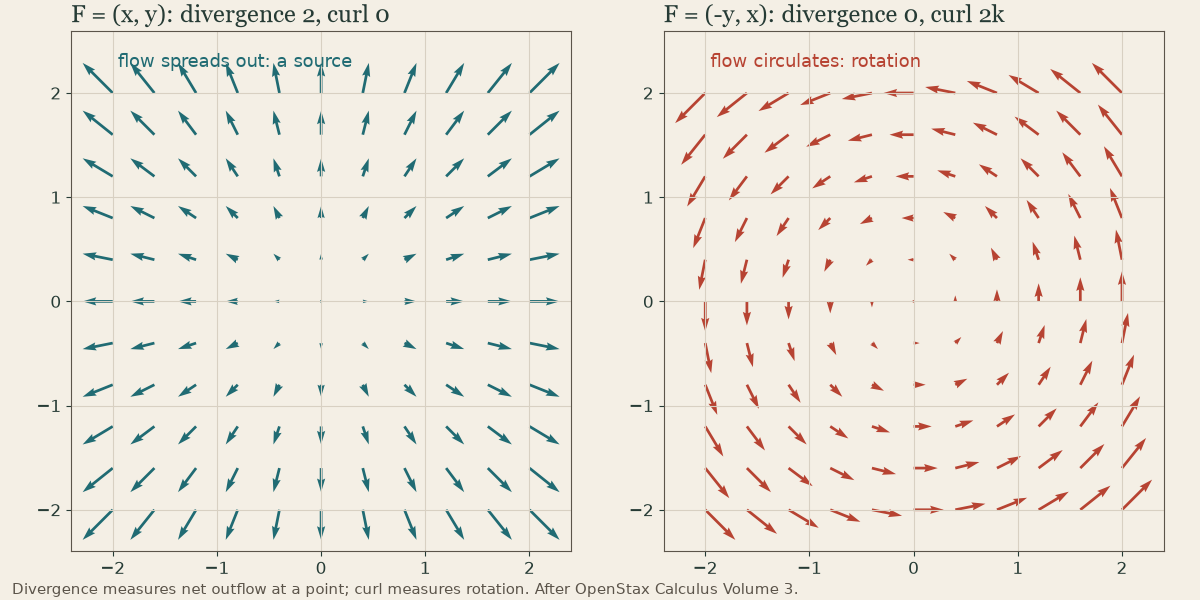
The divergence of \(\mathbf F\) is the dot product \(\nabla\cdot\mathbf F = \dfrac{\partial P}{\partial x} + \dfrac{\partial Q}{\partial y} + \dfrac{\partial R}{\partial z}.\) It is a scalar that measures the net outflow of the field per unit volume at a point — how much the field acts as a source (positive divergence) or a sink (negative). Imagine a tiny box around the point: divergence captures whether more flows out than in.
The curl of \(\mathbf F\) is the cross product \(\nabla\times\mathbf F\), a vector that measures local rotation. If you placed a tiny paddle wheel in the field, the curl points along the axis the wheel would spin around, and its magnitude reflects how fast. A field with zero curl everywhere is called irrotational; one with zero divergence is incompressible (or solenoidal). These two operators — one scalar, one vector — together capture the essential local behavior of a field 1.
Quick check
Curl measures rotation; divergence measures net outflow.
Line integrals and conservative fields
To measure the work done by a field on something moving along a curve \(C\), we use a line integral: $$\int_C \mathbf F\cdot d\mathbf r.$$ The dot product picks out the component of \(\mathbf F\) along the direction of travel, and integrating accumulates that contribution over the whole path. In general this value depends on the particular path taken between two endpoints.
A field is conservative when it can be written as the gradient of a scalar potential \(\phi\), that is \(\mathbf F = \nabla\phi\). For such fields the line integral is path independent: it depends only on the endpoints, so \(\int_C \nabla\phi\cdot d\mathbf r = \phi(\text{end}) - \phi(\text{start})\). This is the Fundamental Theorem for Line Integrals, the vector-calculus analogue of the Fundamental Theorem of Calculus. A useful diagnostic: conservative fields are irrotational, so \(\nabla\times\mathbf F = \mathbf 0\) is a necessary condition 1.
Quick check
Gravity and electrostatic fields are conservative; work around a closed loop is zero.
Surface integrals and flux
Just as a line integral accumulates a field along a curve, a surface integral accumulates it across a surface \(S\). The flux of \(\mathbf F\) through \(S\) is $$\iint_S \mathbf F\cdot d\mathbf S,$$ where \(d\mathbf S\) is an oriented area element pointing normal to the surface. Flux measures how much of the field passes through \(S\) — the rate at which fluid crosses a membrane, or how much electric field pierces a closed shell. The dot product again isolates the component of the field perpendicular to the surface, since flow parallel to the surface carries nothing through it.
The integral theorems
The crowning results of vector calculus all share one idea: a derivative integrated over a region equals the field’s values on the boundary of that region. They generalize the Fundamental Theorem of Calculus to higher dimensions 1.
- Green’s theorem relates a line integral around a closed curve in the plane to a double integral of a curl-like derivative over the region it encloses.
- The Divergence (Gauss) theorem equates the total divergence inside a solid region to the flux through its boundary surface: $$\iiint_V (\nabla\cdot\mathbf F)\,dV=\iint_{\partial V}\mathbf F\cdot d\mathbf S.$$ Everything the field “sources” inside \(V\) must flow out across the boundary \(\partial V\).
- Stokes’ theorem equates the flux of the curl through a surface to the circulation of the field around the surface’s boundary curve. Green’s theorem is its flat, two-dimensional special case.
These theorems are the backbone of Maxwell’s equations, which state laws of electromagnetism in terms of the divergence and curl of electric and magnetic fields, and they underlie the conservation laws of fluid flow. When you reach physics, you will see the very same operators and boundary relationships reappear — now carrying physical meaning. Mastering them here as mathematics makes that later transition a matter of interpretation rather than new technique.
Quick check
Stokes’ and Green’s theorems relate curl to circulation around a boundary.
Lesson complete
Nice work.
Sources for this lesson
- 1Calculus, Volumes 1–3. OpenStax (Rice University). verifiedOpen (CC BY-NC-SA) calculus text. Vol 1 functions/limits/derivatives/integrals; Vol 2 integration/series; Vol 3 multivariable and vector calculus. Cited at: Vol 3, Ch. 6.