Current, Resistance, and DC Circuits
Current, voltage, resistance, and Ohm's law, electrical power, series and parallel combinations, Kirchhoff's current and voltage laws, and a house branch circuit worked through: why outlets are in parallel, breaker loads, and voltage drop in long runs.
- 4 min
- 4 steps
- 3 questions
- Lesson 22 of 36
In this lesson
- Current, voltage, and resistance
- Series and parallel resistance
- Kirchhoff’s laws
- Household circuits
Picking up where you left off.
Current, voltage, and resistance
A current is a flow of charge: \(I = \dfrac{dQ}{dt}\), measured in amperes 1. It is driven around a circuit by a potential difference — a voltage \(V\) — supplied by a source such as a battery. How much current a given voltage drives through a component is set by its resistance \(R\), through Ohm’s law:
Resistance is measured in ohms (Ω); a larger \(R\) means less current for the same voltage. Components that obey this linear relation are called ohmic. The electrical power dissipated (as heat or work) follows from voltage and current 1:
Series and parallel resistance
Real circuits combine many resistances, and two patterns cover most cases. The figure contrasts them.
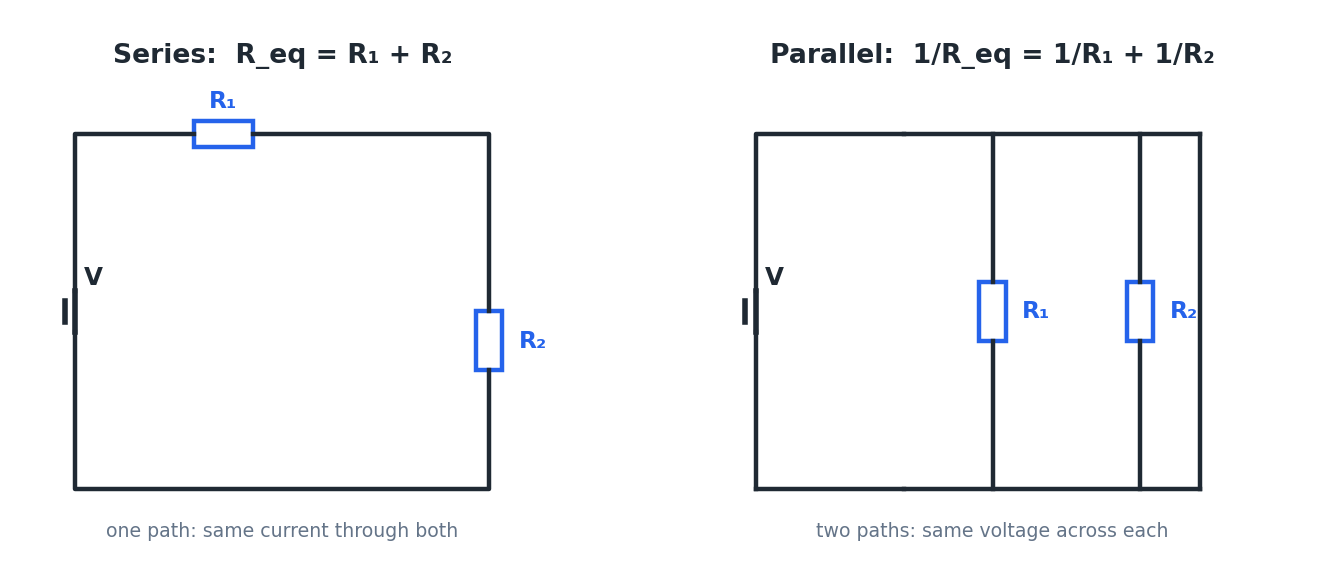
In series, components lie on a single path, so the same current flows through each, and the resistances simply add 1:
In parallel, components share the same two nodes, so each sees the same voltage, while the current splits among them. The reciprocals add:
so the equivalent resistance is always less than the smallest branch — adding parallel paths makes it easier for current to flow.
Quick check
1/R = 3/30, so R = 10 Ω, less than any single branch.
Kirchhoff’s laws
Series and parallel rules are shortcuts for the two general principles that govern any circuit, Kirchhoff’s laws 1:
- Current law (KCL): the currents entering a node equal the currents leaving it — charge is conserved.
- Voltage law (KVL): around any closed loop, the voltage rises and drops sum to zero — energy is conserved.
Applied together, these laws turn a circuit into a system of linear equations in the unknown currents or node voltages — precisely the \(A\mathbf x = \mathbf b\) problem from the linear-algebra lessons. That connection, and analysis of circuits that store energy (capacitors and inductors) and respond over time, is where the Electrical track’s Circuit Analysis course picks up.
Quick check
The voltage law expresses energy conservation.
Household circuits
A house branch circuit is a good test of this lesson:
- Outlets and lights are in parallel, so each gets the full 120 V and one device switching off doesn’t affect the others. The currents of everything plugged in add in the shared wires back to the panel.
- The breaker is in series with the circuit and trips when the total current exceeds its rating. A 15 A breaker at 120 V allows 1,800 W; loads running for hours are usually kept to 80% of that, about 1,440 W.
- A 1,500 W space heater draws \(I = P/V = 12.5\) A, with an element resistance of \(V^2/P = 9.6\ \Omega\). Two on one 15 A circuit trip the breaker.
- Wire size matches the breaker: in U.S. practice, 14 AWG copper for 15 A and 12 AWG for 20 A.
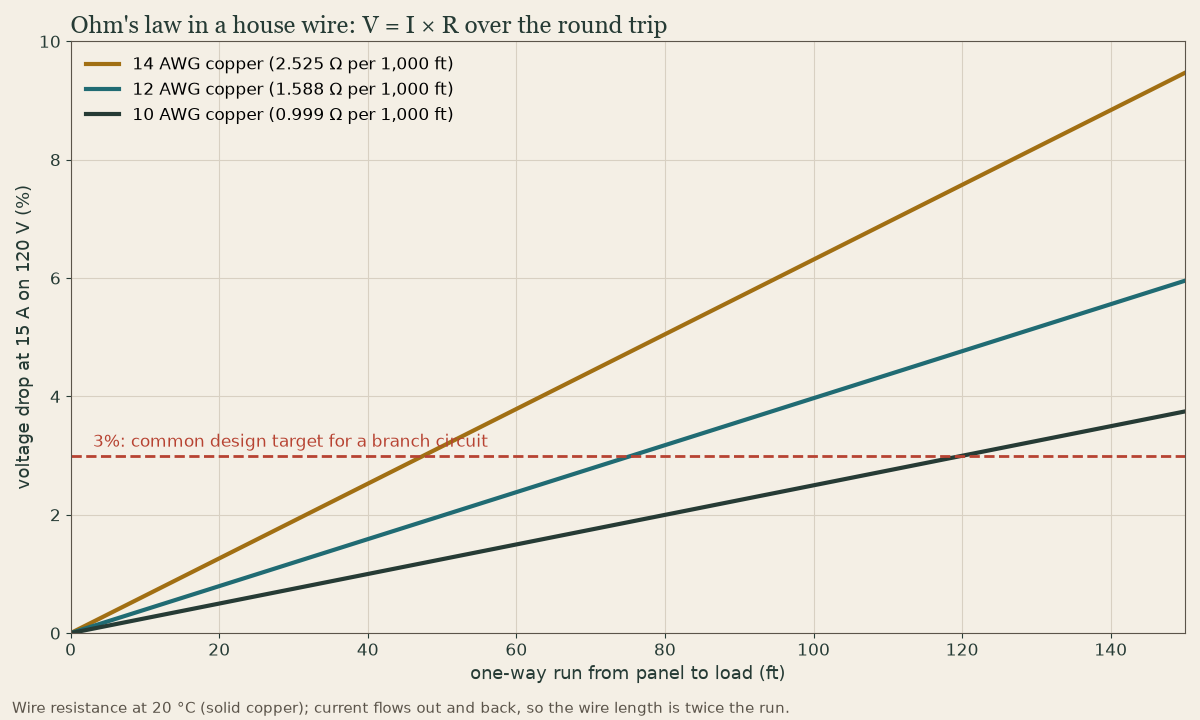
- Long runs lose voltage: current flows out and back, so a 100 ft run is 200 ft of wire. At 15 A on 14 AWG (about 2.5 Ω per 1,000 ft), the drop is \(15 \times 0.505 \approx 7.6\) V, over 6%, enough to dim lights and make motors run hot. Upsizing the wire is the fix.
Quick check
I = P/V = 1,500/120.
Lesson complete
Nice work.
Sources for this lesson
- 1University Physics, Volumes 1–3. OpenStax (Rice University). verifiedOpen calculus-based physics. Vol 1 mechanics; Vol 2 thermodynamics and electricity & magnetism; Vol 3 optics & modern physics. Cited at: Vol 2, Ch. 9; Vol 2, Ch. 10.