Limits and Continuity
What a limit is, the epsilon-delta definition, one-sided limits and limit laws, the three kinds of discontinuity, and why continuity underwrites engineering models.
- 4 min
- 6 steps
- 3 questions
- Lesson 1 of 36
In this lesson
- The idea of a limit
- The formal (epsilon–delta) definition
- One-sided limits
- Limit laws
- Continuity
- Why engineers care
Picking up where you left off.
The idea of a limit
Calculus is the mathematics of change, and almost every idea in it rests on a single foundation: the limit. A limit describes the value a function approaches as its input approaches some point — regardless of what happens exactly at that point. Informally, we write
to mean that \(f(x)\) can be made as close to \(L\) as we like by taking \(x\) sufficiently close to \(a\) (but not equal to \(a\)) 1.
The parenthetical “but not equal to \(a\)” is the whole point. A limit asks where the function is heading, not where it is. A function can have a limit at a point where it is undefined — which is exactly what makes limits powerful enough to define the derivative later.
The formal (epsilon–delta) definition
The intuitive phrasing — “as close as we like” — is made precise with the epsilon–delta definition. We say \(\lim_{x \to a} f(x) = L\) if
Read it as a challenge–response: for any tolerance \(\varepsilon\) on the output, we can find a tolerance \(\delta\) on the input that guarantees \(f(x)\) lands within \(\varepsilon\) of \(L\). If such a \(\delta\) always exists, the limit is \(L\) 1.
One-sided limits
Sometimes a function approaches different values from the left and the right. The one-sided limits capture this:
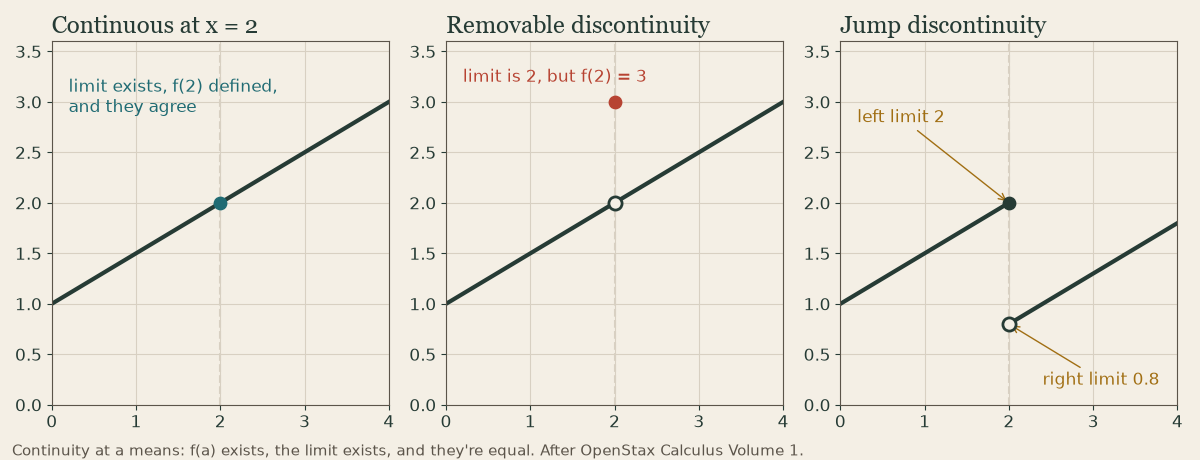
The two-sided limit \(\lim_{x \to a} f(x)\) exists if and only if both one-sided limits exist and are equal. When they differ — as at a jump — the limit does not exist.
Limit laws
Limits respect arithmetic, which is what makes them computable. If \(\lim_{x\to a} f(x)\) and \(\lim_{x\to a} g(x)\) both exist, then
and similarly for differences, products, and quotients (provided the denominator’s limit is nonzero) 1. For polynomials and other continuous functions these laws reduce limit evaluation to simple substitution — the interesting cases are precisely those where substitution fails, such as the indeterminate form \(\tfrac{0}{0}\).
Continuity
A function is continuous at \(a\) when the limit exists, the function is defined, and the two agree:
This compact equation bundles three requirements: \(f(a)\) exists, \(\lim_{x\to a} f(x)\) exists, and they are equal 1. A function continuous at every point of an interval is continuous on that interval — informally, its graph can be drawn without lifting the pen.
When continuity fails, it does so in characteristic ways:
- a removable discontinuity (a single missing or misplaced point, a “hole”),
- a jump discontinuity (the one-sided limits disagree), and
- an infinite discontinuity (the function grows without bound, as at a vertical asymptote).
Quick check
Continuity needs f(a) to exist, the limit to exist, and the two to be equal.
Why engineers care
Continuity and limits are not abstractions for their own sake. The derivative — the rate of change central to every dynamics, circuits, and control problem — is defined as a limit, and it exists only where a function is sufficiently smooth. The next lesson builds the derivative directly on the limit machinery introduced here.
Practice
A limit is about how the function approaches a point, so it depends only on the two one-sided limits agreeing — not on the value (or even existence) of \(f(a)\).
Practice
Disagreeing one-sided limits produce a jump. A removable discontinuity is a single misplaced/missing point; an infinite discontinuity is an unbounded blow-up, as at a vertical asymptote.
Lesson complete
Nice work.
Sources for this lesson
- 1Calculus, Volumes 1–3. OpenStax (Rice University). verifiedOpen (CC BY-NC-SA) calculus text. Vol 1 functions/limits/derivatives/integrals; Vol 2 integration/series; Vol 3 multivariable and vector calculus. Cited at: Vol 1, Ch. 2.