Lesson 3 of 18 · Close Reading and Interpretation
Interpretation as Revision: Parts, Wholes, and Horizons
Open alongside this lesson
Project resources
ENGL 300, Lecture 3: Ways In and Out of the Hermeneutic Circle (opens in a new tab)
Chapter 2 gives the clearest direct account of movement between part and whole; use the chapter timestamps on the page.
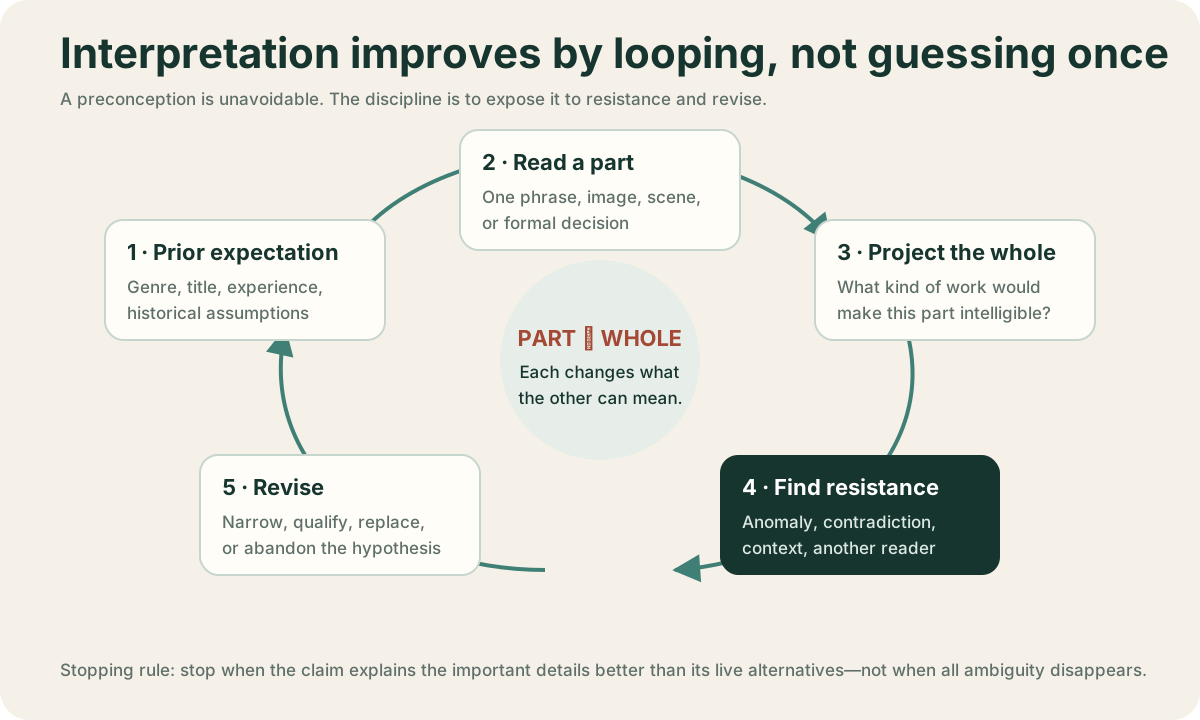
You never approach a work without expectations. A title suggests a genre; a date suggests a period; a familiar image activates memories; the first sentence begins sketching a whole that does not yet exist for you. Interpretation becomes disciplined not by eliminating these preconceptions, but by making them revisable.
This movement is often called the hermeneutic circle: we understand a part through an anticipated whole, and revise the whole as new parts appear. Open Yale’s lecture on the subject describes readers moving back and forth between local phrases or sentences and an evolving sense of the work as a whole 1. “Circle” can sound like going nowhere. In practice, it is closer to an iterative loop: each pass should leave a record of what changed and why.
Write down the fore-hypothesis
Before a second reading, complete three lines:
- I expect this kind of work to ___ because ___.
- So far I think the whole is about or doing ___.
- The detail least compatible with that view is ___.
This is not a confession of bias. It is a test setup. An unrecorded expectation can quietly select only confirming evidence. A recorded expectation can be compared with what the work later demands.
Treat the initial whole as a fore-hypothesis, not a verdict. Use confidence labels:
- low: based on title, opening, or genre expectation;
- medium: supported by a pattern across multiple sections;
- high: survives the ending, contextual checks, and a serious rival reading.
Confidence should sometimes decrease. An ending can reveal that a voice you trusted was quoting someone else; an archival record can change a word’s historical sense; a different edition can restore a deleted passage.
Run the part–whole loop
Use this six-step cycle:
- Select a consequential part. Choose a turn, exception, repeated form, or ending—not merely a favorite line.
- State its local effect. What changes within the immediate sentence, image, or scene?
- Project upward. If this effect matters, what must be true of the larger work?
- Search laterally. Find one parallel and one counterexample elsewhere.
- Add targeted context. Research only what could decide between the live alternatives.
- Revise explicitly. Write “I previously thought ; because , I now think ; this remains uncertain because .”
The final sentence matters. Revision is not simply replacing an answer. It is preserving the reason for the change and the remainder of uncertainty.
Use context as a test, not a backdrop
“Historical context” often becomes a paragraph of facts that never alters the reading. Instead, begin with an interpretive fork.
Imagine an eighteenth-century poem using the word “plastic.” A modern reader may picture synthetic material. Historical lexical context can show that the word carried senses such as formative, shaping, or capable of molding. The Yale lecture uses this example to demonstrate how a historically informed preconception can correct a misleading present-day one 1.
Targeted context answers a decision question:
- Did this word have the proposed sense for this audience?
- Was this formal choice ordinary for the genre or a marked departure?
- Could the creator have known the event I think the work anticipates?
- Was the object originally encountered in a court, home, street, shrine, book, or museum?
- Does the surviving version match what the first audience received?
Context that cannot affect the claim may still be interesting, but it is not currently evidence.
Move between three kinds of whole
“The whole” is not only the complete text.
Compositional whole: the work’s full arrangement—beginning, sequence, ending, framing, and internal contrasts.
Generic whole: the conventions of elegy, portrait, manifesto, diary, memorial, satire, or another form. A feature becomes visible as compliance, variation, or refusal.
Historical whole: the institutions, language, technologies, conflicts, and audiences that made the work possible.
These wholes can compete. A private letter participates in epistolary conventions, but its survival in a state archive gives it a new institutional frame. A devotional object may become “art” in a gallery. State which whole your sentence invokes.
Distinguish meaning, significance, and use
Three questions often blur together:
- Meaning: What relationships does the work establish in its form and historical situation?
- Significance: What does that work matter to a later reader or problem?
- Use: What are you or an institution doing with it now?
A present-day significance can be legitimate without being the creator’s intended meaning. A museum can use an object to tell a national story even if the object was made for a household ritual. Ethical interpretation labels the shift instead of projecting the current use backward.
Try the sentence frame: “In its original situation, the feature likely did ; in this later setting, it has been used to ; the difference matters because ___.”
Revision ledger
Keep a four-column log during a project:
| Version | Working claim | New resistance | Revision made |
|---|---|---|---|
| 1 | initial whole | ending changes speaker | restrict claim to first section |
| 2 | revised scope | genre example behaves similarly | drop claim of uniqueness |
| 3 | mechanism claim | archival variant omits key line | compare editions explicitly |
The ledger prevents “I always knew that” hindsight. It also creates the raw material for explaining method in a final note.
Practice: two-loop interpretation
Choose a work short enough to reread twice.
Loop one: record your fore-hypothesis, select one resistant detail, and revise the compositional whole.
Loop two: find one targeted contextual source. Write what it establishes, what it cannot establish, and whether it raises, lowers, or leaves unchanged your confidence.
Then ask a rival reader—real or imagined—to present the strongest alternative. Use the believing-and-doubting stance from Yale’s active-learning guide to reconstruct it fairly before responding 2.
Your output is a 250-word interpretation containing:
- one qualified claim;
- two precise pieces of primary evidence;
- one contextual fact with citation;
- one alternative;
- one sentence describing how your view changed.
Stop without pretending to finish meaning
An interpretation is ready when it explains the most consequential details, survives its strongest live alternative, uses context that genuinely changes the analysis, and states its boundary. It need not exhaust the work.
Use this stopping statement:
This reading best explains ___ and ___ because . It does not settle . A different conclusion would become stronger if evidence showed ___.
That is not weakness. It tells a future reader exactly where to continue the inquiry.
Source trail
References
- 1Paul H. Fry. ENGL 300, Lecture 3: Ways In and Out of the Hermeneutic Circle. Open Yale Courses. verifiedInstitutional lecture and transcript explaining interpretation as revision between parts, wholes, and historical horizons. Cited at: Ways In and Out of the Hermeneutic Circle.
- 2Active Learning. Yale Poorvu Center for Teaching and Learning. verifiedIncludes the believing-and-doubting close-reading exercise used here as a disciplined test of interpretations. Cited at: Active Learning.
Check your understanding
- In a productive hermeneutic circle, what happens to a reader’s initial expectation?
- It disappears before reading begins.
- It governs the work permanently.
- It becomes explicit and is revised as parts resist the projected whole.
- It is replaced by the author’s biography.
- Which new context is most useful?
- Any fact about the period
- Context that changes how a specific feature or interpretive alternative should be understood
- The longest available history
- A modern reaction that agrees with you
- What is a sound stopping rule for an interpretation?
- All ambiguity has vanished.
- No other reader disagrees.
- The claim explains the significant evidence better than live alternatives and states its limits.
- The first draft reaches the required length.