Lesson 16 of 18 · Case-Analysis Workshop
Frame Before You Judge
Many bad ethical analyses answer a question nobody actually has authority to decide. “Is artificial intelligence good?” is too broad. “Should we tell the truth?” may conceal which information, to whom, under what duty, and at what risk. Before comparing values, write the decision so precisely that a responsible person could act on it.
The Markkula Center’s practical framework begins by recognizing an ethical issue and gathering facts before evaluating options 1. Ethics Unwrapped’s systematic moral analysis similarly distinguishes conceptualizing the problem from justifying a response, warning that after-the-fact rationalization can masquerade as reasoning 2. This workshop combines those insights into FACE: Frame, Alternatives, Compare, Execute and Evaluate.
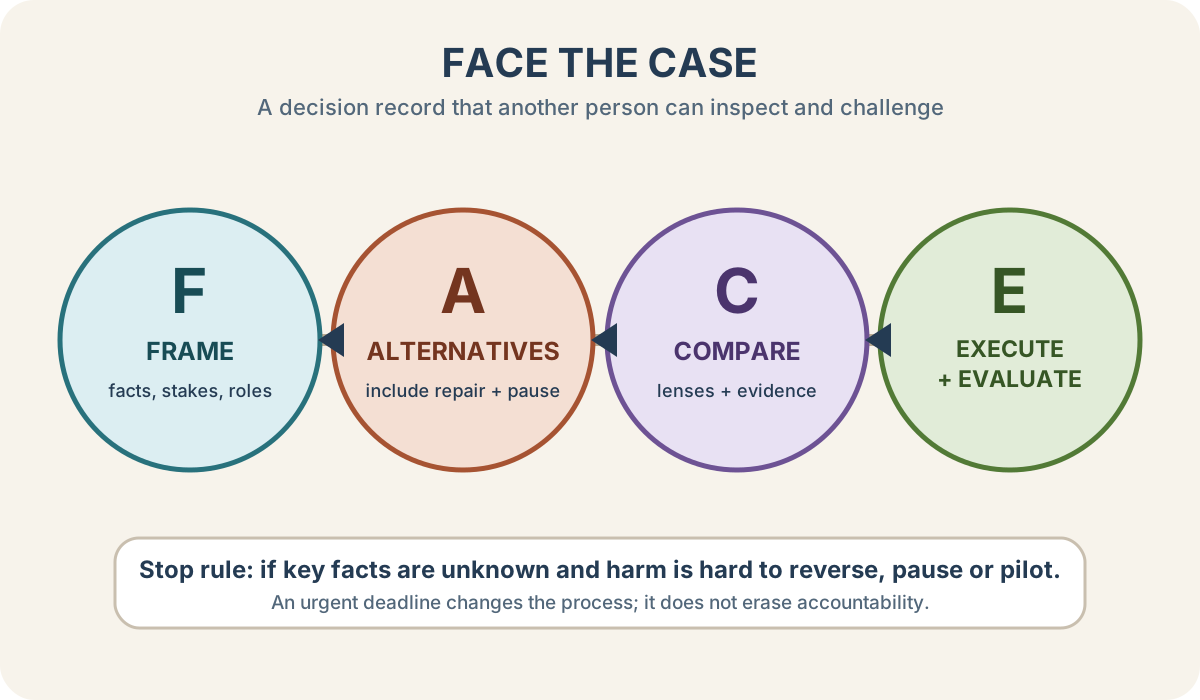
This lesson completes F. The next lesson completes A and C. The capstone completes E.
Write the decision line
Use this template:
Decision-maker must decide whether to action by deadline, within authority and constraints.
Weak: “Should the clinic protect privacy?”
Strong: “The clinic director must decide by Friday whether to send appointment reminders by ordinary text message, and if so what consent, content, opt-out, and vendor safeguards are required under clinic policy.”
A strong decision line names:
- the accountable person or body;
- the concrete action, including scope;
- the real deadline and reason for it;
- the authority the decision-maker does and does not possess; and
- constraints that are fixed for this decision.
Do not hide a chosen answer inside the frame. “How should we implement the necessary surveillance system?” assumes necessity. Write “whether to implement” until that question has been justified.
Separate four kinds of sentence
Create a fact ledger with four labels:
| Label | Meaning | Example |
|---|---|---|
| Known | Supported by reliable evidence | The contract permits cancellation with 30 days’ notice. |
| Estimated | Derived from a stated method | Wait times may fall 10-18 percent based on last quarter’s trial. |
| Assumed | Used provisionally and testable | Staff will complete review in under two minutes. |
| Disputed | Credible parties or sources conflict | The vendor and union disagree about whether keystrokes are retained. |
Add source, date, confidence, and decision sensitivity: would changing this claim alter the recommendation? Investigate high-sensitivity uncertainty first.
Do not confuse confidentiality with evidence absence. A memo can state, “Legal advice exists but is not quoted here; counsel confirmed the action is permitted under X conditions.” It should not use “legal approved” as a substitute for the ethical argument.
Recognize the ethical issue
Not every inconvenience is an ethical problem, and legal permission is not ethical completion. Look for one or more of these signals:
- avoidable harm or substantial risk;
- a person’s right, dignity, consent, or opportunity at stake;
- unequal benefits, burdens, voice, or power;
- a promise, professional duty, or public trust;
- deception, coercion, manipulation, or conflict of interest;
- dependency or care that a general rule overlooks;
- pressure to hide, relabel, rush, or make a private exception; or
- conduct that would shape the character of a person or institution.
Write the conflict as a because/but sentence:
Option A advances ___ because , but risks or violates ___ because .
This prevents the empty phrase “there are pros and cons.” It names why each side has moral weight.
Map stakeholders by impact and power
A stakeholder is not everyone with an opinion. It is a person, group, institution, or future interest that can affect or be affected by the decision. For each, record:
- effect: benefit, burden, risk, right, or responsibility;
- magnitude, probability, timing, and reversibility;
- voice and decision power;
- ability to exit, appeal, or obtain repair;
- relevant dependency or special relationship; and
- what evidence represents their view.
Avoid treating a spokesperson as identical to a whole group. “Residents want” needs a method: survey, hearing, interviews, complaint data, election, or informed inference. Record nonresponse and who could not participate.
Three searches find missing stakeholders:
- Downstream: Who receives the output or deals with failures?
- Maintenance: Who performs the extra work, monitoring, explanation, or repair?
- Absent: Who is not organized, not yet born, unable to speak, or easy to exclude?
Define the baseline and time horizon
Every option must be compared with something. “The pilot causes 20 errors” is incomplete if current practice causes 80; “the pilot prevents 60” is incomplete if those 20 are more severe or fall on people with no appeal.
Write the baseline as an actual system, including its harms, delays, informal workarounds, and uneven access. Then choose at least two horizons: immediate operation and longer-term precedent or adaptation. A short-term benefit can create a rule others later apply in worse conditions.
Triage urgency without using it as a solvent
Classify the decision:
- Routine: ordinary review and consultation are available.
- Time-sensitive: delay has a real cost, but hours or days remain for targeted checks.
- Emergency: immediate action is needed to prevent serious harm.
For urgent cases, use MINS:
- Minimum intrusion or exception necessary;
- Immediate reason recorded;
- Named authority and accountable owner; and
- Sunset plus after-action review.
Emergency measures should expire unless affirmatively renewed. A crisis can justify a narrow exception without turning it into a permanent default.
Framing failures to catch
False binary: “deploy now or abandon innovation.” Add pilot, narrower scope, alternative method, delay, and status quo with improvements.
Moral labeling: “responsible employees support the policy.” Describe conduct and reasons; do not use virtue words to pressure agreement.
Single metric: reducing wait time becomes the whole purpose while accuracy, dignity, staff load, or unequal access disappear.
Agent erasure: “the algorithm denied the claim.” Name who selected, configured, relied on, and can reverse the system.
Outcome hindsight: a lucky result makes a reckless process look wise, or a bad result makes every reasonable risk unethical. Evaluate the evidence and process available at decision time, then learn from the result.
Rest’s four-component model is relevant here: moral sensitivity - noticing what is at stake - is distinct from judgment, motivation, and implementation 3. A flawless comparison cannot repair a stakeholder or risk the frame never included.
Practice: the 20-minute case packet
Use this scenario: a school can publish student attendance dashboards to help families identify patterns. The proposed default shows classroom-level data updated daily; small cells are suppressed, but staff worry that combinations of filters could identify students.
In 20 minutes, produce:
- a decision line;
- a known/estimated/assumed/disputed ledger with six entries;
- a because/but conflict sentence;
- eight stakeholders, including maintenance and absent voices;
- the current baseline and two time horizons; and
- an urgency class.
Circle the highest-sensitivity unknown. State what you would do if it cannot be resolved before the deadline.
Pocket summary
Frame before judging. Name who decides what, by when, and under which authority. Label evidence honestly, map impact and power, compare against the real baseline, and narrow emergencies with MINS. A precise frame does not predetermine the answer; it makes an honest answer possible.
Source trail
References
- 1A Framework for Ethical Decision Making. Markkula Center for Applied Ethics, Santa Clara University. verifiedPractical workflow for recognizing an ethical issue, gathering facts, evaluating alternatives through multiple lenses, acting, and reflecting.
- 2Deni Elliott. Systematic Moral Analysis. Ethics Unwrapped, McCombs School of Business, The University of Texas at Austin. verifiedInstitutional teaching video and transcript distinguishing conceptualization, justification, and rationalization. Cited at: teaching notes and transcript.
- 3James R. Rest. Moral Development - Advances in Research and Theory. Praeger. 1986. verifiedSource for the four-component distinction among moral sensitivity, judgment, motivation, and implementation.
Check your understanding
- Which is the strongest decision line?
- Should technology be ethical?
- Is the director a good person?
- Should the housing department begin a six-week limited pilot of the ranking tool on August 1, with authority to pause held by the compliance lead?
- Is efficiency more important than fairness?
- What should happen when a disputed fact could reverse the recommendation and harm is hard to undo?
- Treat the preferred version as true.
- Pause, investigate, or choose a reversible pilot unless urgency makes delay more harmful.
- Average the competing claims without checking either.
- Remove the fact from the memo.