Lesson 12 of 18 · Ethical Frameworks
Character, Care, and Practical Wisdom
Some ethical failures are failures of calculation or rule. Others happen because nobody notices a quiet dependency, nobody has the courage to speak, or a person follows the letter of a policy with cruel indifference. Virtue ethics and care ethics help diagnose those failures. They ask not only “Which act is correct?” but also “What kind of agent can see and carry out a good response?” and “What do real relationships make us responsible for?”
Virtue ethics makes virtues and moral character central while still allowing consequences and rules to matter 1. Care ethics emphasizes human interdependence, concrete relationships, emotion as a source of moral attention, and the unequal distribution of caring labor 2. The approaches overlap, but they are not identical. Compassion can be treated as a virtue; care ethics goes further by examining the structures and relationships in which care is needed, given, ignored, or exploited.
Virtues are calibrated capacities
A virtue is not a decorative trait word. It is a reliable, teachable capacity to perceive, feel, reason, and act well. Courage is not maximum risk-taking; it is facing a worthy risk for a sound reason. Honesty is not blurting every fact regardless of confidentiality or harm; it is refusing deception while exercising judgment about what, when, and to whom disclosure is owed. Compassion is not agreeing to every request; it can require a boundary that prevents dependence from becoming injury.
Aristotelian virtue ethics uses the idea of a mean, but “mean” does not mean bland moderation. The right response depends on the situation, agent, purpose, manner, and timing. Practical wisdom - often called phronesis - is the developed judgment that calibrates these features. The Stanford overview accordingly treats practical wisdom as essential to recognizing what a virtue requires in a particular circumstance 1.
Use TUNE to make a virtue operational:
- Target: What worthy end does the virtue serve?
- Underdo: What does deficiency look like here?
- oN target: What behavior fits this case and role?
- Excess: What distortion appears when the trait is overapplied?
For courage in a staff meeting: underdo may be silence, on target may be a factual objection with a proposed alternative, and excess may be a theatrical accusation made before checking evidence. TUNE turns “be courageous” into a choice you can rehearse.
Care is disciplined attention
Care begins by asking: Who depends on whom, for what, and under what power? It treats context as morally relevant without claiming that context excuses anything. A generic rule may say all customer calls receive five minutes. Care notices that one caller cannot hear the automated menu, another is in immediate danger, and a third has repeatedly used personal appeals to bypass fair queues. Responsiveness must distinguish need from leverage.
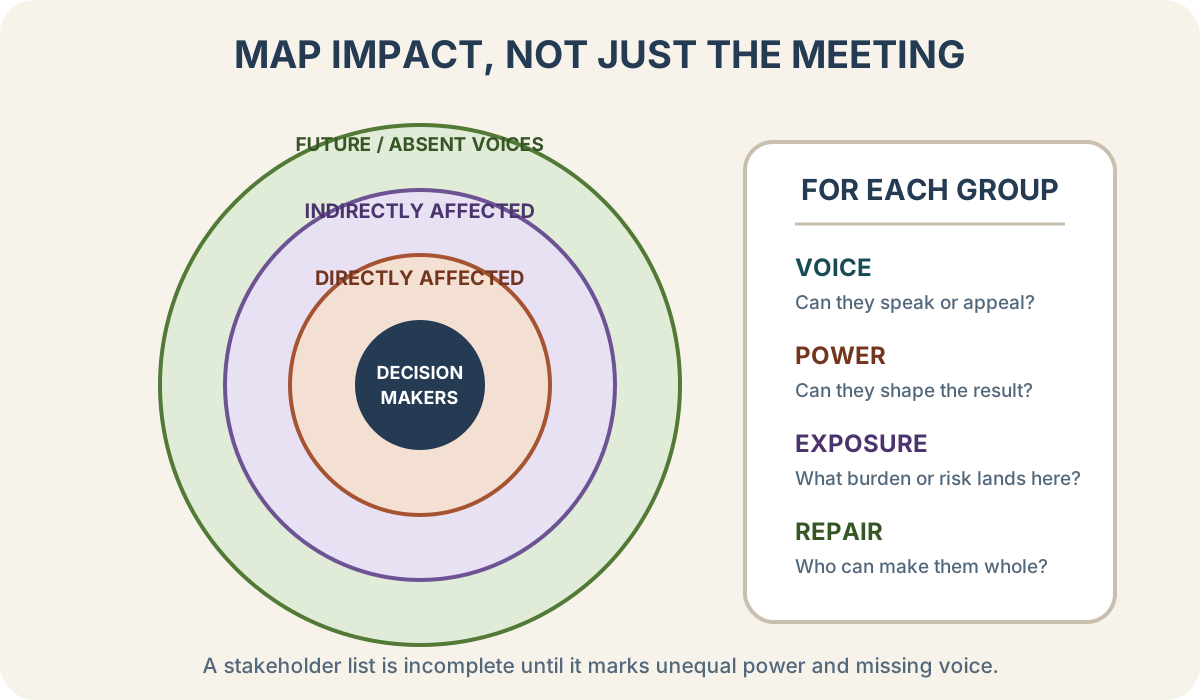
Map stakeholders in rings, then mark four properties for each:
- Voice: Can they describe what the decision will do to them?
- Power: Can they influence the decision or safely refuse it?
- Exposure: How severe and reversible is their burden?
- Repair: If harmed, can they appeal, obtain correction, or be made whole?
This prevents two opposite errors. Abstraction error sees only categories and misses the actual person. Proximity error sees only the person nearby and ignores equally serious needs of strangers or future people. Careful ethics widens attention while remaining responsive to particular relationships.
The institution has a character too
Character language applies to organizations cautiously. An organization does not feel shame or compassion in the same way a person does. Yet its incentives, routines, promotion rules, and tolerated stories make some conduct easier than others. A company that celebrates “moving fast” but punishes anyone who pauses a risky launch cultivates recklessness, even if its values poster says “integrity.”
Ask three institutional questions:
- What behavior is rewarded when values conflict with targets?
- What truth is difficult to say here, and what happens to the speaker?
- Which people perform invisible repair or care work after official decisions?
The answers reveal operational character better than slogans.
Knowing, wanting, and doing
Correct judgment does not guarantee action. James Rest’s four-component model distinguishes moral sensitivity, moral judgment, moral motivation, and implementation 3. In plain language: notice, decide, prioritize, carry out. A person may see the issue but reason poorly; decide well but prefer approval; want to act but lack a script, ally, authority, or safe channel.
Use VOICE when implementation is the obstacle:
- Value: State the value at stake without accusing motives.
- Observation: Name the verifiable fact.
- Impact: Explain the foreseeable effect and affected group.
- Choice: Offer a workable alternative or pause.
- Escalation: Know the next legitimate channel if the first attempt fails.
Example: “I want us to preserve accuracy. The report labels these results final, but two regions have not submitted data. Publishing now may cause leaders to act on an incomplete comparison. Could we label it preliminary and set a 48-hour update? If not, I need the data-quality lead to review the wording.”
That is moral courage with practical wisdom: specific, proportionate, and action-oriented.
Serious objections
Virtue ethics is too vague. “Do what a good person would do” can sound circular, and cultures disagree about virtues. The answer is to specify observable behavior, the worthy target, deficiency and excess, role obligations, and reasons another person can examine. Virtue analysis complements rather than replaces outcome and duty analysis.
Care becomes favoritism. Relationships can excuse nepotism, silence abuse, or load care work onto the least powerful. The answer is not to erase relationships. It is to distinguish a genuine special responsibility from capture. Public roles require consistency, disclosure, recusal, and attention to strangers with comparable need. Good care empowers rather than indefinitely controlling the recipient.
Emotion is unreliable. Emotion can be biased, but so can detached calculation. Compassion may reveal suffering a metric omitted; anger may reveal disrespect. Treat emotion as data about salience, not self-authenticating proof. Name it, investigate what triggered it, and test the resulting claim with evidence and other lenses.
Practice: rewrite a hard conversation
Choose a situation in which you avoided speaking or spoke ineffectively. Do not select a case where practice would place you in danger. Write:
- the virtue you needed, using TUNE;
- the care map, including the absent and less powerful;
- the implementation barrier - authority, skill, time, fear, loyalty, or ambiguity;
- a five-sentence VOICE script; and
- a safe escalation or exit path.
Then steelman the other party: write the strongest reasonable account of what they may be protecting. Revise your script so it addresses that concern without surrendering the value at stake.
Pocket summary
Virtue asks what capacities a good decision-maker must cultivate. Care asks which dependencies, relationships, and power differences require a response. Practical wisdom calibrates both to the case. Remember TUNE for character and VOICE for action. A moral insight that cannot cross the gap into conduct is unfinished work.
Source trail
References
- 1Rosalind Hursthouse, Glen Pettigrove. Virtue Ethics. Stanford Encyclopedia of Philosophy. verifiedPeer-reviewed account of virtue, practical wisdom, flourishing, and major objections to virtue ethics. Cited at: introduction; section 1.
- 2Maureen Sander-Staudt. Care Ethics. Internet Encyclopedia of Philosophy. verifiedAcademic overview of care ethics, relational responsibility, dependency, and critiques of abstract impartiality. Cited at: sections 1-3.
- 3James R. Rest. Moral Development - Advances in Research and Theory. Praeger. 1986. verifiedSource for the four-component distinction among moral sensitivity, judgment, motivation, and implementation.
Check your understanding
- What does practical wisdom add to a list of virtues?
- A fixed formula that ranks every virtue in advance.
- Context-sensitive judgment about what a virtue requires here, in the right manner and degree.
- Permission to ignore duties whenever one’s motive is good.
- A personality test for selecting leaders.
- Which action best answers the criticism that care can become favoritism?
- Care only for people one already knows.
- Replace every relationship with an identical rule.
- Make dependencies visible, then use role boundaries and consistency tests to prevent private care from capturing public decisions.
- Treat partiality as automatically ethical.