Lesson 5 of 18 · History and Primary Sources
Corroboration, Silence, and Perspective
Open alongside this lesson
Project resources
Historical Thinking and Other Unnatural Acts (opens in a new tab)
Use as a deeper treatment of sourcing, contextualization, and corroboration as learned practices.
Corroboration is not collecting several sources that tell the same story. It is comparing evidence with partly independent routes to knowledge and asking why the records agree, conflict, or remain silent. A hundred articles copied from one announcement form one evidentiary chain.
Historians learn to source, contextualize, and corroborate rather than read every document as transparent information 1. The practical unit of corroboration is not the entire source. It is the subclaim.
Decompose the claim first
Take a broad statement:
A new housing rule was introduced because officials feared overcrowding, harmed low-income tenants, and caused families to leave the district.
It contains at least four claims:
- the rule took effect on a particular date;
- officials acted from a stated or inferred motive;
- low-income tenants experienced harm;
- the rule caused relocation.
Different evidence is competent for each. An ordinance and implementation memo can establish text and timing. Meeting minutes may record stated reasons, but stated reasons are not necessarily full motives. Tenant letters or case files can document experiences, though not automatically prevalence. A causal claim requires comparison over time, alternative explanations, and perhaps demographic records.
Never let strong evidence for claim 1 create borrowed confidence for claims 2–4.
Map evidentiary dependence
For every source, ask:
- Did the creator witness or measure the matter directly?
- Did the source copy, translate, summarize, or respond to another source?
- Are two accounts institutionally coordinated?
- Do they share the same informant, data set, photograph, or later memory?
- Could one creator have read the other before producing the account?
Draw arrows of dependence. If B quotes A and C paraphrases B, then A–B–C is one chain. C may be useful evidence of later circulation, but it does not independently confirm A’s event claim.
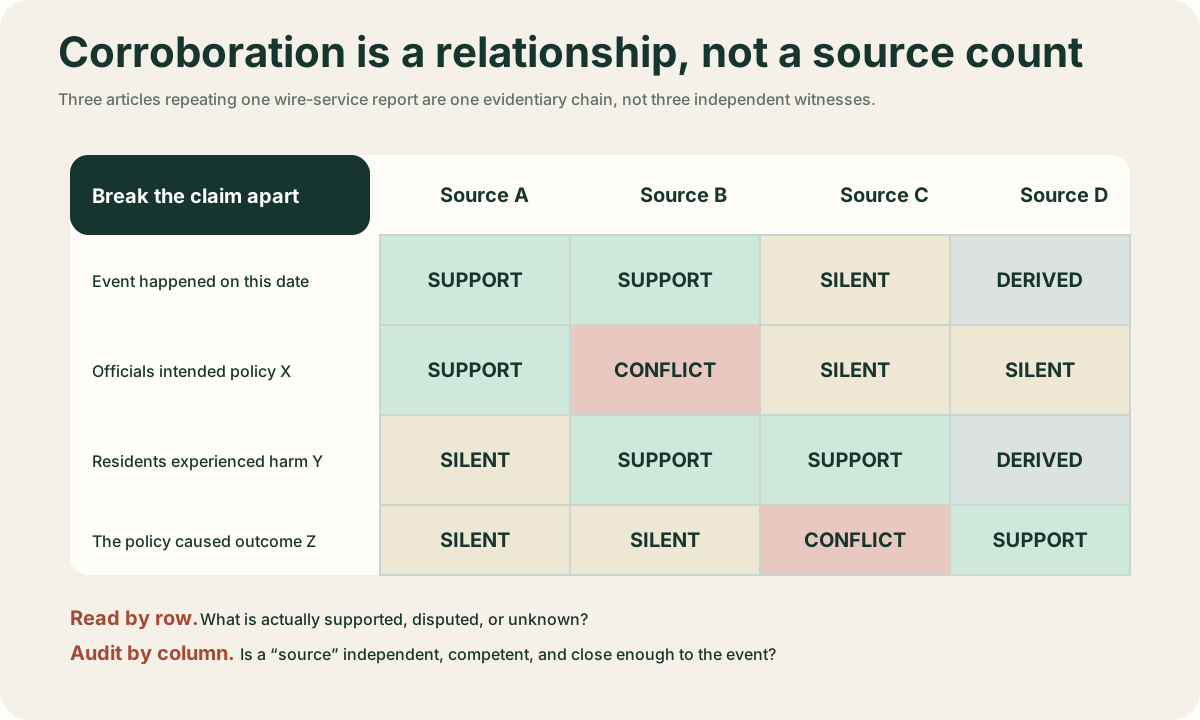
Use four cell labels:
- support: independently supplies evidence consistent with the subclaim;
- conflict: supplies specific incompatible evidence;
- silence: could address the claim but does not—or may lack that capacity;
- derived: repeats or depends on another source.
Add a fifth label, unclear, when provenance or competence is not established. “Unknown” is a research result, not a failure.
Investigate disagreement before choosing a winner
When sources conflict, do not average them. Diagnose the difference.
Position: What could each creator observe? A street-level witness and a distant official had different fields of view.
Timing: Was the account immediate, retrospective, or revised after outcomes became known?
Vocabulary: Do both sources use the same category? “Resident,” “worker,” or “casualty” may be defined differently.
Incentive: What consequences followed from admitting, exaggerating, or denying a fact?
Genre: A legal complaint must frame injury in actionable terms; a diary need not.
Scale: One source may describe an individual case, another an aggregate.
Then write a conflict note:
A and B disagree about . This may result from ___ because . Evidence that could distinguish the explanations is ___.
The cause of disagreement can itself become the historical finding. Two agencies counting the same population differently may reveal competing administrative purposes.
Treat perspective as information
Perspective is more than “bias.” It includes social position, institutional role, location, expertise, risk, genre, and intended audience. A clerk’s ledger may omit emotion but record routine transactions with precision. A protest song may compress events while revealing a community’s moral vocabulary. Neither is “objective”; each makes some features recordable.
Build a perspective inventory:
- What could this person or system perceive?
- What categories did it have available?
- What was routine enough to go unmentioned?
- What was dangerous or costly to record?
- Who appears only as an object of someone else’s description?
Then search for a source produced through a different relationship to the event, not merely one with a different opinion.
Read silences carefully
Absence from the archive is not direct proof of absence in the past. A missing record can arise because:
- nobody created it;
- a genre excluded the information;
- the person lacked access to record-making;
- the record was informal, perishable, private, suppressed, destroyed, uncataloged, or not digitized;
- your search terms use a later category;
- the repository collected some institutions and not others.
Silence becomes more informative when you know the record-generating system. If regulations required every licensed merchant to appear in an annual register and the series survives intact, absence can support a bounded claim about licensing. It still may not prove the person did no business.
Use an “absence ladder”:
- I did not find a record in this search.
- No record appears in this defined collection or series.
- This process normally generated a record of the relevant kind.
- The relevant portion of the series survives and is searchable.
- Therefore the absence is evidence against a narrowly stated condition.
Do not climb higher than your knowledge of creation and preservation permits.
Triangulate across media
The Library of Congress provides different analysis guides because formats answer different questions 2. Use that difference deliberately.
For a public demonstration, compare:
- a photograph for framing, bodies, signs, and spatial arrangement;
- a map for route and controlled space;
- an organizer’s flyer for declared aims and instructions;
- a police log for administrative categories and interventions;
- participant testimony for experience and retrospective meaning;
- a budget or transit record for material scale.
Agreement across media can be stronger because the sources were produced by different systems. Conflict across media may reveal that the systems define the event differently.
Practice: a four-source matrix
Choose one historical question and four sources with at least three independent production chains.
- Break your answer into three or four subclaims.
- Complete P-A-C-T-S for each source.
- Draw dependence arrows.
- Fill the matrix with support, conflict, silence, derived, or unclear.
- For every conflict, propose two explanations.
- For every silence, state what you know about expected record creation.
- Write one paragraph that distinguishes established, probable, possible, and unknown.
Use calibrated language:
- establishes: direct, competent, well-corroborated evidence;
- strongly suggests: convergent evidence with a remaining limitation;
- is consistent with: possible but not distinguished from alternatives;
- does not show: a clear boundary;
- remains unknown: the available evidence cannot decide.
Exit check
Write the strongest sentence your evidence supports. Then remove your most authoritative-looking source. Does the claim collapse? If so, you have a single-source claim with supporting echoes, not corroboration. Name the genuinely independent evidence that would make it more secure.
Source trail
References
- 1Sam Wineburg. Historical Thinking and Other Unnatural Acts. Temple University Press. 2001. verifiedFoundational account of sourcing, contextualization, and corroboration as learned historical practices. Cited at: Historical Thinking and Other Unnatural Acts.
- 2Teacher's Guides and Analysis Tool. Library of Congress. verifiedOfficial Observe–Reflect–Question–Investigate framework and format-specific primary-source guides. Cited at: Teacher’s Guides and Analysis Tool.
Further reading
- Document Analysis. U.S. National Archives and Records Administration. verifiedOfficial staged method for meeting a document, observing parts, making sense of it, and using it as historical evidence.
Check your understanding
- Which set contains three genuinely independent sources?
- Three websites that quote the same press release
- A diary, a later article quoting the diary, and a textbook citing the article
- A municipal ledger, a resident’s letter, and a photograph produced by a separate news agency
- Three editions of the same memoir
- What can archival silence prove by itself?
- That an event did not happen
- That nobody cared about the event
- Only that no record has yet been found in the searched body; stronger inferences require knowledge of creation and preservation
- That records were deliberately destroyed
- Why split a broad claim into subclaims before corroborating?
- Different sources may support the date, intention, experience, and causation differently.
- It makes every source equally credible.
- It eliminates contradictions.
- Historical claims cannot contain more than one fact.