Lesson 18 of 18 · Case-Analysis Workshop
Capstone: The Defensible Decision Memo
Open alongside this lesson
Project resources
A Framework for Ethical Decision Making (opens in a new tab)
Use as a comparison workflow after completing the course's FACE worksheet.
Systematic Moral Analysis (opens in a new tab)
Review the distinction between conceptualization, justification, and rationalization.
Artificial Intelligence Risk Management Framework (AI RMF 1.0) (opens in a new tab)
Use for the technology case; note that NIST is revising the 1.0 framework.
The Belmont Report (opens in a new tab)
Use for the research case and its treatment of respect, beneficence, and justice.
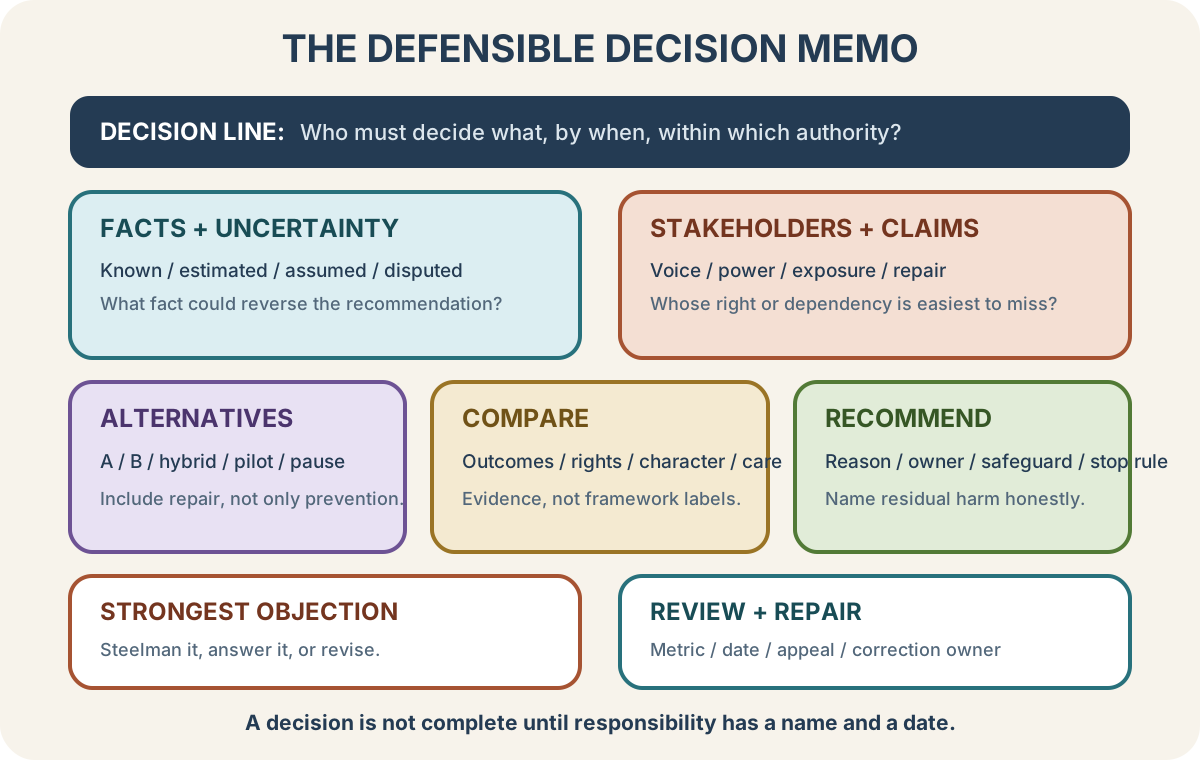
The capstone is a defensible decision memo: concise enough to use, detailed enough to audit, and honest about the harm it cannot eliminate. You will choose one of three cases, complete FACE, write the memo, attack it from the strongest opposing position, and revise once.
A memo is not graded by whether it reaches a preferred ideological conclusion. It is judged by the precision of its frame, treatment of evidence, moral reasoning, alternatives, response to objections, and executable safeguards. A different recommendation can succeed if it faces the same facts and burdens with equal rigor.
Choose one case
Case A: cooling-center transport
A county expects a three-day heat emergency. It can fund extended cooling-center hours or free evening transport, but not both at full scale. Centers currently close at 7 p.m.; the last fixed-route buses leave some neighborhoods at 6:15. Forecast models predict high overnight temperatures, but the neighborhoods with the highest modeled risk have incomplete data on informal housing. Faith groups offer volunteer rides but cannot guarantee wheelchair access. The county executive must approve a plan in 36 hours.
Required questions: What is the public purpose? Which differences are relevant to priority? How will the county represent residents missing from the data? What narrow emergency process and sunset are justified? What residual risk remains?
Case B: employee-support assistant
A 900-person company proposes a generative assistant trained on internal policies and past help-desk tickets. It would answer benefits and leave questions, drafting responses that staff can send. Past tickets contain sensitive personal narratives; names can be removed, but rare circumstances may remain identifiable. The vendor retains interaction logs for 30 days by default. A pilot could use only public policy documents, but leaders expect fewer time savings. The HR vice president decides in four weeks.
Required questions: Is each data use legitimate and necessary? What is the actual baseline? When is human review meaningful? What can an employee appeal or correct? Which pilot, monitoring, stop, retention, and retirement rules are proportionate? NIST’s GOVERN-MAP-MEASURE-MANAGE structure can support the lifecycle analysis 1.
Case C: community health survey
A nonprofit clinic wants to survey patients about housing instability to design referral services. Participation is voluntary, but staff will invite patients while scheduling care. The survey may reveal urgent needs the clinic cannot meet. A university partner offers analysis in exchange for permission to publish de-identified results. The clinic’s advisory board includes patients but has not reviewed the plan. The director wants to begin next month before a grant deadline.
Required questions: Is this service improvement, research, or both under applicable rules? Obtain qualified review rather than resolving that legal question yourself. Ethically, what information, comprehension, and voluntariness are needed? Who bears burden and receives benefit? What is owed when the survey reveals danger? The Belmont Report links respect, beneficence, and justice to consent, risk-benefit assessment, and fair subject selection 2.
You may use a real case from your life only if you remove identifying information, have no unresolved duty to report immediate danger, and can analyze it without exposing someone else’s confidence. Do not use the exercise as legal, clinical, or emergency advice.
Produce the case packet
Before the memo, assemble these working pages:
- Frame: decision line, authority, deadline, purpose, baseline, and because/but conflict.
- Evidence ledger: at least eight known, estimated, assumed, or disputed claims with sources and decision sensitivity.
- Stakeholder map: at least eight groups with voice, power, exposure, exit/appeal, and repair.
- Options: baseline, full proposal, narrow or pilot form, alternative means, pause condition, and repair action.
- Four-lens matrix: evidence-supported analysis of every serious option.
- Stress tests: reversal, publicity, consistency, least powerful, reversibility, and repair.
- Objection: a steelman written strongly enough that an opponent would accept it as fair.
The packet can be rough. Its purpose is to prevent the polished memo from hiding skipped reasoning.
Write the memo
Target 1,200-1,800 words. Use this order:
1. Recommendation
Open with the action, scope, owner, and deadline. Do not begin with background.
I recommend a six-week public-document-only pilot of the assistant, limited to drafting non-case-specific answers, with no past ticket data and no automated sending. The HR vice president owns the pilot; the privacy officer may pause it under the stop rules below; the oversight group decides on any expansion on September 30.
2. Decision and purpose
State authority, legitimate aim, baseline, and constraints. Distinguish fixed constraints from assumptions that can be challenged.
3. Material facts and uncertainty
Include only facts that support or threaten the recommendation. Cite the source close to the claim. Label estimates and disputes. Name the fact most likely to reverse your decision and how you will resolve or monitor it.
4. Stakeholders and moral claims
Describe harms and benefits, rights and duties, relevant virtues, relationships, dependency, and power. Do not write four disconnected mini-essays. Show where lenses converge or conflict.
5. Alternatives and priority rule
Explain why the leading alternative is inferior. State the rule used to give one concern priority: severity, rights constraint, public role, reversibility, least-advantaged impact, or another defended reason. Avoid numerical lens totals.
6. Safeguards, implementation, and repair
Assign names or roles to actions. Include notice, training, accessibility, review, appeal, monitoring, stop thresholds, correction, and a sunset or review date as relevant. The public-administration principle that authority should serve the public interest and remain transparent can guide role design 3.
7. Strongest objection and residual harm
Give the objection its best evidence. Answer it or revise. Then state what cost remains. Acknowledging residual harm does not weaken a decision; concealing it does.
Cite for traceability, not authority theater
Citations support claims; they do not outsource judgment. Cite:
- facts, statistics, dates, and descriptions not based on direct case records;
- framework definitions and borrowed methods;
- legal or professional requirements, with qualified review where needed; and
- contested empirical claims about risk or effectiveness.
You do not need a citation for your transparent value judgment, but you do need an argument. “The Belmont Report lists justice” is sourced; “therefore option C is fair” still requires you to show how burdens and benefits are distributed in this case.
Prefer primary and institutional sources for policy, official duties, and framework text. Check publication date, scope, and whether a standard is current. The Markkula framework and Ethics Unwrapped analysis are useful process guides, not authorities that certify your outcome 4 5.
Score the memo
Use a 24-point rubric, 0-3 in each category:
| Category | 3-point standard |
|---|---|
| Frame | Precise decision, authority, purpose, deadline, and real baseline |
| Evidence | Sources are traceable; uncertainty and decision sensitivity are explicit |
| Stakeholders | Missing voice, power, distribution, and repair are analyzed |
| Alternatives | Genuine options include narrower, reversible, and repair forms |
| Moral reasoning | Lenses are accurately applied; conflicts and priority are defended |
| Objection | Strongest counterargument is fair, specific, and answered or prompts revision |
| Implementation | Owners, safeguards, metrics, stop rules, appeal, and review date are usable |
| Clarity | Recommendation leads; language is concrete; residual harm is candid |
Minimum completion standard: no category at zero, and at least 17/24. A score below three on implementation means the decision is not ready for action even if the philosophy is strong.
Defend, revise, reflect
Ask a reviewer to challenge one fact, one excluded stakeholder, one rights claim, and one implementation assumption. If working alone, wait a day and argue the opposite recommendation for ten minutes. Record revisions in a short change log.
After the review date, evaluate actual effects against the baseline. Ask who used the appeal, who could not, what unanticipated maintenance work appeared, and whether the original priority rule still holds. Ethical evaluation is not a victory lap; it closes the learning loop.
Final pocket card
FACE: Frame the decision and evidence. Generate Alternatives. Compare with consequences, duties and rights, character, and care. Execute and Evaluate with owners, safeguards, stop rules, appeal, repair, and a review date.
The course’s final rule of thumb is simple: a decision is not complete until its reasons can be challenged, its effects can be monitored, and responsibility has a name.
Source trail
References
- 1Elham Tabassi. Artificial Intelligence Risk Management Framework (AI RMF 1.0). National Institute of Standards and Technology. 2023. verifiedVoluntary, rights-preserving framework organized around GOVERN, MAP, MEASURE, and MANAGE; the 1.0 framework is under revision. Cited at: part 2.
- 2National Commission for the Protection of Human Subjects of Biomedical and Behavioral Research. The Belmont Report. U.S. Department of Health and Human Services. 1979. verifiedOfficial text linking respect for persons, beneficence, and justice to consent, risk-benefit review, and subject selection. Cited at: parts B-C.
- 3ASPA Code of Ethics. American Society for Public Administration. verifiedProfessional code emphasizing public interest, constitutional principles, social equity, transparency, and organizational stewardship.
- 4A Framework for Ethical Decision Making. Markkula Center for Applied Ethics, Santa Clara University. verifiedPractical workflow for recognizing an ethical issue, gathering facts, evaluating alternatives through multiple lenses, acting, and reflecting.
- 5Deni Elliott. Systematic Moral Analysis. Ethics Unwrapped, McCombs School of Business, The University of Texas at Austin. verifiedInstitutional teaching video and transcript distinguishing conceptualization, justification, and rationalization.
Check your understanding
- Which recommendation is implementation-ready?
- The organization should balance innovation and fairness.
- Pilot option C for six weeks with 100 cases; the program director owns launch, compliance may pause, weekly error and appeal thresholds are specified, and the review board decides on expansion August 30.
- More research is needed eventually.
- Leaders should act ethically and monitor the situation.
- What is the best use of a citation in an ethics memo?
- To replace the writer’s reasoning with an authority’s name.
- To support a factual, interpretive, legal, or framework claim while making clear what judgment remains the writer’s.
- To prove that ethical disagreement is impossible.
- To make the memo longer.