Lesson 9 of 18 · Visual Culture, Objects, and Synthesis
Capstone: An Evidence-Led Interpretation
Open alongside this lesson
Project resources
The Craft of Research, Fifth Edition (opens in a new tab)
Use its question-to-argument guidance when scaling this capstone beyond the compact course version.
Teacher's Guides and Analysis Tool (opens in a new tab)
Select the guide that matches each historical item in the capstone packet.
The capstone combines the course’s three practices: close reading, historical source criticism, and visual or material analysis. Your goal is not to display everything you found. It is to make one consequential, bounded interpretation whose reasoning a reader can inspect and continue.
The finished project can be a 1,200–1,800 word essay, an 8–10 minute narrated presentation, or an annotated digital exhibit of 6–8 panels. Every format must contain the same intellectual architecture.
Choose a source constellation
Select a focused object of inquiry and assemble at least four items:
- one text for close formal reading;
- one image or material object with stable institutional metadata;
- one contemporaneous historical record produced through a different chain;
- one scholarly or curatorial source that supplies context or an interpretation to test.
Examples:
- a public speech, campaign poster, meeting minutes, and historian’s article;
- a poem, portrait, private letter, and museum catalog essay;
- a travel narrative, map, commercial object, and material-culture study;
- a memorial inscription, site plan, dedication program, and later visitor debate.
Keep the constellation tight in time, place, or relationship. “Ideas of freedom in world history” is too large. “How a 1918 city poster and two neighborhood records translated food conservation into a test of civic loyalty” is workable.
Write the research contract
Before collecting more, complete:
- Question: How or why does ___ use ___ to ___ under ___ conditions?
- Stake: Understanding this changes how we see ___ because ___.
- Scope: This project covers ___ and does not claim to represent ___.
- Decision evidence: I would change my answer if ___ showed ___.
- Stop gate: I will draft after I have two independent evidence chains, one strong alternative, and complete metadata for every reproduced item.
The Craft of Research emphasizes productive questions, source evaluation, argument, audience, and ethical obligations 1. The contract keeps those obligations visible before the project expands.
Make three passes through every primary item
Pass 1 — encounter: Describe the text, image, or object without outside interpretation. Record form, structure, material, exact details, and questions.
Pass 2 — source criticism: Complete P-A-C-T-S: provenance, audience, context, task, and silences. Identify version and production chain. The Library of Congress format guides can sharpen questions for manuscripts, photographs, maps, newspapers, and other sources 2.
Pass 3 — relation: State what subclaim the item supports, complicates, or cannot address. Compare it with at least one independent item.
Preserve each pass separately. If catalog language enters the encounter notes, you lose the ability to see how the institution framed your first description.
Build a synthesis braid
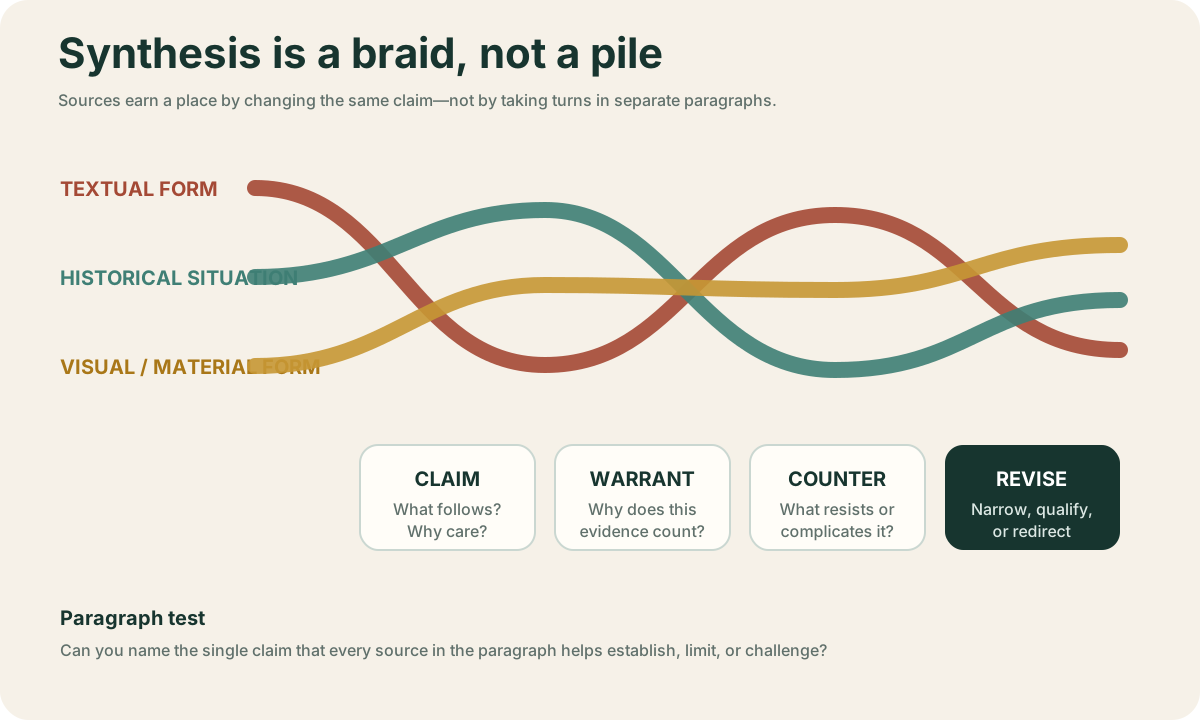
Create one row per subclaim:
| Subclaim | Textual/formal evidence | Historical evidence | Visual/material evidence | Counterevidence | Warrant |
|---|---|---|---|---|---|
| public duty is personalized | direct address, repeated “you” | sponsor’s campaign instructions | single frontal figure points outward | private letter mocks slogan | address converts policy into individual obligation |
The final column is essential. A warrant explains why the relationship among evidence supports the subclaim.
Draft by row, not column. A “text paragraph,” followed by an “image paragraph,” followed by a “history paragraph” usually leaves the reader to perform the synthesis. Instead, put different media into the same analytical unit when they bear on the same proposition.
Use transition verbs that name evidence relationships:
- corroborates, narrows, complicates, contradicts;
- translates, reframes, materializes, omits;
- precedes, responds to, circulates, appropriates;
- records, stages, classifies, remembers.
“Also” usually means you have not yet named the relationship.
Draft the claim in three layers
Mechanism: By what formal, material, or institutional operation does the source constellation work?
Consequence: What understanding, behavior, memory, identity, or relation does that operation make possible?
Boundary: To which sources, audience, place, and period does the claim apply, and what alternative remains?
Template:
Across [defined source set], [formal/material mechanism] reframes [historical problem] as [consequence]. This pattern is strongest in [evidence] and complicated by [counterevidence], so it supports a claim about [bounded subject] rather than [larger unsupported generalization].
Harvard’s close-reading guidance begins from particular patterns and tensions rather than a prefabricated thesis 3. Keep that order in the capstone. If your sources only confirm the first thesis, deliberately search for a rival case.
Include one counter-reading that can win
State the strongest alternative in terms its proponent would accept. Give it exact evidence. Then decide among three responses:
- refute: show why its crucial inference fails;
- absorb: revise your claim to incorporate what it explains;
- preserve: demonstrate that the ambiguity is historically or formally consequential.
Avoid “Some might say…” followed by a weak objection. Name the source or feature that generates the alternative.
Handle images and quotations ethically
For every reproduced object, include creator, title, date, holding institution, accession or call number when available, license/rights statement, and stable source page. Alt text should describe the visual information needed for your argument, not every pixel.
For people represented in images or records, distinguish catalog terminology, historical terminology, and your own language. Do not aestheticize suffering without analyzing the production and circulation conditions. Do not infer consent from digitization.
Quote only what you analyze. If a historical term is harmful but necessary evidence, frame why it appears, quote the minimum, and do not repeat it as your neutral category.
Produce a method note
Add 150–250 words explaining:
- which versions or reproductions you used;
- what repository metadata established;
- how your claim changed after counterevidence or context;
- what the available archive cannot establish;
- what next source would most change confidence.
This is not a diary of search steps. It is an audit trail of consequential decisions.
Capstone structure
- Opening problem: introduce the source relationship and stake, not broad history.
- Bounded claim: mechanism, consequence, and limit.
- Evidence unit 1: close reading plus historical warrant.
- Evidence unit 2: visual/material analysis plus corroboration.
- Counter-reading: strongest alternative and revision.
- Conclusion: what the interpretation changes, what remains unknown.
- Method note and references.
For a digital exhibit, each panel still needs a mini-claim, evidence, and connection to the next panel. Captions are analysis space, not inventory alone.
Self-assessment rubric
Score each dimension 0–3.
- Exactness: claims point to precise textual, visual, or material details.
- Source control: provenance, version, purpose, and dependence are clear.
- Synthesis: different media alter the same subclaims.
- Warrants: the evidence-to-claim connection is explicit.
- Alternatives: counterevidence receives fair analytical weight.
- Calibration: verbs and scope match evidentiary strength.
- Citation and access: quotations, images, rights, and alt text are traceable.
- Revision: the project records what changed and what remains open.
A score below 2 in source control, synthesis, or calibration is a stop gate: revise before polishing prose.
Final defense
End your process by answering aloud:
- What exact detail would I show first to defend the claim?
- Which source is least independent, and how did I account for that?
- What is the strongest alternative?
- Where does my claim stop?
- What discovery would make me rewrite it?
The course’s central habit is now complete: observe closely, identify the source conditions, connect evidence through explicit warrants, test alternatives, and revise. A humanities interpretation is persuasive not because it closes the object, but because it makes its path through the evidence clear.
Source trail
References
- 1Wayne C. Booth, Gregory G. Colomb, Joseph M. Williams, Joseph Bizup, William T. FitzGerald. The Craft of Research, Fifth Edition. University of Chicago Press. 2024. verifiedResearch guide for developing questions, evaluating sources, building warranted arguments, and addressing an audience ethically. Cited at: The Craft of Research.
- 2Teacher's Guides and Analysis Tool. Library of Congress. verifiedOfficial Observe–Reflect–Question–Investigate framework and format-specific primary-source guides. Cited at: Teacher’s Guides and Analysis Tool.
- 3A Brief Guide to Writing the English Paper. Harvard College Writing Center. verifiedPractical account of close reading as an inductive movement from textual detail and pattern to an arguable claim. Cited at: A Brief Guide to Writing the English Paper.
Further reading
- Jules David Prown. Mind in Matter: An Introduction to Material Culture Theory and Method. Winterthur Portfolio. 1982. verifiedClassic method for moving from description through deduction to speculation in object study.
Check your understanding
- What makes several sources a synthesis rather than a list?
- Every source gets one paragraph.
- The sources are all authoritative.
- Different evidence strands establish, limit, or challenge the same subclaim.
- The bibliography is long.
- What belongs in the capstone’s method note?
- A claim that the research was unbiased
- A brief account of versions used, major interpretive revision, and remaining limits
- A plot summary
- Only search keywords
- Which capstone claim is best bounded?
- Art always reflects society.
- This poster proves what citizens believed.
- In the three city-sponsored posters issued from May through July 1918, heroic scale and direct address frame conservation as a public test of loyalty; two private letters complicate any inference of uniform reception.
- The image is powerful and timeless.