Lesson 11 of 18 · Ethical Frameworks
Outcomes with Guardrails
Good intentions are not enough. An action can be meant kindly and predictably make people worse off. Good totals are not enough either. An action can produce a useful result by deceiving, coercing, or treating one person as expendable. Practical ethics therefore needs both an outcome forecast and a respect gate.
Consequentialism is a family of views, not merely the slogan “the greatest good for the greatest number.” Different versions ask whether we should evaluate individual acts, general rules, motives, or institutions; they also disagree about what counts as a good consequence 1. Deontological theories likewise vary, but they share the idea that some features of the action itself - a duty, prohibition, permission, or person’s claim - matter independently of the final total 2.
Forecast with SCALE
For each serious option, use SCALE:
- Stakeholders: Who experiences the result, including people absent from the room?
- Chances: What is the probability range, and what supports it?
- Amount: How large, severe, and durable is each benefit or harm?
- Long term: What precedents, incentives, adaptations, or second-order effects follow?
- Equity: Are small gains widely spread while severe burdens concentrate on a few?
Suppose an employer considers software that automatically rejects applicants whose resumes contain unexplained gaps. A narrow analysis counts recruiter hours saved. SCALE adds applicants, current employees, customers, and the organization itself; distinguishes a frequent inconvenience from a lower-probability life-changing exclusion; considers how applicants will adapt; and asks whether caregiving, illness, military service, or unstable housing make the burden uneven.
Expected value can clarify a forecast: probability x magnitude. It cannot decide which magnitudes are comparable or how benefits to one person trade against harms to another. Use numbers where evidence permits, ranges where knowledge is limited, and words such as “unknown” where precision would be false. A table with honest uncertainty is better than a decimal invented to look scientific.
Three corrections improve consequence estimates:
- Compare against a baseline, not against perfection. What happens if nothing changes?
- Include opportunity cost. Funding option A may prevent option B.
- Search for feedback. A rule changes behavior, trust, reporting, and future data.
Then pass the respect gate
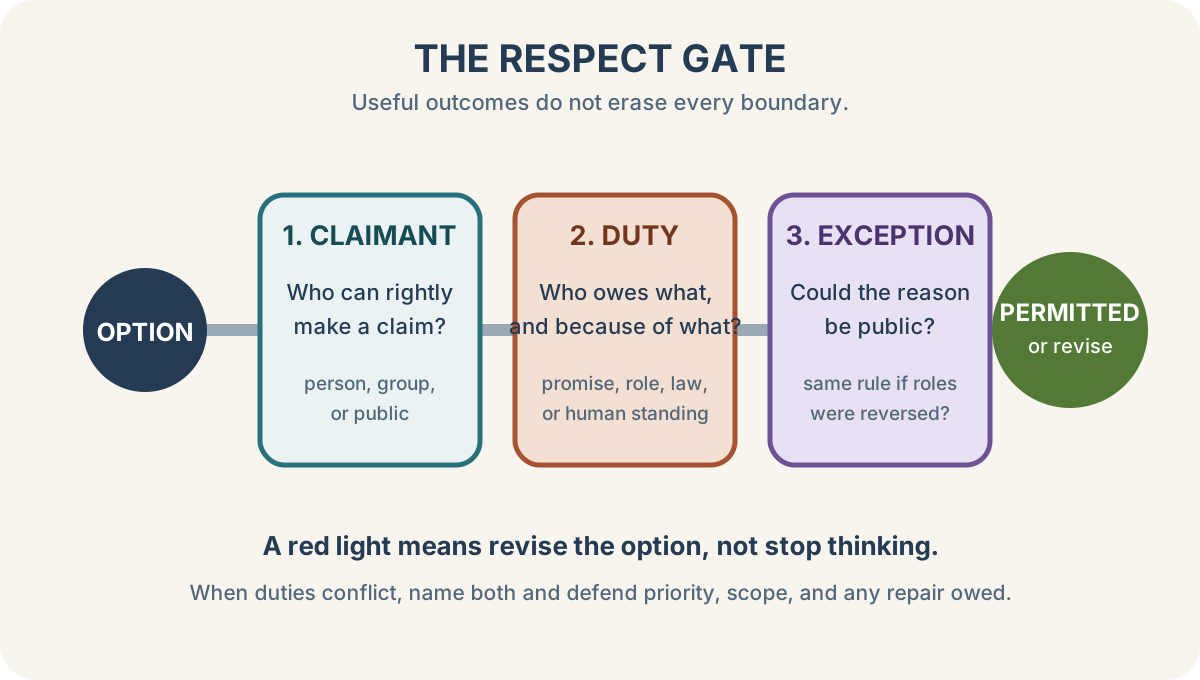
A right is not simply an intense preference. It is a justified claim that places a duty on someone else. To make a rights argument concrete, finish this sentence:
Person or group P has a claim to X against agent or institution A, because B.
The basis might be human standing, a promise, a role, a law, a legitimate expectation, or participation in a fair practice. The Universal Declaration of Human Rights supplies an influential public vocabulary of dignity, equality, liberty, privacy, conscience, association, and participation 3. It is not a plug-in algorithm for every dispute, and legal status does not settle the whole moral question. Still, named rights make vague appeals testable.
Duties can be negative - do not deceive, coerce, discriminate, or invade without justification - or positive - disclose material facts, keep a promise, render aid, protect a person in your care, or provide a fair process. They can also be perfect (owed strictly to identifiable claimants) or imperfect (real but allowing discretion in how and when they are fulfilled).
The Belmont Report gives a useful applied example. In human-subject research, respect for persons is expressed through informed consent, beneficence through systematic risk-benefit assessment, and justice through fair selection of research subjects 4. These principles do not eliminate conflict. Respect can require honoring an autonomous choice while also protecting someone with diminished autonomy. The report’s value is precisely that it translates broad principles into duties and review questions.
When duties collide
“Never break a rule” is not an adequate account of deontology. Duties can conflict: confidentiality versus warning someone of grave danger; promise-keeping versus preventing serious harm; equal treatment versus accommodation for unequal need. Handle a conflict with SCOPE:
- Source: What grounds each duty?
- Claimants: To whom is each owed?
- Object: What exactly does each require or forbid?
- Priority: Why does one carry greater weight here?
- Exception and repair: How narrow is the exception, and what remains owed afterward?
Avoid declaring an absolute unless you are willing to defend it in the hardest foreseeable case. Also avoid inventing an emergency whenever a duty becomes inconvenient. A justified exception usually has a high threshold, narrow scope, documented reason, and a plan to repair the interest that was overridden.
Two classic objections, answered cautiously
Objection to consequences: prediction is unreliable, values are hard to compare, and maximizing totals can sacrifice minorities. The response is not to abandon outcomes. It is to use ranges, sensitivity analysis, distribution checks, rules that protect trust, and rights as constraints. If your recommendation changes only under an implausible forecast, say so.
Objection to duties and rights: rigid rules can produce terrible outcomes, and competing rights can simply restate the dispute. The response is to specify the claimant, duty-bearer, basis, scope, and exception rule. Then test the rule against predictable consequences and comparable cases. A right is stronger when its institutional meaning is clear; it is not strengthened by repeating the word “right.”
Practice: compare two bad options
A supervisor learns that a respected employee altered a minor date on a report so a missed deadline would not appear in a quarterly review. No money was lost and the underlying work is sound. Option A is a quiet warning. Option B is formal reporting, which may trigger a severe automatic penalty.
Build a one-page analysis:
- Forecast A and B with SCALE. Include trust, precedent, proportionality, and reporting incentives.
- Write at least two rights or duties in P-X-A-B form.
- Use SCOPE to describe the conflict between honesty, procedural consistency, confidentiality, and proportionate response.
- Generate option C. For example: correct the record, document the incident, use an independent reviewer, and request a proportionate sanction rather than suppressing or mechanically maximizing punishment.
Do not ask only, “Which person deserves sympathy?” Ask what rule the institution could apply consistently without making truthful records optional or minor mistakes career-ending.
Pocket summary
Use SCALE to forecast outcomes and SCOPE to handle duties in conflict. Consequences tell you what a decision is likely to do. Rights and duties tell you what must not be casually traded away. A defensible recommendation shows both, narrows any exception, and preserves monitoring and repair.
Source trail
References
- 1Walter Sinnott-Armstrong. Consequentialism. Stanford Encyclopedia of Philosophy. verifiedPeer-reviewed overview of act, rule, direct, and indirect forms of consequentialism and their major objections. Cited at: sections 2-4.
- 2Larry Alexander, Michael Moore. Deontological Ethics. Stanford Encyclopedia of Philosophy. verifiedPeer-reviewed survey of agent-centered, patient-centered, and contractualist deontological theories. Cited at: sections 1-2.
- 3Universal Declaration of Human Rights. United Nations. 1948. verifiedOfficial text of the declaration; useful as a public vocabulary of human dignity and rights, not as a complete ethical algorithm. Cited at: articles 1-21.
- 4National Commission for the Protection of Human Subjects of Biomedical and Behavioral Research. The Belmont Report. U.S. Department of Health and Human Services. 1979. verifiedOfficial text linking respect for persons, beneficence, and justice to consent, risk-benefit review, and subject selection. Cited at: parts B-C.
Check your understanding
- In a consequences analysis, why should probability and severity be written separately?
- Because a rare catastrophic harm and a frequent minor harm can require different responses.
- Because severity is always measurable in dollars while probability is not.
- Because only likely harms count ethically.
- Because multiplying any two numbers yields a morally correct answer.
- Which is the strongest rights-and-duties formulation?
- Privacy matters.
- I have a right to whatever I prefer.
- Residents have a claim to notice because the agency’s public role includes giving affected people a fair chance to respond.
- Rights always defeat consequences.