Lesson 10 of 18 · Ethical Frameworks
The Four-Lens Habit
Ethics begins before the dramatic dilemma. It begins when you notice that a routine choice distributes benefits, burdens, voice, risk, or respect. A manager changes a schedule. A friend asks for secrecy. A city buys software. A clinician must allocate one remaining appointment. Each decision contains facts, but facts do not choose their own moral importance.
This course uses four lenses: consequences, duties and rights, character, and care. They are not four answers to memorize. They are four disciplined ways to ask what a quick first impression may have missed. Consequentialism emphasizes what actions bring about; deontological theories emphasize what choices are required, forbidden, or permitted; virtue ethics centers the qualities and practical wisdom of the agent; care ethics emphasizes dependency, relationship, context, and responsive responsibility 1 2 3 4.
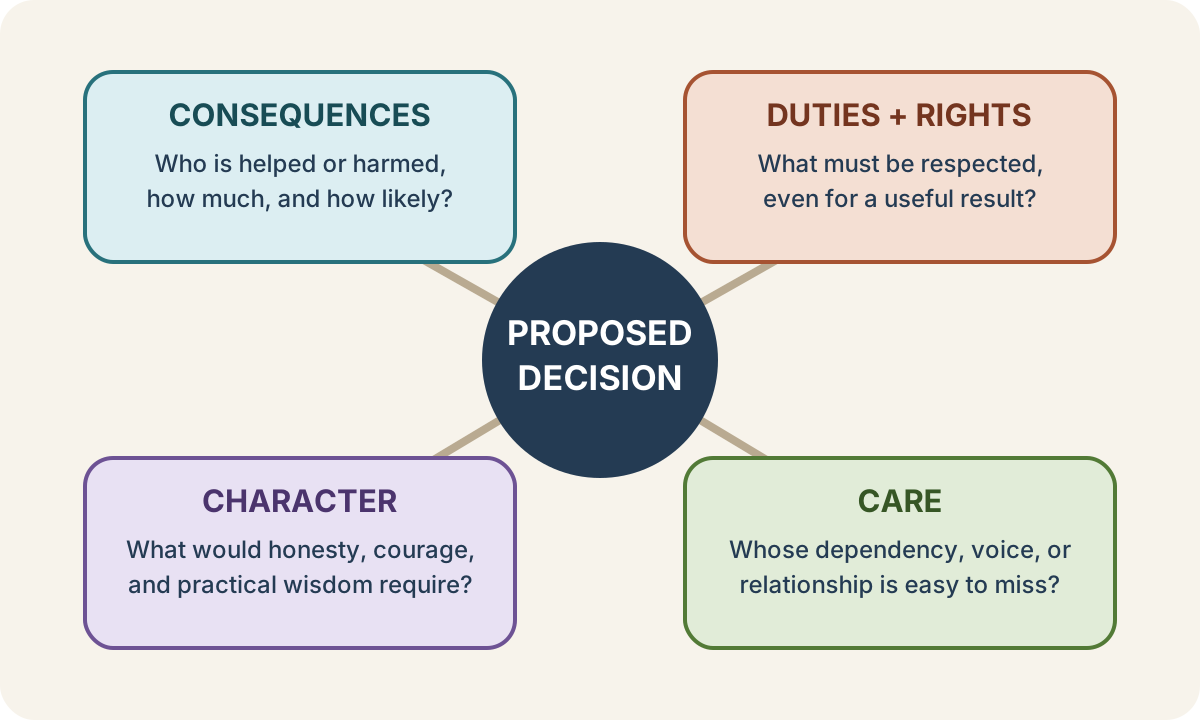
One case, four readings
Imagine a small public library facing a budget cut. The director proposes ending Sunday hours because that shift has the fewest visits. The change saves enough to preserve weekday staffing.
The consequences lens asks who gains and loses, by how much, and with what probability. The proposal preserves more total open hours than several alternatives. Yet aggregate visits may hide concentrated harm: Sunday may be the only usable day for people working two jobs, students sharing a family car, or residents who rely on a caregiver.
The duties and rights lens asks what claims people can make and what the library owes because of its public role. No one may have an unlimited right to every preferred opening hour. Still, equal public standing, nondiscrimination, notice, and a fair opportunity to be heard can constrain how the change is made. A useful saving does not excuse inventing consultation records or concealing the effect.
The character lens asks what honesty, courage, fairness, humility, and practical wisdom require. An honest director does not present one convenient metric as the whole picture. A courageous director can acknowledge uncertainty and defend a painful tradeoff. Humility makes room for revision if affected users reveal facts the staff did not know.
The care lens asks whose dependence and relationship to the institution are easy to overlook. A library is not merely a dispenser of open hours. Staff may know patrons whose access depends on a predictable routine, a quiet refuge, or assistance navigating forms. Care does not command that Sunday hours continue at any cost; it requires that those concrete needs be seen and, if possible, met another way.
Notice the result: the lenses do not necessarily disagree. Together they may produce a better option - reduced Sunday hours, a trial period, outreach to affected patrons, and a review after eight weeks - that was invisible when the choice was framed as “close Sundays or lay off staff.”
Do not turn lenses into arithmetic
A common mistake is to score each lens from one to five and add the numbers. That can be a useful prompt, but it is not a moral calculator. A severe rights violation is not automatically canceled by three mild benefits. A tiny and speculative harm should not automatically defeat a large and well-supported public benefit. Some concerns are thresholds; others are tradeoffs; still others call for safeguards or repair.
Use the mnemonic LENS:
- Locate the choice: what exactly is being decided, by whom, and by when?
- Expose the stakes: consequences, claims, character, relationships, and missing voices.
- Name the conflict: write “value A pulls toward X, while value B pulls toward Y.”
- Support the priority: give evidence, a principle, and a response to the strongest objection.
The final step matters. “I value fairness” is not yet an argument. You must say what fairness means here, why the chosen feature is morally relevant, and how the rule treats comparable cases.
Trolley cases: useful, but incomplete
The opening Harvard Justice lecture uses trolley cases to reveal a durable tension: should we maximize lives saved, or are there ways of using a person that remain wrong even for a better total? The official course page presents the exercise as an entry into moral reasoning, not a trick with one approved answer 5.
Playback is optional. If the player is unavailable, open the video at its source.
Trolley cases are useful because they isolate variables. They are incomplete because real decisions rarely arrive with certain numbers, fixed options, no history, and no opportunity to ask affected people. In practice, you must distinguish:
- stipulated facts, true by definition inside a thought experiment;
- observed facts, supported by records or direct evidence;
- estimates, carrying a method and uncertainty range;
- assumptions, which could change the recommendation; and
- value judgments, which say why a fact matters.
If someone says, “Closing Sunday is obviously best because it affects the fewest visits,” the visit count may be a fact. “Best” is a judgment, and “fewest visits” may be an inadequate measure of harm.
Pluralism without evasiveness
Using multiple lenses can look indecisive: if every framework matters, can one simply select the lens that excuses a preferred choice? That is a real danger. Guard against it by applying every lens to every serious option, stating conflicts openly, and choosing the priority rule before learning which option benefits you personally.
Pluralism also does not mean “every opinion is equally good.” Reasons can be inconsistent with known facts, ignore affected people, make a secret exception for the speaker, or fail when applied to similar cases. Ethical disagreement may remain after those errors are removed. The goal is a defensible decision: factually responsible, morally coherent, open to challenge, and coupled to action and repair.
Practice: the two-column reset
Choose a live but low-stakes decision. On the left, write five factual claims. On the right, write five judgments about what should happen. Circle any sentence that mixes both. Then run LENS and produce at least three options, including a pause, pilot, safeguard, or partial solution.
Finish with two sentences:
I recommend ___ because . The strongest objection is ; I answer it by ___, while preserving ___ as a safeguard.
If you cannot complete the second sentence fairly, you are not ready to decide. You may need better facts, a different option, or a more honest account of the unresolved cost.
Pocket summary
Remember LENS: Locate, Expose, Name, Support. Ethical frameworks are instruments of attention. They improve a decision when they reveal missing stakes, generate alternatives, and force reasons into public view. They fail when used as labels, scores, or after-the-fact decoration for a choice already made.
Source trail
References
- 1Walter Sinnott-Armstrong. Consequentialism. Stanford Encyclopedia of Philosophy. verifiedPeer-reviewed overview of act, rule, direct, and indirect forms of consequentialism and their major objections. Cited at: sections 1-3.
- 2Larry Alexander, Michael Moore. Deontological Ethics. Stanford Encyclopedia of Philosophy. verifiedPeer-reviewed survey of agent-centered, patient-centered, and contractualist deontological theories. Cited at: introduction.
- 3Rosalind Hursthouse, Glen Pettigrove. Virtue Ethics. Stanford Encyclopedia of Philosophy. verifiedPeer-reviewed account of virtue, practical wisdom, flourishing, and major objections to virtue ethics. Cited at: section 1.
- 4Maureen Sander-Staudt. Care Ethics. Internet Encyclopedia of Philosophy. verifiedAcademic overview of care ethics, relational responsibility, dependency, and critiques of abstract impartiality. Cited at: sections 1-2.
- 5Michael Sandel. Justice: What's the Right Thing to Do? Episode 01 - The Moral Side of Murder. Harvard University. 2009. verifiedOfficial course page for the opening lecture, using trolley cases to expose tensions between welfare and individual rights. Cited at: opening lecture.
Check your understanding
- What is the best reason to use more than one ethical lens?
- The lenses always produce a four-to-zero vote for one option.
- Each lens exposes a different kind of morally relevant feature or failure mode.
- Combining lenses turns every value into a numerical score.
- Multiple lenses remove the need to make a judgment.
- Which statement is a conclusion rather than an observation?
- Three residents would lose service under option A.
- The policy was announced on Tuesday.
- Option A is unfair because it places the burden on residents with no alternative.
- The projected annual cost is $40,000.