Lesson 7 of 18 · Visual Culture, Objects, and Synthesis
Looking at Images and Objects
Open alongside this lesson
Project resources
Looking to Connect with European Paintings: Visual Approaches for Teaching in the Galleries (opens in a new tab)
Use its thematic prompts to practice beginning with visual form before researching context.
Guide to Doing History with Objects (opens in a new tab)
A concise bridge from physical description to historical questions.
Images and objects are not illustrations waiting to confirm a story you already know. They are constructed evidence. A painting arranges bodies and light; a photograph frames one interval; a vessel combines material, labor, wear, and use; a memorial scripts movement through space. Visual and material analysis asks how those arrangements produce possibilities for seeing, acting, remembering, or belonging.
The first discipline is simple and difficult: delay the story. Name what is visible or materially present before explaining it.
The Smithsonian’s “See, Think, Wonder” routine separates careful observation, reasoned interpretation, and inquiry 1. Use it as a sequence, not three interchangeable reactions:
- I see ___: a checkable description.
- I think ___ because ___: an inference with a stated basis.
- I wonder ___: a question that new looking or research could answer.
“I see grief” collapses the steps. “I see three faces turned away, two hands covering eyes, and one figure leaning out of the central action; I think the composition distributes grief through avoidance rather than speech” preserves the evidence.
Inventory before emphasis
Look for ninety seconds without taking notes. Then create a neutral inventory:
- people, bodies, poses, gaze, clothing;
- objects, architecture, landscape, text;
- dominant and minor colors;
- bright and dark regions;
- edges, axes, diagonals, curves, repeated shapes;
- empty or compressed space;
- crop, frame, border, damage, repair;
- apparent material, tool marks, joins, surface, weight, and scale.
Count before interpreting: how many figures look at the focal action? How many objects cross the frame? Where does written language appear? Numbers do not make interpretation objective, but they interrupt selective attention.
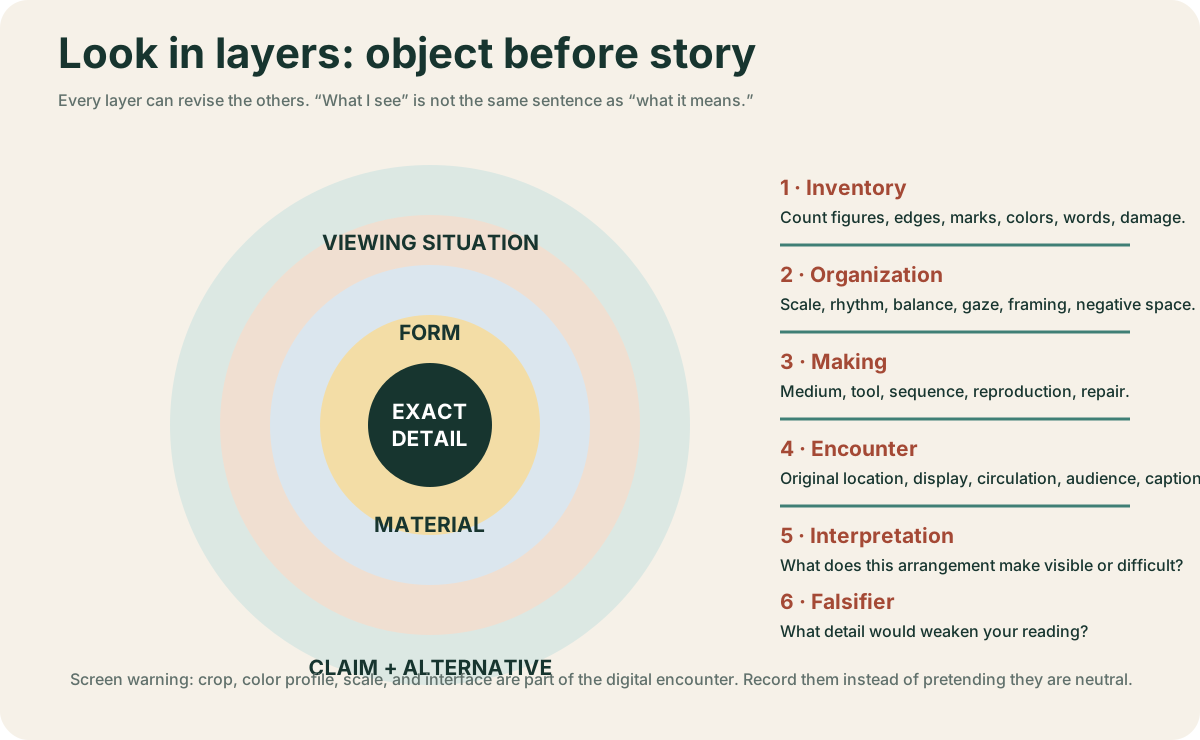
Move from inventory to organization
Formal analysis explains relationships among parts.
Scale: What is larger or smaller than expected? Does scale indicate distance, hierarchy, or visual pressure?
Placement: What occupies the center, edge, foreground, threshold, or vanishing point? Center does not automatically mean “most important”; test how other devices guide attention.
Line and movement: Where do bodies, tools, roads, glances, or contours lead the eye? Do they converge, circulate, or block?
Rhythm and repetition: Which colors, shapes, poses, or intervals recur? Where does the pattern break?
Framing: What is cut off, concealed, shown through a doorway, or separated by a border?
Viewpoint: From whose height and distance is the scene available? What position is assigned to the viewer?
Describe an effect without assuming intention: “The repeated verticals slow movement across the image” is safer than “The artist wanted us to feel trapped” unless you have evidence for intention.
Case studio: The Death of Socrates
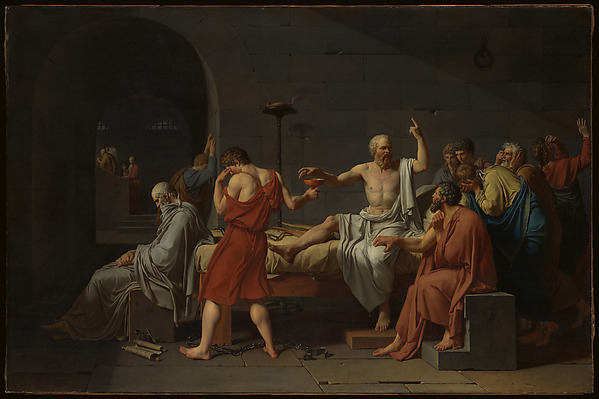
Do not read the museum entry yet. Spend five minutes on the reproduction.
Inventory: Count the figures; locate the cup, chains, bed, walls, scroll, and doorway; note bare and clothed bodies; mark every pointing, grasping, covering, and withdrawing hand.
Organization: Trace the horizontal bed and masonry, then the diagonals of arms and legs. Which gestures converge on the cup? Which turn away? Compare the lit body of Socrates with the surrounding clothing and stone.
Tension: The central figure reaches toward the instrument of death while continuing to gesture as if speaking. Around him, bodily reactions diverge—touching, collapsing, looking away, or attending. A formal question follows: how does the painting make one event contain both philosophical demonstration and embodied grief?
Only now open the catalog. The Met identifies Jacques Louis David, the 1787 date, oil on canvas, large dimensions, and an episode based on Plato’s Phaedo; the record also provides inscriptions, provenance, exhibition history, and curatorial discussion 2. Those facts do not replace looking. They let you revise it.
A digital reproduction hides important conditions. The original is roughly life-sized and much larger than this screen. Color is mediated by photography and display. Texture and brushwork flatten. Your caption and interface sit outside David’s canvas but inside your present encounter. Record both object and surrogate.
Analyze things through material operations
For a physical object, ask what was done to matter:
- cut, carved, cast, woven, fired, printed, painted, assembled, repaired;
- carried, worn, opened, filled, displayed, stored, discarded;
- polished through handling, cracked through stress, faded through light;
- standardized by a mold or made singular by handwork.
Jules Prown’s material-culture method famously moves through description, deduction, and speculation 3. A practical version is:
- Describe: measurable and visible properties.
- Deduce: sensory and bodily relationship—weight, grip, reach, comfort, resistance.
- Speculate: questions about makers, users, systems, values, and contradictions.
- Research: test those questions against catalog, technical, and historical evidence.
Do not skip from a chip or stain to a social story. Wear can indicate use, storage, accident, conservation, or later display. Treat each as a hypothesis.
The Smithsonian’s guide to doing history with objects emphasizes artifacts as sources that can reveal aspects of history less visible in written records 4. Objects also have silences: ownership may be recorded while makers remain anonymous; museum survival favors durable and collectible things.
Description without sterile language
Neutral does not mean lifeless. Use precise verbs:
- a line cuts, echoes, encloses, or redirects;
- a figure leans, recoils, braces, or meets a gaze;
- a surface absorbs, reflects, flakes, or records contact.
Avoid evaluation words—beautiful, powerful, realistic, primitive—until you define the feature and standard behind them.
Practice: ten-to-one object study
Choose one image or object from a museum catalog.
- Write ten observations without interpretive nouns such as power, grief, freedom, identity, or oppression.
- Group the observations into two formal relationships.
- Produce one interpretive question from the relationship.
- Read only the catalog metadata; revise the question.
- Read the curatorial description; identify one claim it helps and one your own observations complicate.
- Draft a 150-word label that distinguishes observation, inference, and established context.
End with a falsifier: “My reading would weaken if closer inspection or technical evidence showed ___.” Close looking is strongest when it knows what it cannot see.
Source trail
References
- 1See, Think, Wonder. Smithsonian Center for Learning and Digital Access. 2022. verifiedObservation routine that separates noticing, interpretation, and inquiry; licensed CC BY-NC-ND 4.0 on the source page. Cited at: See, Think, Wonder.
- 2Jacques Louis David. The Death of Socrates. The Metropolitan Museum of Art. 1787. verifiedPublic-domain Open Access image and object record for accession 31.45, including medium, dimensions, inscriptions, provenance, and curatorial interpretation. Cited at: The Death of Socrates.
- 3Jules David Prown. Mind in Matter: An Introduction to Material Culture Theory and Method. Winterthur Portfolio. 1982. verifiedClassic method for moving from description through deduction to speculation in object study. Cited at: Mind in Matter.
- 4Guide to Doing History with Objects. Smithsonian National Museum of American History. verifiedInstitutional introduction to treating artifacts as historical evidence rather than illustrations. Cited at: Guide to Doing History with Objects.
Further reading
- Elizabeth Perkins. Looking to Connect with European Paintings: Visual Approaches for Teaching in the Galleries. The Metropolitan Museum of Art. 2013. verifiedFree institutional publication modeling inquiry that begins with visual form before adding contextual information.
Check your understanding
- Which sentence is a formal observation?
- The painting celebrates reason over emotion.
- Socrates is morally superior to everyone else.
- The raised hand and reaching arm form opposed diagonals around the cup.
- David wanted to criticize the monarchy.
- Why record medium and dimensions?
- They determine one correct interpretation.
- Making, scale, texture, handling, and viewing distance affect what the object can do.
- Only conservators need them.
- They prove the creator’s intention.
- What should follow a “See, Think, Wonder” observation?
- A reasoned interpretation tied to the observation and a question that could guide investigation
- A universal symbol definition
- Immediate biographical research only
- A judgment of whether the object is beautiful