Lesson 15 of 18 · Recurring Cases
Care, Loyalty, and Public Roles
Loyalty is a moral good. Friends keep confidence; colleagues stand with one another; communities remember who showed up. Public and professional roles also create duties to strangers, clients, patients, students, residents, shareholders, or the law. Trouble begins when loyalty expands beyond its proper jurisdiction: “I owed my friend support” becomes “I owed my friend a favorable official decision.”
Care ethics rejects the fantasy that people are isolated, interchangeable choosers. Relationships and dependency can create genuine special responsibilities 1. Public ethics rejects a different fantasy: that affection or loyalty can privately allocate powers held in trust. The task is not to choose cold impartiality over human care. It is to care through a role without converting public authority into private property.
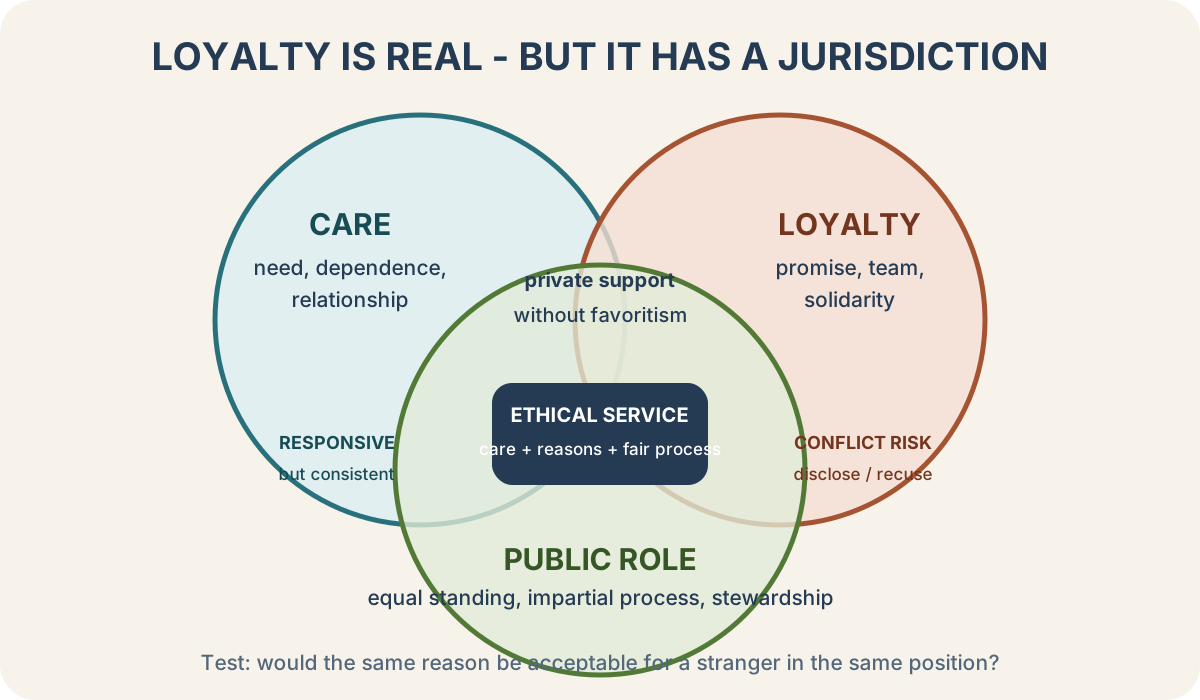
Separate three questions
When a relationship touches a formal decision, ask:
- What may I do as a person? Listen, provide emotional support, explain public information, or help someone prepare.
- What may I do in this role? Apply criteria, protect confidentiality, disclose a conflict, document reasons, or transfer the decision.
- What may I not do with entrusted power? Share nonpublic information, alter criteria, suppress a record, pressure a reviewer, or create a private exception.
The same act can change meaning by role. Telling a friend about a publicly posted grant deadline is ordinary help. Giving them competitors’ confidential applications uses official access for private advantage.
Conflict of interest is a condition, not a conviction
A conflict of interest exists when a secondary interest could interfere - or reasonably appear to interfere - with professional judgment 2. It does not prove bad character or a corrupt decision. That is why good systems manage conflicts before motives and outcomes are disputed.
Secondary interests include money, family, friendship, career advancement, ideology, gifts, future employment, reputation, and avoiding embarrassment. The person inside the conflict often has the least reliable view of its influence. “I know I can be objective” does not answer the institutional concern.
Use D-MAR:
- Disclose the relevant relationship to the proper authority, not necessarily to the whole world.
- Manage with boundaries: independent review, restricted access, recorded criteria, or supervision.
- Abstain/recuse when management cannot preserve trustworthy judgment.
- Record what was disclosed, who decided the response, and why.
Disclosure alone is not a cure. It can unfairly shift responsibility to people with less power: “I told you my brother owns the company, so continuing is acceptable.” The institution must decide whether management or recusal is adequate.
Public reasons and equal standing
A public reason is one you could offer to any person subject to the decision without relying solely on private affection, identity, or secret doctrine. It need not persuade everyone. It must connect the role’s authority to shared rules, evidence, and a legitimate public purpose.
The ASPA Code of Ethics is one professional example. It directs public servants to advance the public interest, uphold constitutional principles, promote social equity, provide accurate information, strengthen ethical organizations, and demonstrate personal integrity 3. A code does not decide every case, but it names role-based commitments that limit “my boss wanted it” and “my friend needed it” as complete justifications.
The Universal Declaration’s commitment to equal protection and equal access to public service gives this role ethics a wider foundation 4. Equal standing does not mean every person receives the same result; it means official reasons cannot simply be the decision-maker’s private attachments.
A worked case: the neighborhood grant
You sit on a city panel awarding five small improvement grants. A close friend leads one applicant organization. You know the group does excellent work and also know it submitted a rushed budget. The scoring rubric leaves room for “community capacity,” where your personal knowledge would help.
Bad option one is secret favoritism: score the group high because you trust your friend. Bad option two is punitive overcorrection: score it low to prove impartiality. Both substitute the relationship for the criteria.
D-MAR produces a cleaner path. Disclose the friendship to the panel chair. Do not access competitors’ materials beyond what panel rules require. Recuse from scoring and discussion if the relationship is close enough to undermine trust; use an alternate reviewer. If factual knowledge about the organization’s public track record is relevant, ensure the same kind of evidence can be submitted and evaluated for every applicant. Record the recusal.
You can still care as a friend: after the process, listen to disappointment, point to public feedback, or help identify future training. You may not disclose panel deliberations or privately rewrite the application.
Loyalty under wrongdoing
Loyalty becomes harder when a colleague has made a mistake. Three distortions recur:
- concealment: hiding the record to protect the person;
- abandonment: treating one error as proof the person is disposable; and
- tribal reversal: condemning in an outsider what one excuses in an insider.
Ethical loyalty can mean insisting on truthful correction, proportionate accountability, and humane treatment. “I will not lie for you, and I will not leave you alone in facing the consequences” is often more loyal than concealment.
Before escalating, distinguish error, disagreement, policy violation, serious misconduct, and imminent danger. Use the least forceful channel that can safely address the problem, but do not let gradualism become delay that exposes others to harm. Preserve evidence lawfully, avoid gossip, seek confidential advice, and know anti-retaliation or emergency procedures relevant to the role.
The care burden
Organizations often praise care while assigning it invisibly to the same people: the employee who smooths conflict, translates, trains newcomers, or comforts distressed clients without time or recognition. A care analysis asks who performs this labor, whether they can refuse, and whether staffing and compensation match the declared value.
This matters in public life. Responsiveness cannot depend on which resident finds the one unusually caring employee. Build care into accessible forms, language support, predictable callbacks, warm referrals, and appeal systems. Institutional care is a reliable capacity, not a favor.
Counterarguments
“All relationships bias us, so impartiality is impossible.” Perfect neutrality may be impossible. That supports transparent safeguards, not surrender. Some conflicts are manageable; others require recusal.
“Recusal abandons responsibility.” Recusal can protect the responsibility attached to a role by placing judgment with an unconflicted decision-maker. The recused person remains responsible for honest disclosure and a clean transfer.
“Codes are bureaucratic and ethics is personal.” Codes can be vague, self-protective, or incomplete. Yet public roles need stable commitments others can invoke. Personal conscience should criticize an inadequate code, not replace public reasons with private preference.
Practice: mark the loyalty boundary
Choose a role you hold - friend, supervisor, volunteer, caregiver, committee member, or citizen. Write one legitimate special obligation and one power you hold in trust. Create a case where they conflict.
Then produce:
- the three-question person/role/prohibition analysis;
- a D-MAR plan;
- the public reason for the official action;
- one caring action still permitted outside the official decision; and
- the strongest accusation an affected stranger could make.
Revise until you can answer that accusation without claiming pure motives as evidence.
Pocket summary
Care sees relationship and dependency; public ethics sees entrusted power and equal standing. Loyalty has a jurisdiction. Use D-MAR: Disclose, Manage, Abstain, Record. The aim is neither cold bureaucracy nor private favoritism, but institutions capable of humane, consistent, reviewable service.
Source trail
References
- 1Maureen Sander-Staudt. Care Ethics. Internet Encyclopedia of Philosophy. verifiedAcademic overview of care ethics, relational responsibility, dependency, and critiques of abstract impartiality. Cited at: sections 2-3.
- 2Conflict of Interest. Ethics Unwrapped, McCombs School of Business, The University of Texas at Austin. verifiedShort institutional introduction to how private interests can interfere, or appear to interfere, with professional judgment.
- 3ASPA Code of Ethics. American Society for Public Administration. verifiedProfessional code emphasizing public interest, constitutional principles, social equity, transparency, and organizational stewardship.
- 4Universal Declaration of Human Rights. United Nations. 1948. verifiedOfficial text of the declaration; useful as a public vocabulary of human dignity and rights, not as a complete ethical algorithm. Cited at: articles 7 and 21.
Check your understanding
- Which statement best describes a conflict of interest?
- It proves that a person has acted corruptly.
- It is a condition in which a secondary interest could interfere, or reasonably appear to interfere, with entrusted judgment.
- It exists whenever coworkers disagree.
- It disappears if the decision-maker believes they can remain objective.
- Why can recusal be an expression of responsibility rather than abandonment?
- It transfers the decision to someone without any standards.
- It protects the process when one’s relationship or interest would undermine impartial judgment or public trust.
- It guarantees the preferred outcome.
- It keeps the relationship secret.