Lesson 17 of 18 · Case-Analysis Workshop
Generate, Compare, and Stress-Test
Once the case is framed, do not race directly from “problem” to “yes” or “no.” Ethical skill includes moral imagination: constructing an option that preserves more values, shifts a burden away from the vulnerable, makes uncertainty reversible, or creates a real path to repair. Many hard cases remain hard, but they need not remain trapped inside the first binary offered.
The Markkula framework explicitly calls for evaluating alternative actions through several ethical perspectives and reflecting on the result 1. Ethics Unwrapped’s systematic moral analysis distinguishes justification from rationalization and emphasizes searching for alternatives that minimize harm 2. Here, A and C in FACE mean generate Alternatives, then Compare them with reasons and evidence.
Build an option ladder
Always include the real baseline. Then generate options across scope, time, control, and repair:
- Do nothing / maintain: preserve current practice, including its actual harms.
- Full action: adopt the proposal at intended scale.
- Narrow: reduce population, data, duration, authority, or intensity.
- Pilot or phase: create learning with predefined limits and stop rules.
- Alternative means: pursue the legitimate purpose through a different method.
- Pause: resolve a decision-sensitive unknown.
- Repair: if harm has already occurred, correct, compensate, apologize, restore, or change the rule.
Do not use “pilot” as a euphemism for rollout. A pilot needs a question, comparison, limit, owner, metric, stop rule, and decision date. If everyone is exposed and the system cannot be rolled back, it is a launch.
Use AND prompts to escape binaries:
- How might we protect X and reduce the burden on Y?
- Can we achieve the purpose and give affected people voice or appeal?
- What could we learn and keep reversible?
Some conflicts cannot be dissolved. Generating options is not a promise of harmony; it is a duty not to impose avoidable sacrifice through laziness.
Compare with an evidence matrix
Create one row per option and four lens columns. In each cell write a claim, evidence, and unresolved concern - not a framework label.
| Lens | Minimum content |
|---|---|
| Consequences | stakeholder, benefit/harm, probability, severity, distribution, horizon, baseline |
| Duties and rights | claimant, protected interest, duty-bearer, basis, scope, conflict/exception |
| Character | relevant virtue, underuse, calibrated action, excess, institutional habit |
| Care | dependency, relationship, power, voice, context, burden of maintenance/repair |
Consequentialism asks how acts, rules, or institutions shape outcomes 3. Deontology asks what choices are required, forbidden, or permitted 4. Virtue ethics centers character and practical wisdom 5. Care ethics directs attention to dependency and relational responsibility 6. A matrix uses these distinctions without pretending that each theory itself is one simple test.
Do not total the cells mechanically. Instead mark:
- red line: option violates a constraint not yet justified;
- material concern: substantial tradeoff needing mitigation or priority reasoning;
- uncertainty: conclusion depends on a weak or disputed fact;
- advantage: evidence-supported moral reason favoring the option; and
- residual harm: burden that remains even after safeguards.
Then state a priority rule: “When options offer similar benefit, prefer the one that is reversible and preserves appeal” or “No efficiency gain justifies secret alteration of the record.” Apply it to all options, including the one you prefer.
Weight uncertainty by reversibility
You rarely know exact probabilities. Use ranges and ask whether the ranking changes at plausible endpoints. If option A is preferred only when an uncertain benefit is at its maximum, it is fragile.
Combine two axes:
- evidence: strong, moderate, weak, or absent;
- reversibility: easy, costly, or effectively irreversible.
Weak evidence plus irreversible severe harm creates a high burden for action. Weak evidence plus a contained, monitored, reversible pilot may support learning. Delay also has consequences, so compare the harm of waiting rather than invoking a vague “precautionary principle.”
Rules of thumb:
- The harder the harm is to undo, the narrower the first step should be.
- The less voice an affected person has, the stronger the appeal and monitoring should be.
- The more a benefit depends on behavior changing after launch, the less historic data alone can prove.
- The more an exception benefits the decision-maker, the more independent review it needs.
Run adversarial stress tests
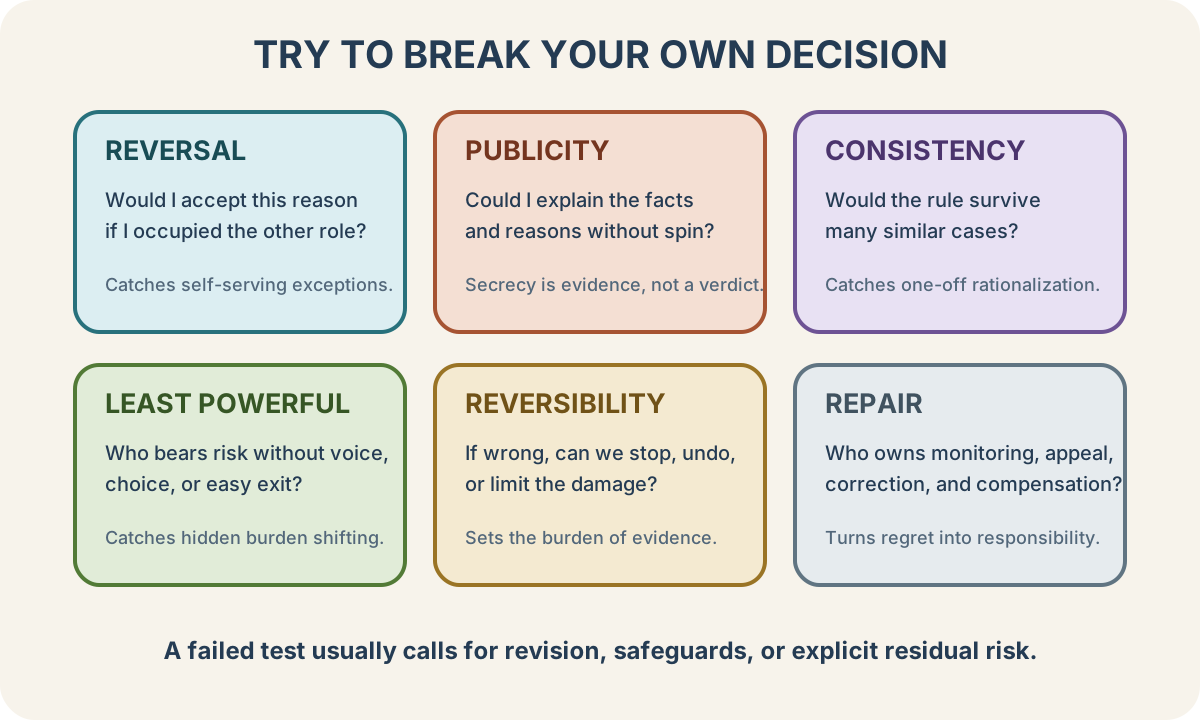
Apply all six tests to the leading recommendation:
- Reversal: Would I accept the same reason in the affected person’s position?
- Publicity: Could I describe the material facts and reasons without euphemism?
- Consistency: What rule does this create for similar cases?
- Least powerful: Who bears risk with the least voice, choice, or exit?
- Reversibility: What happens if our central assumption is wrong?
- Repair: Who must detect, acknowledge, correct, and compensate for harm?
Publicity is not “Would social media approve?” Popular anger can be mistaken. The test asks whether the decision depends on deception or a description so sanitized that affected people could not recognize what happened.
Reversal is not “Would I personally mind?” You retain the other person’s actual vulnerability, rights, and alternatives. Empathy should not erase evidence.
Steelman the objection
A straw objection is easy to defeat. A steelman states the strongest plausible case against the recommendation using facts and principles its proponents would recognize.
Write:
A reasonable critic would argue ___ because . This matters because . My recommendation answers it through , but cannot eliminate .
If the objection reveals a false fact, fix the record. If it reveals a red line, revise the option. If it identifies residual harm, name and mitigate it. Do not call every objection a “communication problem.”
Catch rationalization
Rationalization protects a preferred conclusion by moving standards after the fact. Warning signs include:
- “Everyone does it.”
- “It is legal, so it is ethical.”
- “No one complained.”
- “We had no choice” when alternatives were not explored.
- “The ends justify the means” without counting all ends and all means.
- “Just this once” without a limiting rule.
- “They would have agreed” without asking or establishing authority.
Use the prior rule test: would you endorse the reason before knowing which person or option it favors? If not, obtain independent review.
Practice: compare three responses
A nonprofit discovers that a mailing error exposed 300 donors’ email addresses to one another. No financial data was shared. Leaders fear disclosure will damage trust.
Frame three options: quiet technical correction; prompt notice with apology and protective guidance; or notice plus an independent review and process change. Add at least two hybrid options. Build the four-lens matrix, state a priority rule, perform sensitivity analysis on one unknown, run six stress tests, and steelman the case against your recommendation.
End by naming the residual harm. Even the best response cannot unexpose the addresses; ethics now includes truthful repair.
Pocket summary
Generate before choosing. Compare the actual baseline, a full action, narrower and reversible forms, alternative means, pause, and repair. Use claims plus evidence in every lens. Then try to defeat your recommendation through reversal, publicity, consistency, least-powerful, reversibility, and repair tests. A decision that survives honest attack is stronger; one that changes under attack is better.
Source trail
References
- 1A Framework for Ethical Decision Making. Markkula Center for Applied Ethics, Santa Clara University. verifiedPractical workflow for recognizing an ethical issue, gathering facts, evaluating alternatives through multiple lenses, acting, and reflecting.
- 2Deni Elliott. Systematic Moral Analysis. Ethics Unwrapped, McCombs School of Business, The University of Texas at Austin. verifiedInstitutional teaching video and transcript distinguishing conceptualization, justification, and rationalization. Cited at: transcript.
- 3Walter Sinnott-Armstrong. Consequentialism. Stanford Encyclopedia of Philosophy. verifiedPeer-reviewed overview of act, rule, direct, and indirect forms of consequentialism and their major objections. Cited at: sections 2-3.
- 4Larry Alexander, Michael Moore. Deontological Ethics. Stanford Encyclopedia of Philosophy. verifiedPeer-reviewed survey of agent-centered, patient-centered, and contractualist deontological theories. Cited at: introduction.
- 5Rosalind Hursthouse, Glen Pettigrove. Virtue Ethics. Stanford Encyclopedia of Philosophy. verifiedPeer-reviewed account of virtue, practical wisdom, flourishing, and major objections to virtue ethics. Cited at: section 1.
- 6Maureen Sander-Staudt. Care Ethics. Internet Encyclopedia of Philosophy. verifiedAcademic overview of care ethics, relational responsibility, dependency, and critiques of abstract impartiality. Cited at: sections 1-3.
Check your understanding
- Which option set shows genuine alternative generation?
- Approve or reject.
- Approve enthusiastically or approve reluctantly.
- Keep the baseline, approve at full scale, run a limited reversible pilot, redesign the process, or pause for a decision-sensitive fact.
- Choose the cheapest or call the cheapest a pilot.
- What is the difference between justification and rationalization?
- Justification starts from reasons and applies them consistently; rationalization recruits reasons after a preferred outcome is protected.
- Justification uses emotion and rationalization uses evidence.
- Rationalization is acceptable when the decision is urgent.
- There is no meaningful difference.