Lesson 8 of 18 · Visual Culture, Objects, and Synthesis
Context, Display, and the Power to Frame
Open alongside this lesson
Project resources
Under the Wave off Kanagawa, or The Great Wave (opens in a new tab)
Compare catalog metadata with what the screen crop and common title encourage you to notice.
Objects do not reach you alone. They arrive through frames: a title, crop, wall color, plinth, catalog category, search ranking, textbook chapter, audio guide, conservation decision, or national collection. Visual culture analysis studies both the object and the conditions of visibility that make one reading easy and another difficult.
This does not mean the frame invents everything. Material features constrain interpretation. The method is to ask how object and frame interact.
Make a frame inventory
For an online museum object, record:
- page title and alternate titles;
- creator attribution and uncertainty;
- date range, culture, medium, dimensions, accession number;
- credit line, provenance, and rights statement;
- default crop and available zoom;
- sequence of images and which view appears first;
- curatorial description and cited sources;
- collection category and related-object links;
- interface elements surrounding the image.
For a gallery encounter, add room, height, distance, lighting, neighboring objects, barrier, label length, visitor path, and sound. A devotional image beside related ritual objects affords a different reading than the same image isolated as a masterpiece.
Titles are evidence with dates
Ask who named the object and when. Artist-given, publisher-given, collector-given, translated, popular, and catalog titles have different authority. An alternate title can redirect the apparent subject.
Do not write “the title tells us” until you know which title. Use:
The museum catalogs the object as ___ and lists ___ as an alternate or popular title; that naming emphasizes ___ while the material/image also shows ___.
If the original language survives, preserve it alongside translation when relevant. Translation can collapse ambiguity or import a later category.
Case studio: one wave, a series, many impressions
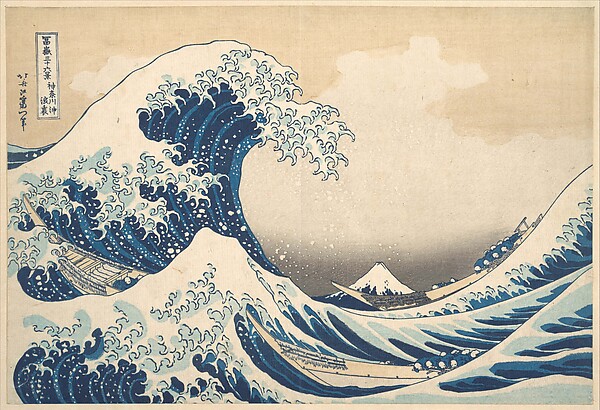
Begin with form. A large curling wave occupies much of the foreground and upper field. Three long boats cut diagonally across the water. The snow-capped mountain repeats the wave’s triangular hollow at a radically smaller apparent scale. White foam breaks into claw-like tips, but “claw-like” is an analogy, not an object in the image.
The museum record changes the frame. The title is Under the Wave off Kanagawa (Kanagawa oki nami ura), commonly called The Great Wave. The work belongs to Thirty-six Views of Mount Fuji, was produced around 1830–32, and is a woodblock print in ink and color on paper 1. “A picture of a wave” becomes one impression from a printed series organized around views of Fuji.
That context prompts new questions:
- Why is the series subject visually small but structurally persistent?
- How do repeated impressions complicate the modern assumption of a singular original artwork?
- What can this particular impression’s color, wear, trimming, and provenance reveal?
- How has the short English title shifted attention from place and series toward the wave alone?
The object record identifies accession JP2569, the medium, dimensions, credit line, and public-domain status. Cite that record when using the local image. A generic web copy may depict another impression with different color or margins.
Analyze reproduction, not only representation
Representation asks what an image depicts and how. Reproduction asks how the image was multiplied, circulated, resized, translated, restored, cropped, and remediated.
For prints and photographs, identify:
- negative, block, plate, matrix, or digital file;
- impression, edition, state, print date, later restrike;
- hand coloring or mechanical color;
- crop, retouching, restoration, and compression;
- publication or distribution channel;
- relation between scarcity, repetition, and value.
A work can change function through repetition: souvenir, textbook icon, logo, meme, protest sign. Later uses are not automatically the original meaning, but they are legitimate primary evidence for later reception.
Follow institutional verbs
Institutions acquire, attribute, classify, conserve, display, loan, reproduce, restrict, describe, and deaccession. Each verb implies decisions and authority.
Ask:
- Who had power to collect or remove the object?
- What legal and ethical conditions shaped acquisition?
- Whose name is recorded as artist, donor, owner, sitter, maker, or culture?
- Which histories become provenance and which remain “unknown”?
- Does conservation stabilize one moment in a changing object?
- Can the originating community access, interpret, or govern the object?
Provenance is not a pedigree appended to formal analysis. It is a history of relationships. Gaps may reflect missing research, informal exchange, colonial removal, lost records, or deliberate concealment; do not assign a cause without evidence.
The Smithsonian’s object-history guide emphasizes that artifacts reveal aspects of history that written records may not show 2. The reverse is also true: collection practices determine which artifacts survive to be studied.
Write a two-layer label
Create two short blocks.
Object layer, 60–80 words: identify maker/attribution, title and title history, date, place/culture, material, dimensions, accession, and the exact version shown.
Interpretive layer, 100–130 words: begin with two visible/material relationships, explain one contextual frame, and state one uncertainty or alternative.
Avoid the “culture in a box” sentence: “This object shows how [entire people] believed…” Replace it with specific production and circulation: “This impression was produced within…,” “The cataloged example entered the collection through…,” or “The motif appears in…”
Reframe the same object three ways
Use one cataloged image or object and draft three 75-word labels:
- formal: arrangement, material, and viewing experience;
- historical: production, audience, institution, and event;
- reception: later collection, display, reproduction, or controversy.
Then underline what each version omits. Combine them into one 180-word label without pretending all three frames have equal relevance. The Met’s teaching publication recommends beginning with the visual and then adding contextual information, so that context answers what looking has made consequential 3.
Screen audit
Before citing any online image, answer:
- What exact object or version does the file reproduce?
- What has been cropped or flattened?
- Which institution supplied metadata and rights information?
- Am I analyzing the object, the reproduction, the interface, or all three?
- Which claim depends on seeing the original scale, surface, reverse, or setting?
The phrase “in this digital reproduction” is not an apology. It accurately locates your evidence.
Source trail
References
- 1Katsushika Hokusai. Under the Wave off Kanagawa, or The Great Wave. The Metropolitan Museum of Art. ca. 1830–32. verifiedPublic-domain Open Access image and object record for accession JP2569, with medium, dimensions, series, credit line, and curatorial context. Cited at: The Met object record.
- 2Guide to Doing History with Objects. Smithsonian National Museum of American History. verifiedInstitutional introduction to treating artifacts as historical evidence rather than illustrations. Cited at: Guide to Doing History with Objects.
- 3Elizabeth Perkins. Looking to Connect with European Paintings: Visual Approaches for Teaching in the Galleries. The Metropolitan Museum of Art. 2013. verifiedFree institutional publication modeling inquiry that begins with visual form before adding contextual information. Cited at: Looking to Connect.
Further reading
- Jules David Prown. Mind in Matter: An Introduction to Material Culture Theory and Method. Winterthur Portfolio. 1982. verifiedClassic method for moving from description through deduction to speculation in object study.
Check your understanding
- What does a museum label do in addition to supplying facts?
- Nothing; labels are neutral containers.
- It frames attention through selection, naming, sequence, and institutional voice.
- It reproduces the creator’s exact intention.
- It eliminates the need to inspect the object.
- Why distinguish an object from its digital surrogate?
- Digital images are always inaccurate.
- Crop, scale, color, interface, and missing material qualities shape the online encounter.
- Online catalogs contain no useful evidence.
- Only original objects can be cited.
- Which caption is most source-aware?
- An ancient image proves people feared nature.
- Hokusai’s famous wave shows Japanese culture.
- In The Met’s impression of Hokusai’s print, the wave’s scale and framing visually compress boats and distant Fuji; interpretation of that relation requires the series and print context.
- The artist clearly intended one timeless message.