Lesson 13 of 18 · Recurring Cases
Justice Under Scarcity
Scarcity makes moral conflict visible. There are fewer emergency repair crews than damaged buildings, fewer seats than qualified applicants, or less time than worthy needs. “Be fair” does not settle the choice because fairness has several dimensions: equal standing, relevant need, legitimate desert, reliable procedure, and protection from domination. The work is to decide which dimension fits the purpose and why.
Justice can concern distribution, procedure, correction after wrongdoing, relationships among equals, or the design of institutions 1. This lesson focuses on allocation without pretending the other dimensions disappear. A perfectly even distribution created through deception is procedurally defective. A transparent lottery may still be unjust if it ignores a morally urgent difference in need.
The PRPD method
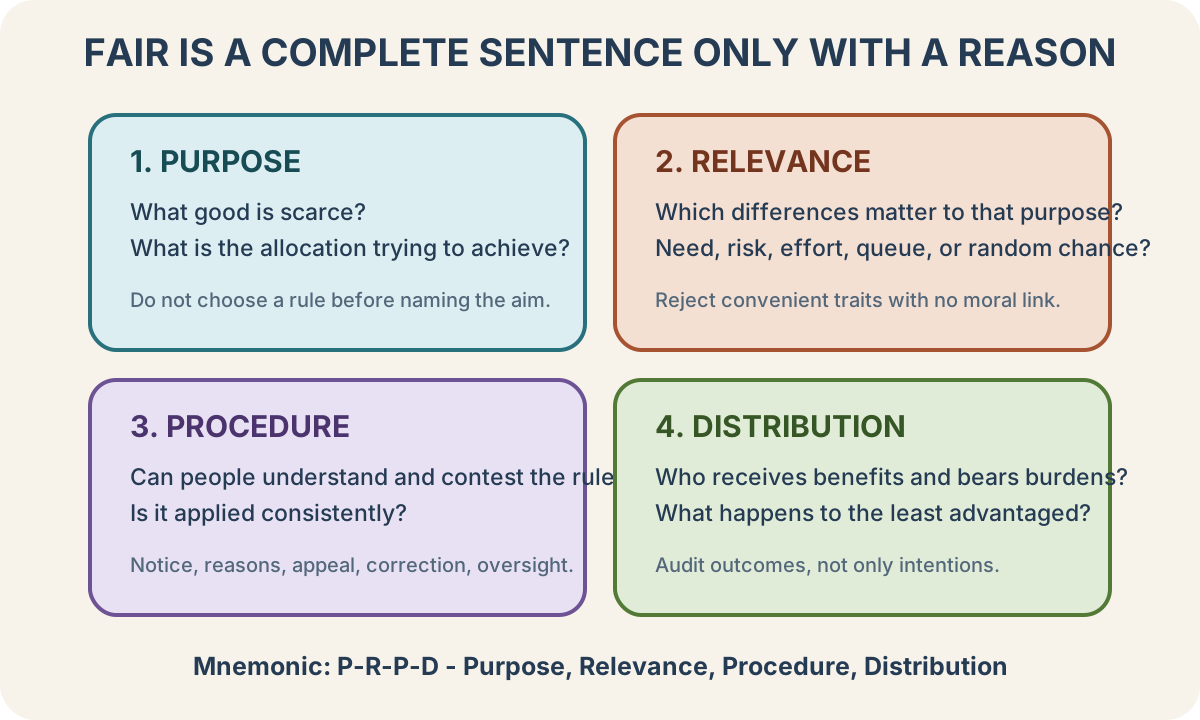
Use P-R-P-D: Purpose, Relevance, Procedure, Distribution.
1. Purpose
Name the good and the legitimate objective. “Allocate four generators” is incomplete. Are generators protecting life, preventing property loss, maintaining essential public services, or rewarding preparedness? Different purposes support different rules.
Separate the institution’s mission from convenient proxy goals. A school admissions process might legitimately seek students prepared to learn and a class able to fulfill an educational mission. It may not quietly substitute donor satisfaction merely because donations are useful. If purposes conflict, rank them openly.
2. Relevance
List differences among claimants and ask which are morally connected to the purpose. Common allocation principles include:
- equality: equal shares or equal chance;
- need or urgency: priority to those facing the greatest deficit or harm;
- benefit: priority where the resource is most likely to achieve its purpose;
- contribution or reciprocity: consideration of effort, service, or burdens previously borne;
- desert: response to conduct for which a person is appropriately responsible;
- queue: order of request when claims are otherwise comparable; and
- lottery: equal chance when relevant claims remain tied.
None is universally fair. Need can conflict with expected benefit. Rewarding contribution can disadvantage people unable to contribute. Lotteries prevent biased discretion but ignore morally relevant difference if used too early. Queues look neutral yet may reward flexible schedules, fast internet, insider knowledge, or proximity.
Write the rule in one sentence: “Priority goes to ___ because ___ advances the purpose of ___.” Then ask whether the distinguishing trait is a cause, a proxy, or merely correlated. “Lives nearby” may predict quick installation, but travel time itself - not neighborhood identity - is the relevant operational fact.
3. Procedure
Fair procedures usually require clear criteria, advance notice where possible, consistent application, reasons, records, an avenue for appeal or correction, and management of conflicts of interest. Procedure matters even when everyone cannot receive the desired result. It treats people as participants who can understand and contest power.
Do not overpromise. A ten-minute emergency decision cannot include a month-long comment period. It can still use two-person review, a written priority rule, a logged exception, and later audit. Urgency compresses procedure; it does not erase it.
4. Distribution
Audit who actually receives benefits and bears burdens. Use counts, severity, duration, and reversibility. Break results down by relevant groups, but do not assume every difference proves discrimination. Ask whether the pattern arises from need, the rule, unequal access to the process, historical burden, or noise.
The Belmont Report illustrates why distribution matters: justice in research concerns who bears research burdens and who receives potential benefits; it warns against selecting vulnerable groups merely because they are convenient or easily manipulated 2. The lesson generalizes: convenience is not a moral entitlement to someone else’s risk.
Impartiality without pretending identity is irrelevant
Rawls’s original position asks people to choose principles without knowing the personal characteristics and social position that might tempt them to tailor rules to themselves 3. Use it as a stress test:
Would I accept this allocation rule if I did not know whether I would be powerful or vulnerable, early or late, healthy or ill, connected or unknown?
This does not generate one automatic answer. People may disagree about risk, liberty, responsibility, or the priority of the least advantaged. Nor does impartiality require ignoring every identity. If a trait tracks a morally relevant vulnerability created by past or current institutions, refusing to see it can preserve rather than remove unfairness.
The Universal Declaration joins equal dignity and nondiscrimination with social, civic, and political rights 4. That combination is useful: justice is not only equal treatment at a counter; it also concerns the conditions under which people can participate as equals.
A worked case: four generators, seven sites
After a severe storm, a county has four portable generators and seven requests:
- a nursing facility with failed cooling and forty residents;
- a water pumping station serving 6,000 people;
- a grocery store holding perishable food;
- two apartment buildings, one with several electricity-dependent medical devices;
- an animal shelter; and
- the emergency operations office, which has battery backup for twelve more hours.
A defensible process starts with purpose: prevent severe and imminent harm while maintaining essential systems. It then asks for evidence: backup duration, temperature forecast, installation time, alternative power, people at risk, and whether loads can be split. “Number served” is not enough; one person facing imminent death can outweigh many minor inconveniences. “Most vulnerable” is not enough either without specifying the vulnerability and what the generator changes.
An initial rule might prioritize imminent life-safety need and essential infrastructure, then use duration and absence of alternatives. The county could assign generators to the nursing facility, pumping station, medically vulnerable apartment, and the site whose backup expires next. It should also pursue alternatives: relocate residents, share a unit if loads permit, obtain dry ice, or arrange neighboring mutual aid. Scarcity does not freeze the option set.
Record residual harm and a reassessment time. A fair decision at 10 a.m. can become unfair by 4 p.m. when facts change.
Counterarguments worth taking seriously
“Need always comes first.” Need is morally important but can be unlimited, difficult to compare, or unrelated to whether the resource helps. Include expected benefit and alternatives without blaming people for need.
“Equal treatment means the same rule for everyone.” Consistency matters, but accommodation can be required to give genuinely equal access. The relevant question is whether different treatment responds to a morally relevant difference.
“Experts should simply decide.” Expertise helps establish facts and feasibility; it does not grant private ownership of public values. Experts should explain criteria, disclose uncertainty, and make review possible.
Practice: build and attack an allocation rule
You have ten free seats in an eight-week job-training program and thirty eligible applicants. Design a rule. State the program’s purpose, choose relevant criteria, specify tie-breaking, make an appeal process, and identify data you refuse to use.
Then attack your rule from four positions: a caregiver with little schedule flexibility, a recent graduate, an older displaced worker, and the program administrator judged on completion rates. Revise once. Finish with a sentence naming the residual unfairness your rule cannot remove.
Pocket summary
Use P-R-P-D. Begin with purpose; justify relevant differences; design a contestable procedure; audit distribution. Fairness is not sameness, intuition, or a neutral-looking proxy. It is a reasoned relationship between the good, the rule, the people subject to it, and the pattern it creates.
Source trail
References
- 1David Miller. Justice. Stanford Encyclopedia of Philosophy. verifiedPeer-reviewed survey of distributive, corrective, procedural, and relational ideas of justice. Cited at: sections 1-2.
- 2National Commission for the Protection of Human Subjects of Biomedical and Behavioral Research. The Belmont Report. U.S. Department of Health and Human Services. 1979. verifiedOfficial text linking respect for persons, beneficence, and justice to consent, risk-benefit review, and subject selection. Cited at: part B.3 and part C.3.
- 3Fred D'Agostino, Gerald Gaus, John Thrasher. Original Position. Stanford Encyclopedia of Philosophy. verifiedExplanation of Rawls's impartial-choice device, the veil of ignorance, and major criticisms. Cited at: sections 2-3.
- 4Universal Declaration of Human Rights. United Nations. 1948. verifiedOfficial text of the declaration; useful as a public vocabulary of human dignity and rights, not as a complete ethical algorithm. Cited at: articles 1-2 and 21-27.
Check your understanding
- Why is “first come, first served” not automatically fair?
- Queues are illegal in public institutions.
- Arrival order may reflect unequal information, transportation, schedule flexibility, or internet access unrelated to the good’s purpose.
- Random selection is always morally superior.
- A queue never produces an efficient result.
- What does the veil-of-ignorance test contribute to an allocation debate?
- It predicts exactly which policy Rawls would endorse in every local case.
- It removes the need for empirical evidence.
- It asks whether a rule remains acceptable when you do not know which social position you will occupy.
- It proves that equal shares are always required.