Lesson 1 of 18 · Close Reading and Interpretation
Reading for Evidence, Not Just Information
Open alongside this lesson
Project resources
A Brief Guide to Writing the English Paper (opens in a new tab)
Keep this beside a passage when practicing the observation-to-claim sequence.
Close reading is a controlled way to turn attention into evidence. It is not reading slowly for its own sake, finding hidden symbols by instinct, or paraphrasing every sentence. The product is an interpretive claim: a debatable account of how specific choices in a work create meaning or pressure a reader.
The fundamental distinction is between what is there and what you think it does.
- Observation: “The paragraph contains five questions, none answered.”
- Interpretation: “The unanswered questions make certainty feel unavailable.”
- Claim: “By replacing explanations with unanswered questions at the moment of decision, the narrator turns apparent confidence into a performance the scene cannot sustain.”
The claim is not merely longer. It names a mechanism (“replacing explanations with questions”), locates it (“at the moment of decision”), and explains a consequence. A reader can return to the passage and challenge it.
The first pass: establish the literal floor
Read a short unit once without annotating: a poem, paragraph, scene, speech, or tightly framed image. Then write a literal account in no more than three sentences:
- Who or what is present?
- What changes during the unit?
- What remains unresolved?
This is not the final interpretation. It is a floor that prevents analysis from floating away from the work. If two careful readers cannot agree on the basic sequence, settle that disagreement before discussing symbolism.
On the second pass, mark features rather than themes. Useful categories are:
- diction: repeated, technical, archaic, blunt, or unexpectedly vague words;
- syntax: sentence length, interruption, subordination, fragments, lists;
- sound: rhythm, rhyme, consonance, pause, harshness, fluency;
- perspective: who can see or know what, and when;
- structure: opening and closing positions, turns, parallels, delayed information;
- absence: what the genre or situation leads you to expect but withholds.
Harvard’s writing guide describes close reading as inductive: begin with particulars such as repetitions, unexpected developments, or contradictions and let them generate a question rather than forcing a preselected theme onto the work 1.
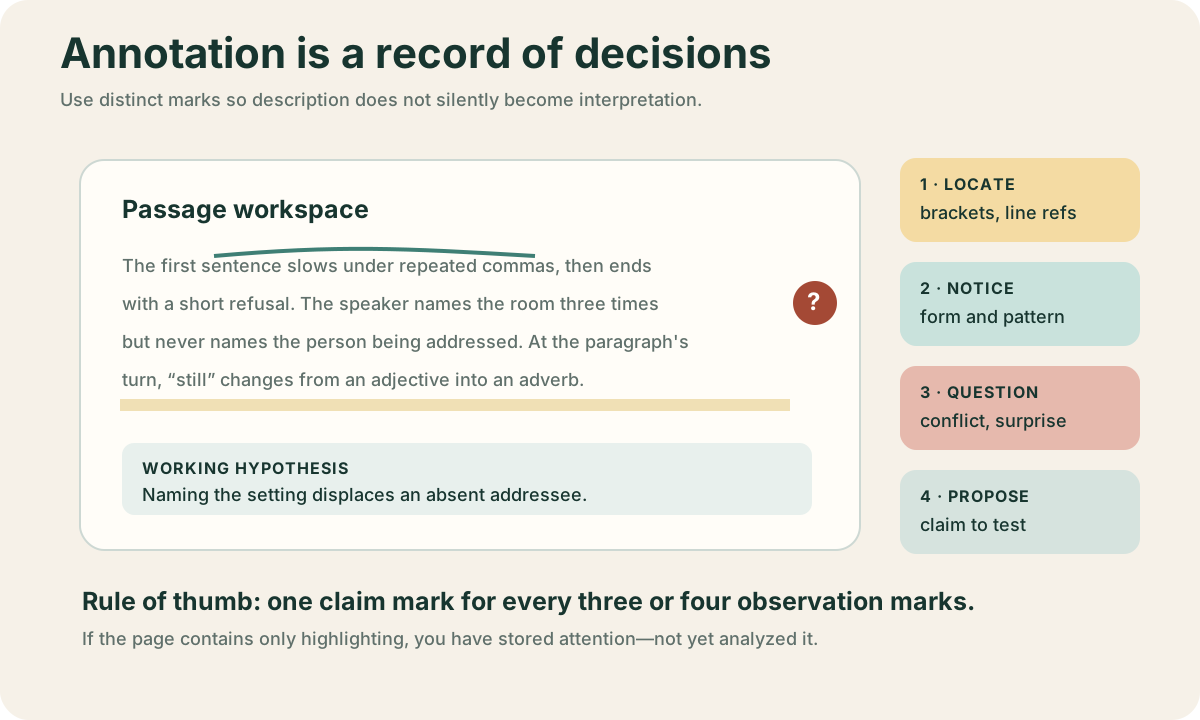
A compact annotation code
Use a small, consistent legend:
- underline = exact feature;
R= repetition or return;Δ= shift in speaker, time, scale, tone, or form;X= contradiction or exception;?= a real question, not “interesting”;H:= hypothesis to test.
The ratio matters. Aim for three or four descriptive marks for every hypothesis. Highlighting an entire page creates no hierarchy. A useful mark should let you later say, “This is the word, boundary, or relationship on which my inference depends.”
Climb the evidence ladder
Move through five rungs:
- Exact detail: quote or describe the smallest relevant feature.
- Pattern: connect it to a repetition, contrast, shift, cluster, or exception.
- Tension: state what becomes difficult to reconcile.
- Question: ask how or why the work produces that difficulty.
- Qualified claim: propose what the difficulty accomplishes and set its limits.
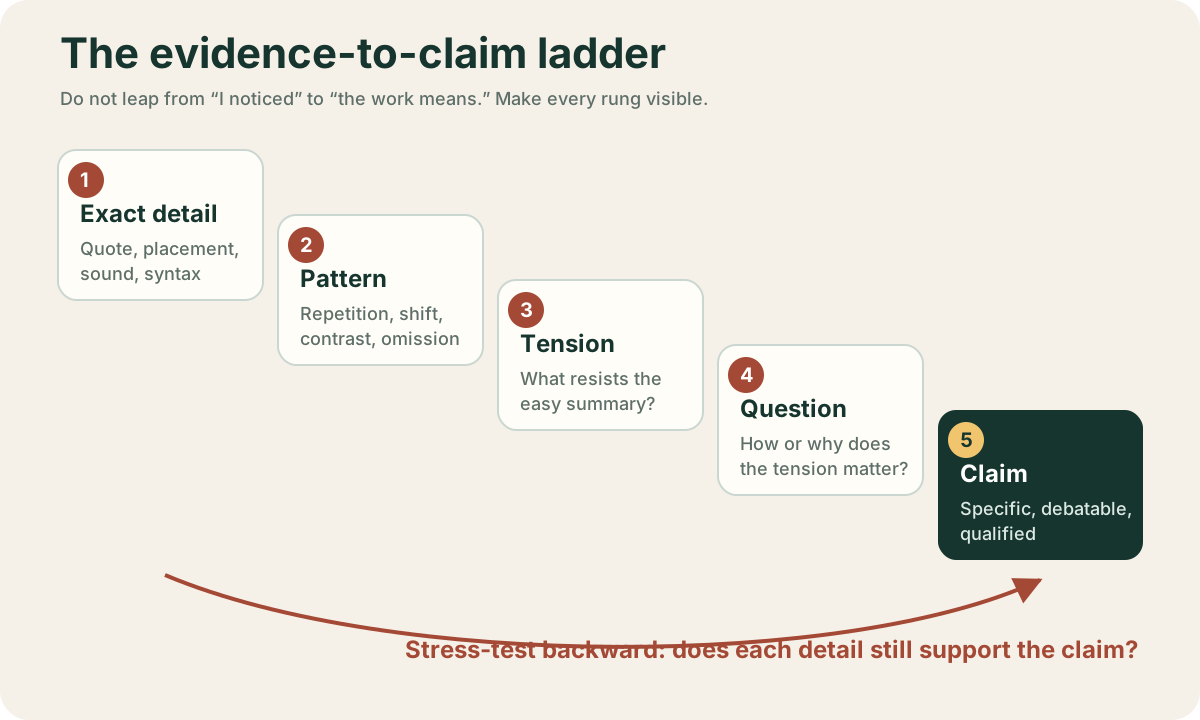
Suppose a story repeatedly calls a house “quiet,” but each use appears beside mechanical sounds: a clock, pipes, a refrigerator. A weak response says, “The house symbolizes loneliness.” The ladder produces something sharper:
- detail: the adjective “quiet” occurs four times;
- pattern: each occurrence is followed by an inanimate sound;
- tension: the narrator names quiet while the prose supplies noise;
- question: why insist on quiet when the house is acoustically active?
- claim: the story defines quiet not as absence of sound but as absence of human reply, converting ordinary appliances into measures of isolation.
The last sentence can be wrong. That is a virtue: it is precise enough to test.
Use three tests before keeping a claim
The exactness test: Can you point to at least two details, including one not used to invent the idea? If not, the claim may be an impression.
The difference test: Does the claim explain something that summary alone would miss? “The scene is about grief” names a topic. “The scene makes grief legible through failed routines rather than direct confession” identifies a formal strategy.
The resistance test: What detail does the claim explain poorly? Do not hide it. A counterexample may require you to narrow the claim from “always” to “during public scenes,” distinguish two speakers, or abandon the reading.
Practice: a twelve-minute close read
Choose 8–15 lines or one paragraph.
- Two minutes: write the literal floor without interpretation.
- Three minutes: circle repeated or related words; box a shift; mark one absence.
- Two minutes: write one pattern sentence using “while,” “but,” or “although.”
- Two minutes: turn that tension into a how-or-why question.
- Three minutes: draft a claim with this frame: “By , the passage , which makes ___.” Then name one detail that could disprove it.
Do not consult outside context yet. The point is not to ban history or biography; it is to learn what the work itself can make you ask before context begins answering for it.
Believing and doubting
Yale’s Poorvu Center recommends a useful two-position exercise: first read as a “believer” trying to make the author’s perspective coherent; then reread as a “doubter” locating weaknesses and objections 2. Adapt it to your own claim:
- Believer: list the three strongest pieces of support.
- Doubter: identify an alternative reading and the evidence it explains better.
- Judge: revise the original claim so it survives the best objection without becoming empty.
The goal is neither suspicion nor sympathy alone. It is accountable interpretation: every imaginative move leaves a visible trail back to the work.
Keep this rule
Quote less than you analyze. After every quotation, answer two questions: What exact feature matters? Why does that feature change the larger reading? If a quotation only repeats your sentence in more elegant language, it is decoration, not evidence.
Check your work
Take one paragraph of your notes and label each sentence O for observation, I for inference, or C for claim. If every sentence is I or C, return to the work. If every sentence is O, decide which relationship among the observations is consequential. Good close reading keeps all three in motion.
Source trail
References
- 1A Brief Guide to Writing the English Paper. Harvard College Writing Center. verifiedPractical account of close reading as an inductive movement from textual detail and pattern to an arguable claim. Cited at: A Brief Guide to Writing the English Paper.
- 2Active Learning. Yale Poorvu Center for Teaching and Learning. verifiedIncludes the believing-and-doubting close-reading exercise used here as a disciplined test of interpretations. Cited at: Active Learning.
Check your understanding
- Which note is an observation rather than an interpretation?
- The speaker is ashamed of leaving.
- The sentence repeats “door” three times and ends with a dash.
- The door symbolizes death.
- The author wants the reader to feel trapped.
- What is the best next move after noticing a repeated image?
- Declare its universal symbolic meaning.
- Search for a biography of the author before rereading.
- Track where it recurs, what changes around it, and any exceptions.
- Replace the observation with a plot summary.
- What makes a close-reading claim useful?
- It cannot be disputed.
- It connects exact details to a consequential interpretation and can be tested.
- It states the work’s topic in broad terms.
- It includes as many quotations as possible.