Lesson 4 of 18 · History and Primary Sources
Provenance, Context, and Purpose
Open alongside this lesson
Project resources
Teacher's Guides and Analysis Tool (opens in a new tab)
Use the format-specific prompts after completing the P-A-C-T-S source card in this lesson.
Document Analysis (opens in a new tab)
Select the worksheet matching the actual format—written document, photo, map, poster, artifact, or audiovisual source.
A primary source is not simply an old object or a firsthand statement. It is material produced within the time, activity, or relationship being investigated and used as evidence for a later question. The same item can be primary for one project and secondary for another. A 1998 museum label is secondary evidence about an ancient vessel, but primary evidence about museum interpretation in 1998.
Historical method begins by replacing “Is this source reliable?” with two better questions:
- What process produced and preserved this item?
- For what claim is it competent evidence?
A diary may be excellent evidence of what its writer chose to record and poor evidence of what an entire city believed. A census may systematically count categories while erasing people who did not fit them. A staged photograph may still reveal a sponsor’s desired public image.
Meet the source before reading through it
The National Archives teaches document analysis as a progression: meet the document, observe its parts, try to make sense of it, and use it as historical evidence 1. That ordering is crucial. Begin with the item as an artifact.
Record:
- physical or digital format;
- title, markings, seals, handwriting, file metadata, or accession number;
- apparent completeness and damage;
- original, copy, transcription, translation, crop, scan, or later edition;
- the repository and stable catalog record;
- who created the description you are reading.
Do not silently treat a modern transcript as the manuscript. A transcript makes words searchable but may normalize spelling, omit deletions, or decide how ambiguous marks should read. Cite the version actually used.
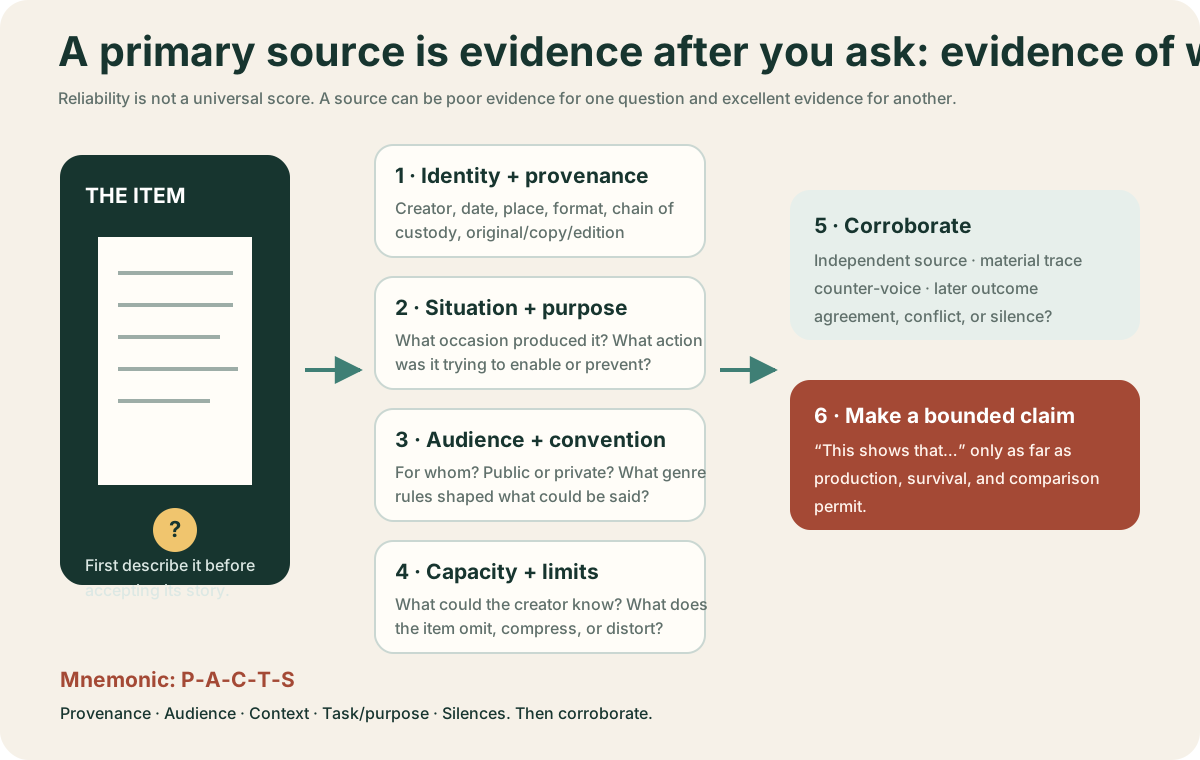
Build the P-A-C-T-S card
Use one page per source.
P — Provenance: creator, date, place, version, chain of custody, repository. What evidence supports the attribution?
A — Audience: intended, actual, overhearing, and later audiences. Was access private, public, restricted, ceremonial, or accidental?
C — Context: the specific event, institution, relationship, law, technology, or convention needed to understand production. Avoid an encyclopedia of the era.
T — Task or purpose: what was the source made to do—record, persuade, request, classify, commemorate, sell, threaten, entertain, justify, or coordinate?
S — Silences: what could the creator not know, not safely say, not fit into the form, or not need to explain to the intended audience?
The Library of Congress analysis tool uses a complementary cycle—observe, reflect, question, and investigate—and provides specialized guides for photographs, maps, newspapers, manuscripts, political cartoons, sheet music, and other formats 2. Use format-specific questions because media have different capacities. A photograph freezes one framed interval; a map classifies space; an account book records selected transactions; a speech text does not prove delivery or reception.
Purpose is not the same as truth value
“Biased” is usually the beginning of analysis, not the conclusion. Every source has a position. Ask what that position enables you to study.
Consider an official recruiting poster. It is designed to persuade, so it may be weak evidence that military life actually matched the image. It can be strong evidence of the traits a recruiting office chose to celebrate, the audience it targeted, and the visual vocabulary it believed persuasive. To infer that viewers agreed, you need reception evidence: letters, surveys, enlistment records, parodies, defacement, or competing posters.
Rewrite blanket judgments as capacities:
- Instead of “The memoir is unreliable,” write “The memoir was composed forty years later and is weak evidence for exact dialogue, but strong evidence for the public identity the author constructed in retirement.”
- Instead of “The newspaper is biased,” write “The editorial states the publisher’s position; circulation and reader letters are needed before inferring community consensus.”
Case: one famous photograph, several objects
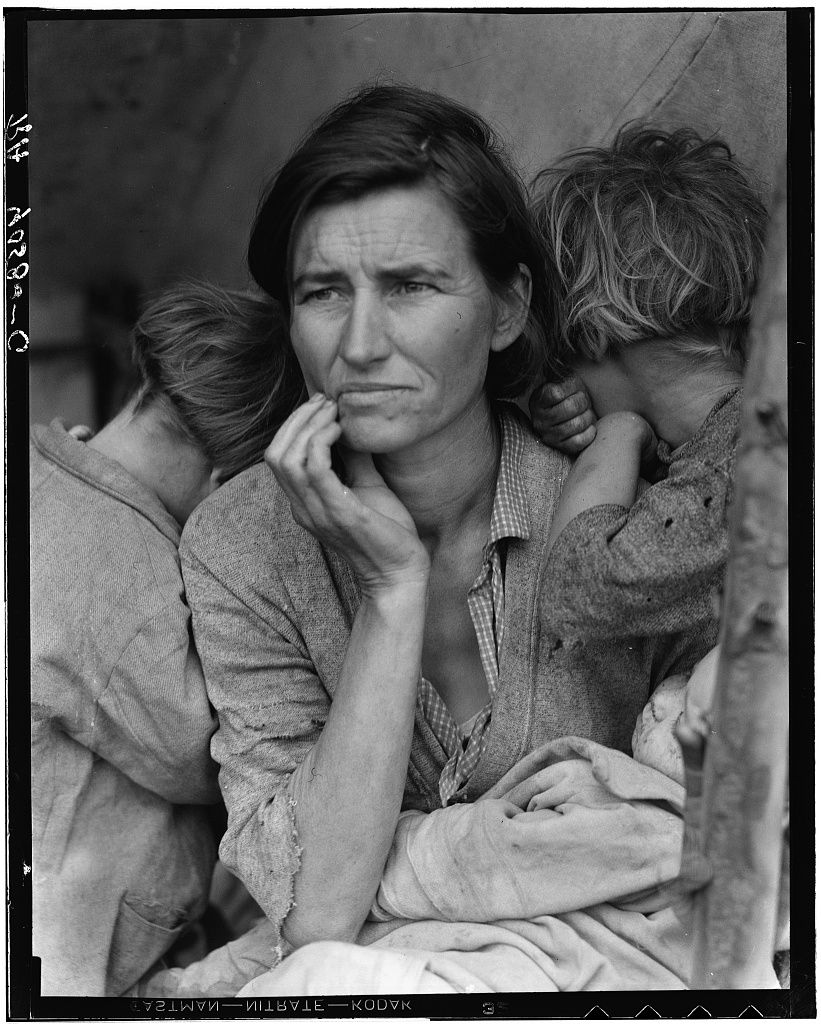
The catalog title is Destitute pea pickers in California. Mother of seven children. Age thirty-two. Nipomo, California; “Migrant mother” appears as another title 3. That difference already matters. One caption specifies poverty, agricultural labor, age, family size, and place; the shorter title makes the figure more archetypal.
The record identifies Dorothea Lange as photographer, dates the negative to March 1936, and describes Florence Thompson with three children. It also lists several digital files made from a negative and prints. Most importantly for provenance, the record notes that the negative was retouched in the 1930s to erase a thumb holding a tent pole at the lower right; an unretouched file print survives.
Therefore “the photograph” is not one transparent window. There was an encounter, a sequence of exposures, a selected negative, retouching, prints, captions, cataloging, digitization, and repeated publication. Those stages do not make the image false. They define the object you can responsibly analyze.
A bounded claim might be:
The selected image’s tight framing, averted children, and central adult face concentrate family precarity into a single maternal figure; its later short title and circulation help explain why the photograph could function as an icon beyond its original captioned report.
That claim concerns composition and circulation. It does not assume the photograph alone proves the typical experience of all migrant workers or fully reports Thompson’s perspective.
Separate production, content, and reception
For every source, make three boxes:
- Production: who made it, under what conditions, through which choices?
- Content/form: what does the surviving item say or arrange?
- Reception/use: who encountered, circulated, resisted, altered, or archived it?
Do not infer reception from production. An author can intend persuasion and fail. Do not infer production from reception. A later community can adopt an object for purposes its maker never imagined.
Practice: a source card and claim boundary
Select one digitized source from an institutional repository. Save its catalog URL, not only the image URL.
- Describe the item for sixty seconds without explaining it.
- Complete P-A-C-T-S, marking unknown fields rather than guessing.
- Write three claims the source can support: one about production, one about content/form, and one about possible historical conditions.
- Write one tempting claim it cannot establish alone.
- Name the next independent source needed to test that claim.
End with this formula:
Because this source was produced by ___ for ___ under , it is especially useful for studying . It cannot by itself establish ___ because ___.
That sentence turns source criticism into a usable research decision.
Source trail
References
- 1Document Analysis. U.S. National Archives and Records Administration. verifiedOfficial staged method for meeting a document, observing parts, making sense of it, and using it as historical evidence. Cited at: Document Analysis.
- 2Teacher's Guides and Analysis Tool. Library of Congress. verifiedOfficial Observe–Reflect–Question–Investigate framework and format-specific primary-source guides. Cited at: Teacher’s Guides and Analysis Tool.
- 3Dorothea Lange. Destitute Pea Pickers in California; Mother of Seven Children; Age Thirty-Two; Nipomo, California. Library of Congress Prints and Photographs Division. 1936. verifiedCatalog record for the photograph commonly called Migrant Mother; the Library lists no known restrictions and documents multiple versions and retouching history. Cited at: Library of Congress catalog record.
Further reading
- Sam Wineburg. Historical Thinking and Other Unnatural Acts. Temple University Press. 2001. verifiedFoundational account of sourcing, contextualization, and corroboration as learned historical practices.
Check your understanding
- What does provenance establish?
- Whether every statement in a source is true
- The source’s origin, custody, version, and route to the present
- The creator’s private psychology
- Whether the source agrees with a textbook
- A propaganda poster is biased. What follows?
- It is useless for every historical question.
- It is automatically accurate about public opinion.
- It may be strong evidence of an institution’s message and intended audience but weak evidence of audience belief.
- Its imagery should be ignored in favor of its words.
- Why identify a source’s genre?
- Genre conventions shape what a creator was expected or permitted to say and how.
- Every genre has one fixed meaning.
- Genre proves authorship.
- Only literary sources have genres.