Techniques and Applications of Integration
u-substitution and integration by parts, further techniques, area between curves, volumes of revolution, work and average value, and what to do when no antiderivative exists.
- 6 min
- 8 steps
- 3 questions
- Lesson 5 of 36
In this lesson
- u-Substitution: Reversing the Chain Rule
- Integration by Parts: Reversing the Product Rule
- Two Further Techniques
- Area Between Curves
- Volumes of Revolution
- Work and Average Value
- When Antiderivatives Run Out
Picking up where you left off.
The Fundamental Theorem of Calculus tells you that a definite integral can be evaluated by finding an antiderivative. The catch is that finding an antiderivative is rarely as simple as reversing a basic differentiation rule. This lesson develops the two most important techniques for actually computing integrals, surveys two more, and then turns to what integrals are for: measuring area, volume, work, and averages 1.
u-Substitution: Reversing the Chain Rule
The chain rule says \(\frac{d}{dx}F(g(x)) = F'(g(x))\,g'(x)\). Reading this backward gives a method for integrals that contain a function and (a multiple of) its own derivative. Set \(u = g(x)\), so that \(du = g'(x)\,dx\), and the integral collapses into something elementary.
Consider $$\int 2x\sqrt{x^2 + 1}\,dx.$$ Let \(u = x^2 + 1\). Then \(du = 2x\,dx\), which is exactly the \(2x\,dx\) already present. Substituting, $$\int \sqrt{u}\,du = \frac{2}{3}u^{3/2} + C = \frac{2}{3}(x^2 + 1)^{3/2} + C.$$ You can check the result by differentiating it: the chain rule returns the original integrand. For a definite integral, either convert the limits to \(u\)-values or rewrite the antiderivative in terms of \(x\) before evaluating. The skill is recognizing the inner function whose derivative is also present.
Quick check
du = 2x dx is sitting right there; the answer is sin(x²) + C.
Integration by Parts: Reversing the Product Rule
Where substitution undoes the chain rule, integration by parts undoes the product rule. From \(\frac{d}{dx}(uv) = u\,\frac{dv}{dx} + v\,\frac{du}{dx}\), integrating both sides and rearranging gives $$\int u\,dv = uv - \int v\,du.$$ The art is choosing \(u\) and \(dv\) so that the new integral \(\int v\,du\) is simpler than the original. A useful guideline is to let \(u\) be the factor that gets simpler when differentiated.
Consider $$\int x e^{x}\,dx.$$ Let \(u = x\) and \(dv = e^{x}\,dx\). Then \(du = dx\) and \(v = e^{x}\). Applying the formula, $$\int x e^{x}\,dx = x e^{x} - \int e^{x}\,dx = x e^{x} - e^{x} + C = e^{x}(x - 1) + C.$$ Differentiating \(e^{x}(x-1)\) returns \(x e^{x}\), confirming the answer. Parts is the standard tool for integrands that mix a polynomial with an exponential, logarithm, or trigonometric function 1.
Quick check
∫u dv = uv - ∫v du; choose u so that du is simpler.
Two Further Techniques
When an integrand is a ratio of polynomials, partial fractions decomposes it into a sum of simpler fractions, each of which integrates to a logarithm or arctangent. For instance, \(\frac{1}{x^2 - 1}\) splits into \(\frac{1/2}{x-1} - \frac{1/2}{x+1}\), and each piece integrates directly. When an integrand contains expressions like \(\sqrt{a^2 - x^2}\) or \(\sqrt{x^2 + a^2}\), trigonometric substitution replaces \(x\) with a sine, tangent, or secant so a Pythagorean identity clears the radical. These extend the same idea: transform the integral into a form you already know how to evaluate 1.
Area Between Curves
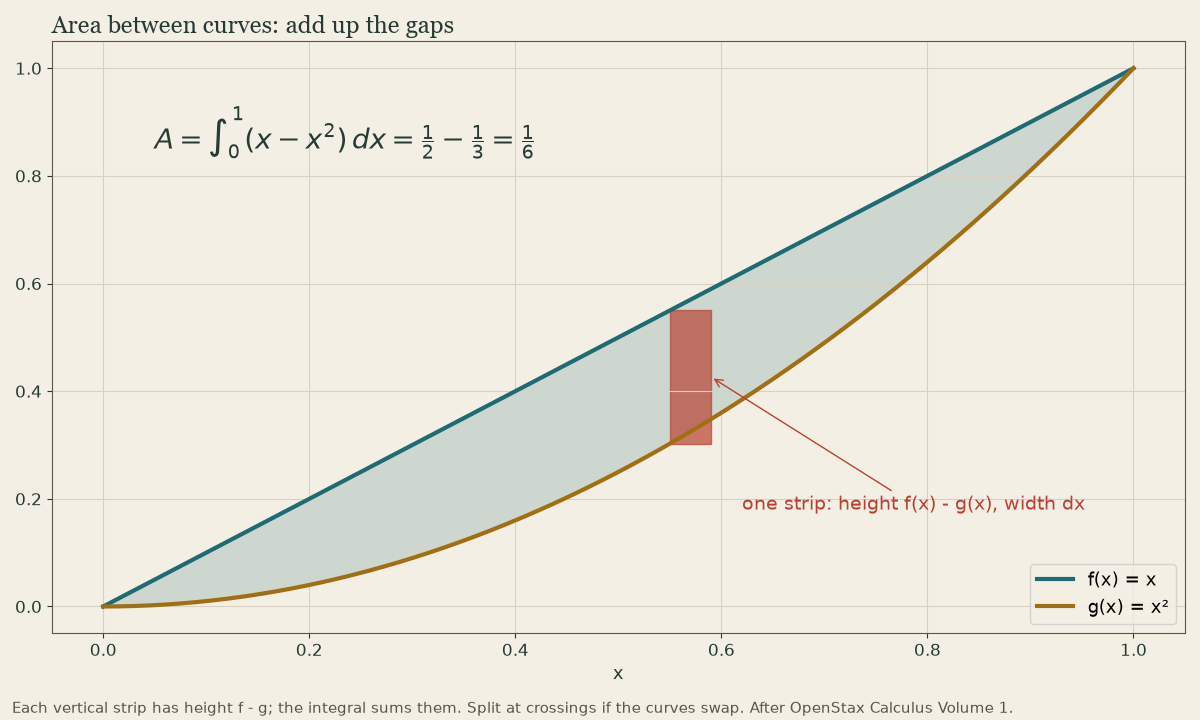
The most direct application of the definite integral is area. If \(f(x) \ge g(x)\) on \([a, b]\), the area of the region between the two curves is the integral of the gap between them: $$A = \int_a^b \big(f(x) - g(x)\big)\,dx.$$ Each thin vertical strip has height \(f(x) - g(x)\) and width \(dx\); the integral sums infinitely many such strips. When the curves cross, split the interval at the intersection points and integrate the positive difference on each piece.
Volumes of Revolution
Rotating a region about an axis sweeps out a solid whose volume an integral can capture. The disk method slices the solid perpendicular to the axis of rotation into thin circular disks. A disk at position \(x\) has radius \(R(x)\) and thickness \(dx\), so its volume is \(\pi R(x)^2\,dx\), and $$V = \int_a^b \pi\,R(x)^2\,dx.$$ The shell method instead slices the region into thin vertical strips parallel to the axis; each strip becomes a cylindrical shell of radius \(r\), height \(h\), and thickness \(dx\), contributing \(2\pi r h\,dx\). Whether disks or shells are easier depends on the geometry, but both rest on the same principle: build the solid from infinitesimal pieces and integrate 1.
Work and Average Value
Integration also answers physical questions. When a variable force \(F(x)\) acts along a straight path, the work done in moving an object from \(x = a\) to \(x = b\) is $$W = \int_a^b F(x)\,dx.$$ This generalizes the constant-force formula \(W = F\,d\): over each tiny displacement \(dx\), the force is nearly constant, and the integral accumulates the contributions. Compressing a spring with force \(F(x) = kx\), for example, requires work \(\int_0^d kx\,dx = \tfrac{1}{2}kd^2\).
A related quantity is the average value of a function over an interval, $$\bar{f} = \frac{1}{b - a}\int_a^b f(x)\,dx,$$ which divides the accumulated total by the length of the interval — the continuous analog of averaging a list of numbers. Engineers use it for quantities such as the mean value of a fluctuating signal or a varying load 1.
When Antiderivatives Run Out
These techniques are powerful, but many integrands have no antiderivative expressible in elementary functions — \(e^{-x^2}\) and \(\frac{\sin x}{x}\) are classic examples. In practice, a large share of integrals that arise in engineering are evaluated numerically, by approximating the area with sums of trapezoids or parabolic segments. A later course on computation develops those methods, which let you evaluate any well-behaved integral to whatever precision you need, even when no formula exists.
Quick check
Real data and messy functions are integrated numerically all the time.
Lesson complete
Nice work.
Sources for this lesson
- 1Calculus, Volumes 1–3. OpenStax (Rice University). verifiedOpen (CC BY-NC-SA) calculus text. Vol 1 functions/limits/derivatives/integrals; Vol 2 integration/series; Vol 3 multivariable and vector calculus. Cited at: Vol 1, Ch. 6 and Vol 2.