Stress, Strain & Safety Factor
Stress, strain, and margin: a worked tie-rod, predicting axial stretch, using the area that can actually fail, stress concentrations, buckling as a stability limit rather than a strength limit, and stating what a factor of safety is measured against.
- 5 min
- 7 steps
- 3 questions
- Lesson 34 of 36
In this lesson
- Worked tie-rod calculation
- Predict axial deformation
- Use the load-carrying area that can actually fail
- Concentrations and local stress
- Stability is not material strength
- State the margin convention
Picking up where you left off.
Stress converts internal force into intensity over an area; strain measures deformation relative to original size. For a uniform axial member,
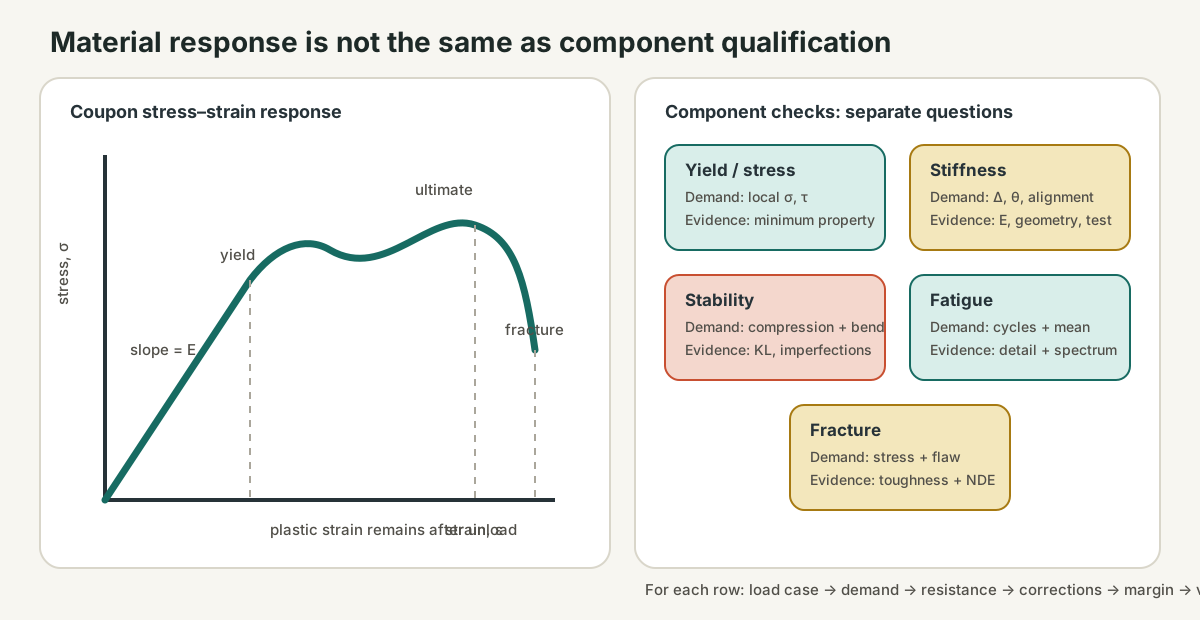
In the linear elastic range, \(\sigma=E\epsilon\), where \(E\) is Young’s modulus. MIT’s material courses emphasize that modulus, yield, plasticity, creep, and fracture describe different parts of a material’s response—not one ranking called “strength” 1.
MIT’s mechanics-of-materials notes connect external equilibrium to internal force, then to stress and deformation 2. Keep that chain visible: load case → reactions → internal resultants → local demand → resistance → margin.
Worked tie-rod calculation
A 10 mm diameter steel tie rod carries 12 kN in tension.
If \(E=200\) GPa, elastic strain is \(153/200{,}000=0.000765\). Over 400 mm, predicted elongation is 0.306 mm. If the material’s specified minimum yield strength is 350 MPa, a simple yield-based factor is \(350/153=2.29\).
That number is incomplete. Threads reduce area and concentrate stress; load may be eccentric; fatigue may govern; corrosion can remove section; temperature can change properties. A safety factor belongs to a named limit state and load case.
Quick check
Area = π(10)²/4 = 78.5 mm²; 12,000 N / 78.5 mm² ≈ 153 MPa.
Predict axial deformation
For a prismatic member under constant axial load,
For stepped members, sum \(N_iL_i/(A_iE_i)\) with signs. If load, area, or modulus varies continuously, integrate the local expression. Deformation matters in tie rods, preload stacks, press frames, and parallel load paths: a stiffer branch attracts more load.
The 10 mm tie rod above elongates 0.306 mm only if the 400 mm gauge length is uniform and the load enters concentrically. A threaded 40 mm segment with 58 mm² tensile-stress area adds about \(12{,}000(40)/(58\cdot200{,}000)=0.041\) mm. Connection compliance may add still more.
Use the load-carrying area that can actually fail
Gross area is not always the resistance area. A hole creates a smaller net section. Threads use a tensile-stress area rather than nominal shank area. Pins and plates may need
where \(n\) is the number of shear planes, \(t\) the loaded plate thickness, and \(d\) the pin diameter. Also screen edge tear-out, plate bending, pin bending, and contact deformation. Several modes can share one connection but use different areas and allowables.
Concentrations and local stress
Holes, grooves, sharp shoulders, keyways, and thread roots disturb nominal stress. A geometric stress-concentration factor \(K_t\) estimates peak elastic stress: \(\sigma_{max}=K_t\sigma_{nom}\). Do not apply a factor from memory to an unmatched geometry. Better design often comes from increasing fillet radius, smoothing load flow, moving holes away from high moment, or adding section locally instead of thickening everything.
Stability is not material strength
A slender compression member can buckle before it approaches yield. The ideal elastic Euler load is
where \(K\) represents end restraint. The square on effective length makes unsupported length and bracing powerful. Real crookedness, residual stress, connection flexibility, and inelasticity reduce the usefulness of the ideal value; use an applicable design standard or validated model for safety-critical columns.
State the margin convention
Organizations use “factor of safety” and “margin of safety” differently. Define yours. A common resistance-to-demand factor is \(n=R/D\); a common margin is \(MS=R/D-1\). If an allowable already includes code factors, do not unknowingly apply the same conservatism twice. Separate nominal values from characteristic, minimum, allowable, and factored values.
Write:
For load case LC-3, the predicted bracket-root stress is 82 MPa. Against a documented 205 MPa minimum yield strength, the nominal yield factor is 2.5 before the listed corrections for weld geometry, residual stress, and fatigue.
This exposes demand, resistance, failure mode, and exclusions. Resistance evidence should name material specification, condition or temper, direction, thickness range, temperature, lot certification when relevant, and whether the property is typical or guaranteed minimum. A polished catalog average is not interchangeable with a drawing-controlled minimum.
Practice
Build a table for one component with these columns: limit state, demand model, resistance evidence, uncertainty or correction, and verification method. Include yielding, excessive deflection, buckling, fatigue, wear, fastener slip, and loss of alignment even if several are later screened out.
For the tie rod, compare shank yield, threaded-section yield, connection bearing, fatigue at the first engaged thread, and total elongation. Record which claim comes from calculation, supplier data, inspection, or a planned load test. Safety does not come from multiplying one stress by one customary number; it comes from finding plausible ways the function can be lost.
Practice
Average normal stress is sigma equals axial force divided by load-carrying area.
Practice
The justified margin depends on how uncertain the demand and resistance are and what failure would mean.
Lesson complete
Nice work.
Sources for this lesson
- 1Mechanical Behavior of Materials. MIT OpenCourseWare. verifiedUndergraduate treatment of elastic and plastic deformation, creep, fracture, and the processing-structure-property relationship. Cited at: elasticity through fracture.
- 2Mechanics of Materials. MIT OpenCourseWare. verifiedOpen modules on stress, strain, trusses, torsion, bending, deflection, yielding, fracture, fatigue, and material properties. Cited at: stress, strain, and deformation.