Newton's Laws and Forces
Newton's three laws, the common forces (weight, normal, friction, tension), free-body diagrams, the inclined plane, and using friction coefficients to judge when a load starts to slide.
- 4 min
- 4 steps
- 3 questions
- Lesson 16 of 36
In this lesson
- The three laws
- Common forces
- Free-body diagrams
- When a load slides
Picking up where you left off.
The three laws
Kinematics described motion; dynamics explains it through forces. Newton’s three laws are the foundation 1:
- Law of inertia. An object at rest stays at rest, and one in motion continues at constant velocity, unless acted on by a net external force. Equilibrium means \(\vec F_{net} = 0\), not “no forces.”
- \(\vec F_{net} = m\vec a\). The net force equals mass times acceleration. This vector equation is the workhorse of mechanics: sum the forces, divide by mass, get the acceleration.
- Action–reaction. For every force there is an equal and opposite force on the other body: \(\vec F_{AB} = -\vec F_{BA}\). The two forces act on different objects, which is why they do not simply cancel.
Quick check
Cancellation only applies to forces on the same body.
Common forces
A handful of forces recur throughout engineering statics and dynamics 1:
- Weight, the gravitational pull, \(W = mg\), directed downward.
- Normal force \(N\), the push a surface exerts perpendicular to itself.
- Friction \(f\), resisting sliding along a surface, modeled as \(f \le \mu N\) (with \(f = \mu N\) at the point of slipping, where \(\mu\) is the coefficient of friction).
- Tension in ropes and cables, and applied/contact forces.
Free-body diagrams
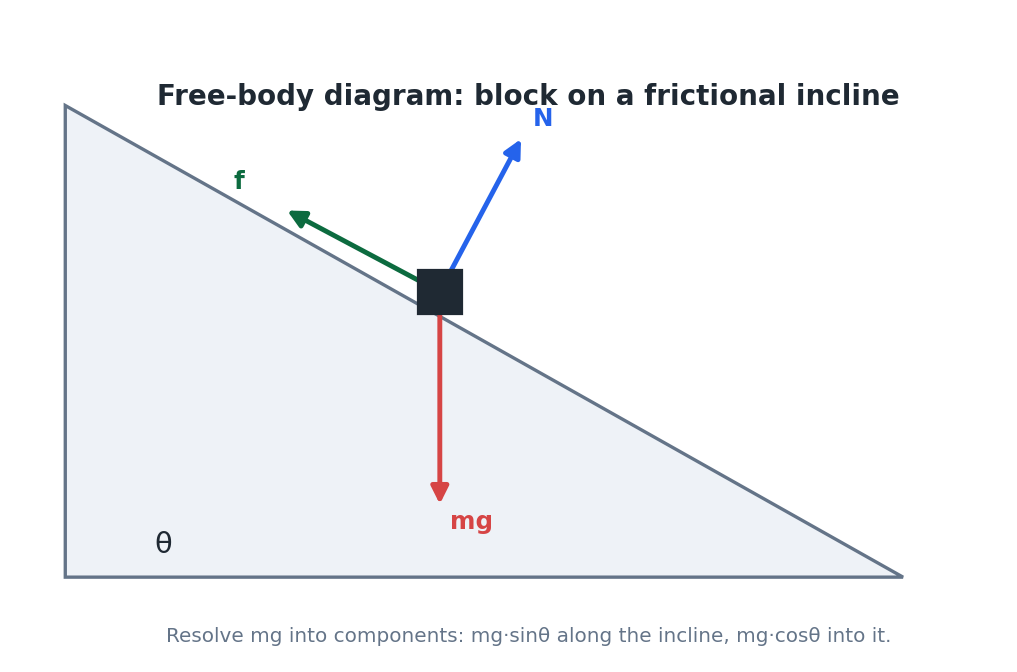
The single most important problem-solving habit is the free-body diagram: isolate one object, draw every force acting on it as an arrow, and nothing else. Then apply \(\vec F_{net} = m\vec a\) along convenient axes.
The inclined-plane case in the figure is the canonical example, and the trick is choosing axes along and perpendicular to the incline rather than horizontal and vertical. Resolving the weight into those axes gives a component \(mg\sin\theta\) directed down the slope and \(mg\cos\theta\) pressing into it 1. Perpendicular to the surface there is no acceleration, so the normal force balances the perpendicular weight component:
Along the surface, the net force sets the acceleration. If the block is in equilibrium, friction balances the downhill pull, \(f = mg\sin\theta\); if it slides, the net force is \(mg\sin\theta - \mu N\) and Newton’s second law gives the acceleration. This decomposition — pick smart axes, resolve forces, apply \(\vec F_{net} = m\vec a\) per axis — is exactly the method the Statics course builds on for structures in equilibrium.
Quick check
Static friction supplies only what is needed, up to μ_s N; N = mg cos θ on an incline.
When a load slides
Combine the incline analysis with static friction: a block stays put as long as the friction it needs, \(mg\sin\theta\), is no more than the most friction available, \(\mu_s N = \mu_s mg\cos\theta\). Mass cancels, so the block starts to slide when
Typical coefficients 1:
| Surfaces | static \(\mu_s\) | kinetic \(\mu_k\) |
|---|---|---|
| wood on wood | 0.5 | 0.3 |
| rubber on dry concrete | 1.0 | 0.7 |
| waxed wood on wet snow | 0.14 | 0.1 |
| steel on steel, oiled | 0.05 | 0.03 |
So a dry board resting on a wooden ramp starts to slide at about \(\tan^{-1}0.5 \approx 27^\circ\), and because \(\mu_k < \mu_s\), once moving it keeps going down to about \(17^\circ\). A 50 kg load on a toboggan over wet snow takes about \(0.14 \times 50 \times 9.8 \approx 69\) N to start and 49 N to keep moving.
These numbers are rough, since real friction depends on moisture, finish, and contact pressure, so build in margin: chock or strap loads on trailers and ramps rather than trusting friction.
Quick check
tan θ = μ_s, so θ = arctan 0.5 ≈ 26.6°.
Lesson complete
Nice work.
Sources for this lesson
- 1University Physics, Volumes 1–3. OpenStax (Rice University). verifiedOpen calculus-based physics. Vol 1 mechanics; Vol 2 thermodynamics and electricity & magnetism; Vol 3 optics & modern physics. Cited at: Vol 1, Ch. 5; Vol 1, Ch. 5–6; Vol 1, Ch. 6.