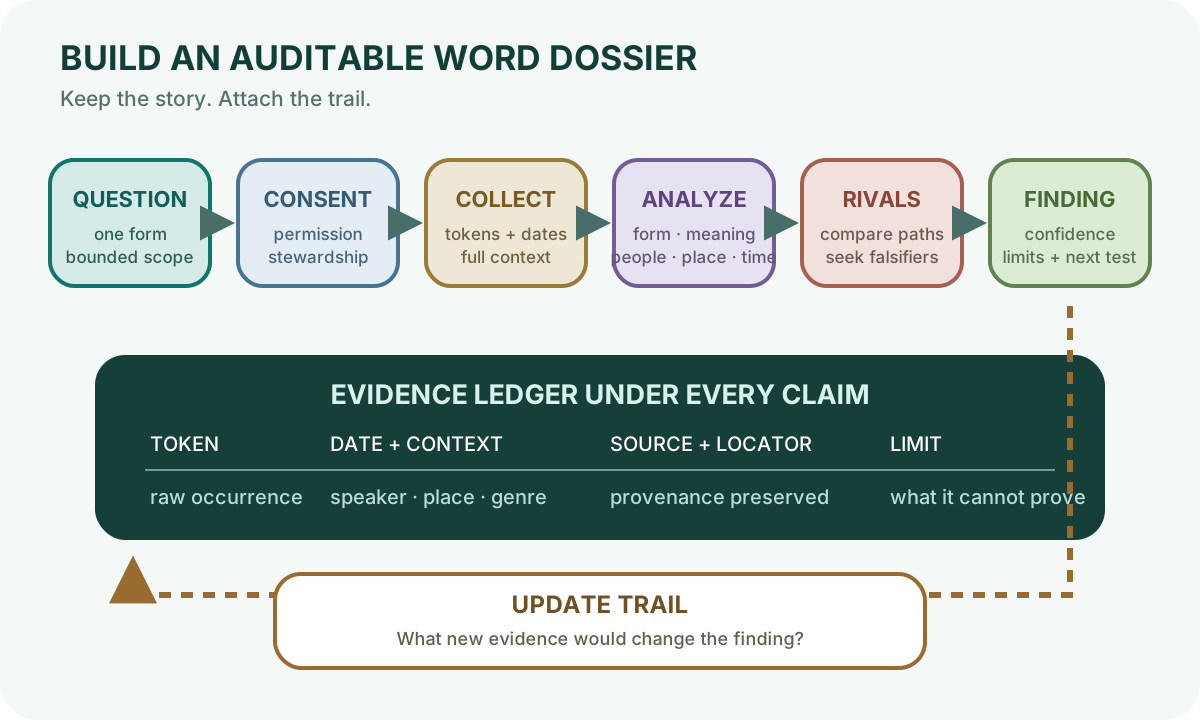
Capstone: Build a Word Dossier
The capstone: a bounded question about one word, interviewing speakers, collecting dated evidence from dictionaries and corpora, a token ledger, analysis of form, meaning, use, distribution, and history, one original visual, a calibrated finding, and a rubric.
- 9 min
- 13 steps
- 3 questions
- Lesson 25 of 36
In this lesson
- Choose a bounded question
- The Word Cabinet
- Deliverables
- Method: SCOPE the evidence
- Step 1: open with lived language
- Step 2: collect dated evidence
- Step 3: build the ledger
- Step 4: analyze five dimensions
- Step 5: make one original visual
- Step 6: write a calibrated finding
- Scoring rubric
- Course rule to keep
Open alongside this lesson
-
Language Research Resources (opens in a new tab)
Choose tools suited to pronunciation, regional distribution, historical use, slang, names, or word origins.
-
DARE Survey Results (opens in a new tab)
Compare a local memory with documented survey responses and record the limits of the sample.
-
American English Dialect Recordings from the Center for Applied Linguistics (opens in a new tab)
Listen with collection metadata open; a recording documents one speaker in one interview, not an entire place.
-
Smithsonian Folklife and Oral History Interviewing Guide (opens in a new tab)
Use for consent, open questions, recording choices, and responsible stewardship.
Picking up where you left off.
The capstone turns a language curiosity into a word dossier: a compact, cited account that another reader can audit, challenge, and extend. Your subject can be a word, pronunciation, phrase, grammatical construction, name, or punctuation habit. The best choice is close enough to gather firsthand evidence and puzzling enough to require more than a dictionary lookup.
A Way with Words begins with a caller’s lived question and then moves outward through memory, records, dictionaries, dialect evidence, and informed uncertainty. The show describes language as a route into culture, history, and family rather than a contest for the strangest word 1. Your dossier uses that same doorway while making every research seam visible.
Choose a bounded question
Good dossier questions include:
- Who in my family says warsh, in which situations, and how has that pattern changed?
- Where is devil strip documented for the grass between sidewalk and street?
- Does come with occur in Wisconsin English, and what contact explanations have evidence?
- When did a newer sense of preppy become visible in my sample?
- Is “from the gecko” an eggcorn, a joke, or both for the speakers who use it?
“The history of slang” is too large. Rewrite it as one form + one community or period + one researchable uncertainty.
Avoid identifying an anonymous writer, diagnosing a person, or making legal conclusions from language. A Way with Words describes forensic linguistics as potentially useful but not a foolproof “silver bullet”; in this capstone, treat any attribution hunch as a question for a qualified specialist, not a conclusion 2.
The Word Cabinet
- token: one occurrence of the item;
- type: the recurring form or category those tokens instantiate;
- metadata: date, speaker, place, audience, genre, and collection details that make a token interpretable;
- provenance: where evidence came from and how it was preserved;
- corpus: a deliberately assembled, searchable body of language data;
- elicitation: a prompt designed to obtain language data;
- negative evidence: a meaningful absence, interpretable only relative to search coverage;
- dossier: an organized claim-and-evidence record with uncertainty and update history.
Deliverables
Produce seven pieces:
- a one-sentence research question and scope;
- a 150-word listener-style opening that explains why the item matters;
- an evidence ledger with at least twelve tokens;
- one map, timeline, form diagram, or distribution chart made from your data;
- an analysis of form, meaning, people, place, and change;
- a finding with explicit confidence and at least one rival explanation; and
- a source list plus an update note describing what to investigate next.
Audio is optional. A carefully documented written memory can be valuable. If you record anyone, obtain consent before recording and agree on whether their name, voice, and exact words may appear.
Method: SCOPE the evidence
S — Set one question. Define the form, population, time, and uncertainty. State what would count against your first hunch.
C — Capture provenance. Save full context and metadata. For web evidence, keep the URL, access date, creator, and screenshot or archive information. For a conversation, record the interview conditions and permission.
O — Organize independent streams. Combine lived testimony, edited dictionaries, dialect surveys, archival records, corpora, and scholarship when appropriate. Trace repeated claims back to their shared source.
P — Pit explanations against rivals. Test contact, inheritance, word formation, sound reinterpretation, stylistic performance, and coincidence. Do not turn a broad migration history into proof of one word’s origin.
E — Express confidence and ethics. Label observation, inference, speculation, and unknown. Remove details a contributor did not authorize and preserve a route for correction.
Mnemonic: scope first; story second.
Step 1: open with lived language
Interview one or two willing people who know the item. The Smithsonian guide recommends preparation, informed participation, open questions, active listening, and clear plans for recordings and access 3. Ask:
- “What do you call the strip of grass there?” not “Do you call it a devil strip?”
- “Who said that when you were growing up?”
- “Can you remember a sentence or situation?”
- “Would you use it with a stranger, at work, or in writing?”
- “Has anyone reacted to the way you say it?”
Avoid correcting or testing the speaker. Follow their categories first. A remembered date should be recorded as approximate testimony, not converted into a precise first use.
The Linguistic Society of America’s ethics resources emphasize responsibilities to participants and communities, not merely extraction of interesting data 4. For a personal project, the practical rule is: permission is specific, revisable, and never implied by kinship.
Step 2: collect dated evidence
Use a layered search.
Edited references. Start with dictionaries and specialist works. The A Way with Words resources page points to tools for regional English, slang, etymology, names, and large text collections 5. Record the exact entry and what it claims.
Dialect evidence. Search DARE results and inspect the original question, places, informants, and response counts. The DARE questionnaire shows how fieldworkers elicited vocabulary by topic rather than simply asking whether a rumored regional word existed 6. A survey distribution is evidence about its sampled time and speakers, not a permanent border.
Archives and corpora. Search spelling variants, singular/plural forms, and phrases around the item. The A Way with Words segment introduces Google Books as a large source of dated print evidence 7. Google’s own Ngram documentation shows why corpus version, OCR, metadata, tokenization, search behavior, and automated tags still matter 8. Read the scanned page, title page, and publication metadata before treating a result as an attestation.
Audio collections. The Library of Congress dialect recordings span 1941–1984, with most recorded from 1968–1982 9. Treat each recording as a contextualized primary source. Listen beyond the target word so style and interview setting remain visible.
Step 3: build the ledger
Use one row per token:
| ID | Date | Exact form and context | Speaker/place/genre | Source + locator | Analysis | Confidence/limit |
|---|---|---|---|---|---|---|
Never cite a search-result snippet as the evidence. Open the item. If five pages repeat one definition without sources, collapse them into one “circulating claim” row. The Double-Tongued Dictionary project, discussed by A Way with Words, models why dated citations matter when documenting under-recorded vocabulary 10.
Assign codes only after preserving raw context. Possible codes include sense A/B, pronunciation variant, age band, region, formal/informal setting, or stance. Define each code so you could apply it again next week.
Step 4: analyze five dimensions
Form: spelling, pronunciation, word parts, syntax, and variants.
Meaning: dictionary sense, contextual sense, connotation, and social action.
People: who uses it, who recognizes it, and whose evidence is missing.
Place: documented clusters, mobility, contact, and the difference between “found here” and “unique here.”
Change: earliest located evidence, later distributions, coexisting uses, and plausible bridge contexts.
For a miniature model, use devil strip. A Way with Words discusses it as a regional label for the verge between sidewalk and street 11. A weak dossier says, “Ohioans call it that.” A stronger one asks which Ohio communities, what other labels coexist, which dates and surveys document it, and whether speakers recognize without producing it.
Step 5: make one original visual
Choose the visual your claim needs:
- map: place-coded tokens, with sample sizes and an “unobserved” category;
- timeline: dated senses or forms, with oral memories visibly distinct from print;
- morphology tree: roots, affixes, blend inputs, or reduplicative template;
- sound-boundary diagram: heard stream versus competing segmentations;
- evidence ladder: support for and gaps in an origin claim.
Do not decorate uncertainty away. Sparse regions should look sparse. A blank county means “no evidence collected here,” not “people there never say it.”
Step 6: write a calibrated finding
Use this template:
Finding: In [bounded sample], [pattern]. Confidence: [level], because [strongest independent evidence]. Limits: [coverage and method]. Rival: [best alternative]. Next evidence: [observation that would discriminate].
Example:
In three Stoughton family interviews and selected DARE materials, the term is locally recognizable but not produced by every speaker. Confidence is moderate for local attestation and low for exclusivity. A migration-based explanation remains plausible but is not established. Interviews with two age cohorts using the same open prompt would test apparent decline.
Scoring rubric
Score each 0–3:
- Question: bounded form, community/time, and uncertainty.
- Provenance: context, dates, locators, permissions, and preservation.
- Evidence: at least two genuinely independent kinds, with coverage limits.
- Analysis: form, meaning, social distribution, place, and change distinguished.
- Alternatives: strongest rival represented and tested.
- Calibration: claim strength matches the evidence; unknowns remain visible.
- Visual: explanatory, legible, accessible, and honest about missing data.
- Care: contributors retain dignity, context, and control appropriate to the project.
A dossier cannot earn “complete” with a score below 2 in provenance, calibration, or care, no matter how delightful the word.
Course rule to keep
Language lore becomes linguistics when the evidence trail stays attached. Keep the family story, the odd phrase, the regional pride, and the surprise. Then add dates, contexts, alternatives, uncertainty, and consent so the story can be learned from instead of merely repeated.
Practice
Oral testimony and print attestation answer related but different questions; preserving provenance makes both useful without overstating either.
Practice
Pages that all repeat one unsourced story are one stream. Independence depends on underlying evidence, not the number of URLs.
Practice
It states the evidence, bounds the population, and separates a supported distribution claim from an unresolved origin hypothesis.
Lesson complete
Nice work.
Sources for this lesson
- 1About A Way with Words. A Way with Words. verifiedOfficial background on the public-radio program, its hosts, nonprofit producer, and culture-and-language mission. Cited at: About.
- 2Forensic Linguistics. A Way with Words. verifiedSegment introducing language evidence in investigations and the need for cautious, bounded claims. Cited at: segment and show notes.
- 3Smithsonian Folklife and Oral History Interviewing Guide. Smithsonian Center for Folklife and Cultural Heritage. verifiedPractical guide to preparation, consent, open questions, recording, documentation, and stewardship in community interviews. Cited at: Interviewing Guide.
- 4Ethics. Linguistic Society of America. verifiedProfessional ethics resources for linguists, including responsibilities to research participants and language communities. Cited at: Ethics resources.
- 5Language Research Resources. A Way with Words. verifiedCurated dictionaries, corpora, dialect projects, and usage references for investigating listener questions. Cited at: Language Research Resources.
- 6The DARE Questionnaire, 1965–1970. Dictionary of American Regional English, University of Wisconsin–Madison. verifiedThe original topical questionnaire used to elicit regional vocabulary from thousands of informants. Cited at: Questionnaire.
- 7The Google Books Corpus. A Way with Words. verifiedSegment introducing the Google Books corpus as a tool for finding and comparing dated language evidence. Cited at: segment and show notes.
- 8Google Books Ngram Viewer — Information and Usage Guide. Google Books. verifiedOfficial corpus documentation covering scope, OCR and metadata revisions, tokenization, search behavior, smoothing, and known analytical limits. Cited at: corpora, release notes, and FAQs.
- 9American English Dialect Recordings from the Center for Applied Linguistics. Library of Congress. verifiedPublic collection of U.S. dialect recordings spanning 1941–1984, with the bulk recorded from 1968–1982 and collection metadata for speakers and interviews. Cited at: About this collection.
- 10The Double-Tongued Dictionary. A Way with Words. verifiedSegment on documenting new and under-recorded words through dated citations. Cited at: segment and show notes.
- 11Devil Strip. A Way with Words. verifiedSegment on a regional term for the ground between sidewalk and street, useful as a model dossier subject. Cited at: segment and show notes.
Further reading
- DARE Survey Results. Dictionary of American Regional English, University of Wisconsin–Madison. verifiedSearchable results from the original DARE fieldwork and later surveys.