Speaking Around the Taboo: Euphemism, Dysphemism, and Context
Euphemism and dysphemism: one referent framed many ways, strategies like circumlocution and borrowing, 'number one' and 'number two,' the euphemism treadmill and what slows it, why directness isn't the same as respect, and three framings of one event.
- 5 min
- 9 steps
- 3 questions
- Lesson 34 of 36
In this lesson
- One referent, several framings
- Why euphemisms form
- Number one, number two, and the origin trap
- The euphemism cycle—with brakes
- Directness is not the same as respect
- The SHIELD diagnostic
- Practice lab: three framings, one event
- Rule of thumb
Open alongside this lesson
-
Number One and Number Two for Pee and Poo (opens in a new tab)
Use the familiar euphemisms to separate present function from a much less certain origin story.
-
Euphemisms and Dysphemisms (opens in a new tab)
Follow the connections among taboo, politeness, style, identity, context, and historical change.
-
Politeness Theory and Relational Work (opens in a new tab)
Avoid assuming that indirect language is always polite or that direct language is always rude.
Picking up where you left off.
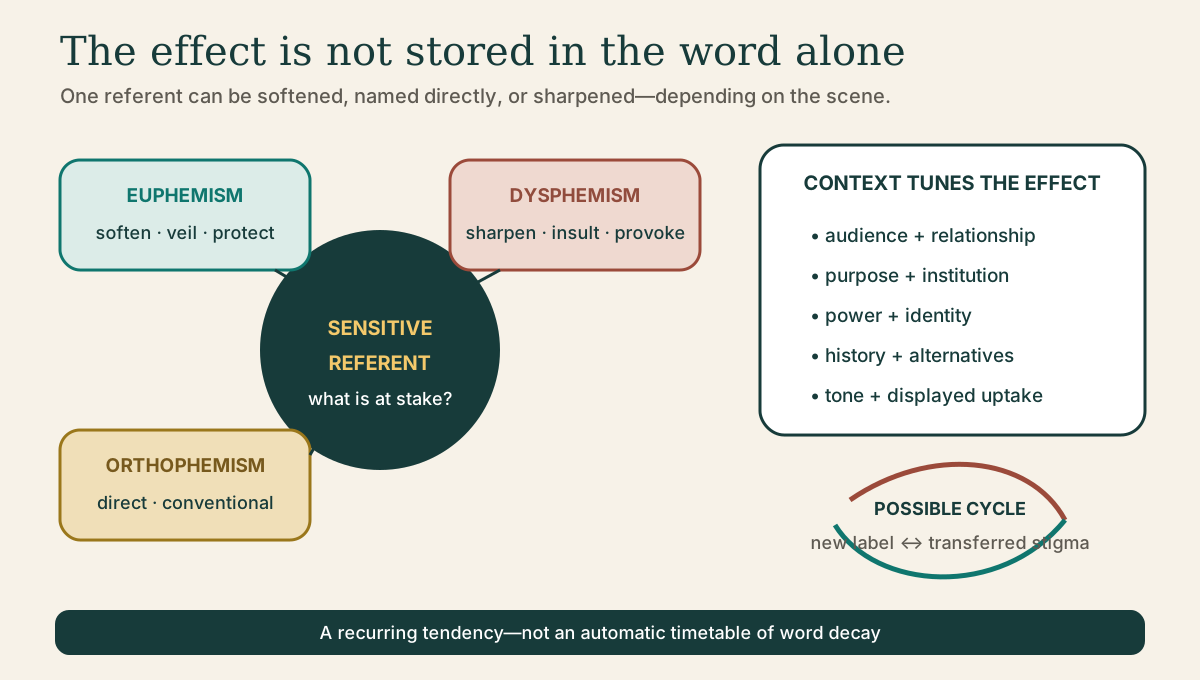
Speakers rarely face a choice between saying a thing and saying nothing. They choose among ways of framing it: clinical, direct, gentle, humorous, bureaucratic, intimate, insulting, evasive, or reclaimed.
Euphemism is language used to avoid or soften a disfavored expression or sensitive referent. Dysphemism makes a referent harsher, more contemptuous, or more provocative. Orthophemism is a relatively direct or neutral expression. These are not permanent stickers on words. Context can move one form among the categories.
One referent, several framings
Imagine a death notification:
- died may be direct and compassionate;
- passed away may be gently euphemistic;
- expired may be clinical, bureaucratic, comic, or dehumanizing depending on speaker and setting;
- a crude expression may be affectionate dark humor inside one group and cruel in another.
No dictionary can decide the effect without relationship, activity, tone, history, and uptake. Burridge’s research overview places euphemism and dysphemism across taboo, politeness, style, identity, anthropology, and historical change 1.
Why euphemisms form
Common strategies include:
- circumlocution: passed away for died;
- technical vocabulary: a clinical term where everyday wording feels exposed;
- abbreviation: initials that reduce the salience of a taboo phrase;
- metaphor: let go for dismissed from employment;
- understatement: not doing well for a serious condition;
- generalization: use the restroom for a more specific bodily action;
- borrowing: a foreign or learned term whose emotional charge differs;
- phonological alteration: a minced oath that echoes a taboo form without fully saying it.
The same strategy can serve care or concealment. Collateral damage may reduce emotional impact in official discourse; that reduction can be experienced as necessary precision, strategic distancing, or moral evasion. Analyze who benefits from the softened frame.
Number one, number two, and the origin trap
A Way with Words discusses number one and number two as polite references to urination and defecation 2. Their present function is easy to observe: the numerical code avoids direct vocabulary in situations such as childcare.
The exact origin is harder. Proposed links to school routines, order, or earlier labels may be plausible without being proven. Separate:
- synchronic claim: speakers now use these expressions euphemistically;
- historical claim: the expressions began in a particular institution at a particular date.
The first can be supported by current examples. The second needs dated evidence and competing hypotheses. A vivid origin is not a citation.
The euphemism cycle—with brakes
A replacement can acquire the stigma attached to its referent. Once it does, speakers may seek another label. This recurring tendency is often called the euphemism cycle or euphemism treadmill.
But the metaphor can overpromise. Words do not sour on a fixed schedule. Outcomes depend on:
- whether the underlying group or condition remains stigmatized;
- who chooses and controls the replacement;
- institutional adoption and resistance;
- whether a community reclaims a term;
- differences among technical, legal, self-chosen, and outsider labels;
- context—an older term may remain neutral in historical quotation but harmful as present address.
Replacing vocabulary without changing treatment can transfer stigma. Changing material conditions and social attitudes can alter a word’s trajectory. The treadmill is a hypothesis about recurring semantic contamination, not a reason to ignore people’s current naming preferences.
Directness is not the same as respect
Traditional politeness models explain why speakers mitigate face-threatening acts 3. Later relational-work approaches emphasize that appropriateness is negotiated and contested 4.
That distinction matters:
- A physician’s direct cancer may be clearer and kinder than a vague something concerning.
- A family’s euphemism may create a safe way to discuss grief.
- Bureaucratic softening may obscure responsibility.
- A blunt in-group term may signal solidarity that an outsider cannot assume.
Ask not “Is this word polite?” but “What relational work does this choice attempt here, and how is it received?”
The SHIELD diagnostic
- S — Sensitive referent: what topic, group, action, or body is being managed?
- H — History: what earlier meanings and social uses travel with the form?
- I — Interlocutors: who speaks, who is addressed, and who is discussed?
- E — Effect: softening, distancing, concealing, insulting, affiliating, reclaiming?
- L — Local alternatives: what other expressions are available in this setting?
- D — Displayed uptake: acceptance, correction, discomfort, laughter, or repair?
Practice lab: three framings, one event
Choose a non-personal public notice about layoffs, illness, death, sanitation, or conflict.
- Identify the sensitive referent.
- Mark euphemistic, orthophemistic, and dysphemistic alternatives without using slurs.
- Compare what each foregrounds or hides.
- Identify the institution and audience.
- Search dated evidence before repeating any origin claim.
- Write a clearer version that preserves necessary care without concealing agency.
Do not treat vulnerable people as vocabulary specimens. Follow current self-identification where relevant, quote harmful historical language only when necessary, and explain why it appears.
Rule of thumb
A euphemism is a social action, not a longer synonym. Identify the referent, relationship, purpose, history, and uptake—and change conditions, not only labels, when stigma is the real problem.
Practice
Euphemism is a context-sensitive relationship among expression, referent, participants, and purpose.
Practice
The treadmill is a useful tendency, not an automatic schedule or explanation for every contested label.
Practice
Present use can be clear even when a precise origin story remains uncertain.
Lesson complete
Nice work.
Sources for this lesson
- 1Kate Burridge. Euphemisms and Dysphemisms. Oxford Bibliographies in Linguistics. 2017. verifiedScholarly map of taboo avoidance, euphemism, dysphemism, politeness, style, and the importance of context. Cited at: scholarly map.
- 2Number One and Number Two for Pee and Poo. A Way with Words. 2020. verifiedTranscript hook for euphemistic substitution and the uncertainty that often surrounds tidy origin stories. Cited at: transcript.
- 3Penelope Brown, Stephen C. Levinson. Politeness: Some Universals in Language Usage. Cambridge University Press. 1987. verifiedInfluential face-based account of politeness strategies; best taught with later critiques of universality and context-free prediction. Cited at: influential account.
- 4Miriam A. Locher, Richard J. Watts. Politeness Theory and Relational Work. Journal of Politeness Research / De Gruyter. 2005. verifiedCritiques the equation of politeness with mitigation and proposes relational work as a framework encompassing appropriate, polite, impolite, and contested behavior. Cited at: critique and alternative.
Previous: The New Name for the Old Thing: Retronyms and Category Splits