Yeah, No, Mm-Hmm: Backchannels and Discourse Markers
The small sounds listeners make: backchannels like mm-hm, oh as a change of knowledge, 'yeah, no' and 'right?', why mm-hm isn't agreement, cross-language research on turn timing, and annotating forty-five seconds of real talk.
- 8 min
- 9 steps
- 3 questions
- Lesson 21 of 36
In this lesson
- The Word Cabinet
- Method: put a small token in its PLACE
- Worked case 1: “mm-hm” is not a truth stamp
- Worked case 2: new information, trouble, and delay
- Worked case 3: “yeah, no” and “right?”
- Timing is shared infrastructure, not one etiquette
- Practice: annotate forty-five seconds
- Rule of thumb
Open alongside this lesson
-
Non-Word Utterances Also Have Meaning (opens in a new tab)
Hear why spelling alone cannot capture a vocalization whose pitch, placement, and family history do the interpretive work.
-
Yeah, No (opens in a new tab)
Treat the pair as a conversational resource rather than arithmetic performed on yes and no.
-
Using Right? in Conversational Flow (opens in a new tab)
Compare uses that invite alignment, build camaraderie, hold a turn, or hand it over.
-
When Listeners Talk: Response Tokens and Listener Stance (opens in a new tab)
Use form, prosody, timing, and sequential position to analyze response tokens as displays of listener stance.
Picking up where you left off.
Listeners do not merely wait. They nod, inhale, laugh, say mm-hm, oh, right, or yeah, and sometimes produce a sound no dictionary knows how to spell. Speakers use well, so, I mean, you know, and yeah, no to connect one moment of talk to another. These small forms help conversations move, but none comes with a single function stamped on it.
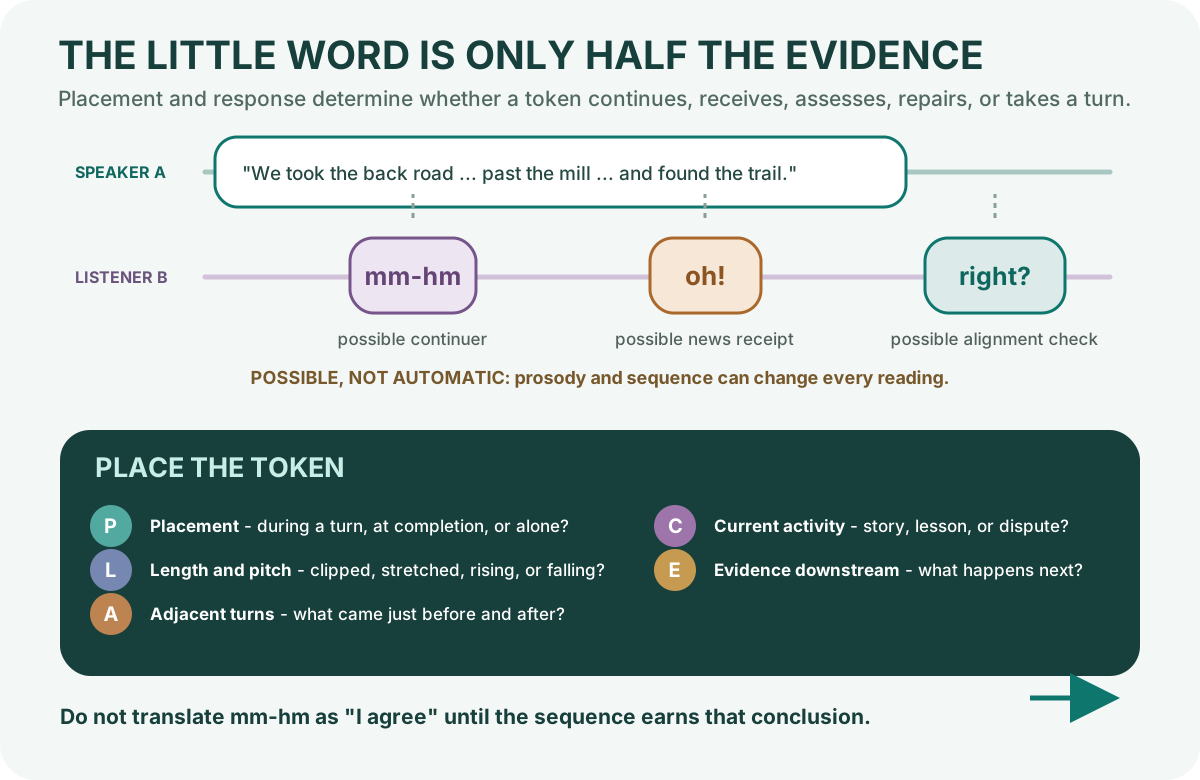
Call mm-hm an agreement word and you will often be wrong. In the middle of a story it may say, “I’m following; continue.” After “Do you accept the terms?” it can function as an answer. After surprising news, a lengthened, falling mmmmm may display assessment. The sound matters, but its place in the sequence matters just as much.
A Way with Words tells of a non-word vocalization understood within one family through recurring sound and context 1. That example reveals a general lesson: interactional meaning can be conventional without being easily spellable, and it can be shared locally without being universal.
The Word Cabinet
- listener response: a vocal or embodied action produced while another participant has, or is expected to continue having, the main turn;
- response token: a short form such as mm-hm, yeah, oh, or right used to display receipt, stance, or another response to prior talk;
- backchannel: a common label for listener activity that supports a main channel of talk; researchers also use continuer, acknowledgment token, receipt token, and listener response because the channel metaphor can oversimplify participation;
- continuer: a response that invites the current speaker to go on;
- assessment: an evaluation, as in a sympathetic aw or impressed wow;
- repair initiation: an action indicating trouble in hearing or understanding and inviting repair, such as “Huh?” or “Who?”;
- discourse marker: a form that helps organize relations among utterances, ideas, actions, speakers, or information states;
- prosody: rhythm, loudness, duration, pitch, and intonation;
- turn-construction: how participants build and recognize possible speaking turns.
These categories overlap but are not synonyms. Oh can be a listener response and a discourse marker. So at the start of a lecture may organize discourse without backchanneling anyone. A nod can be a listener response without being a spoken marker. Deborah Schiffrin’s foundational work follows forms such as oh, well, now, then, you know, and I mean across conversation to show how they support coherence and information management 2. Later traditions draw the category’s boundary differently, so use it as an analytic family, not a parts-of-speech box with a perfect lid.
Method: put a small token in its PLACE
Before translating a response, inspect PLACE.
P — Placement. Does it arrive mid-clause, at a possible completion, after a question, during word-search, or after news? Early and late tokens can do different work.
L — Length and pitch. Compare a clipped right, a lengthened riiight, a rising right?, and a low falling right. Transcription should record relevant sound rather than flatten everything to spelling.
A — Adjacent turns. What immediately precedes and follows? A yes/no question makes an answer relevant. An unfinished story makes continuation relevant. Trouble can make repair relevant.
C — Current activity. Are participants telling a story, teaching a procedure, arguing, taking an order, joking, or planning? The same token serves different projects.
E — Evidence downstream. Does the speaker continue, clarify, defend, laugh, stop, or correct the listener? Later conduct displays how the token was understood, though participants can still misunderstand each other.
Mnemonic: PLACE before paraphrase.
Worked case 1: “mm-hm” is not a truth stamp
Read this invented sequence:
A: We got to the station, and the departure board was blank—
B: Mm-hm.
A: —so we asked the guard which platform we needed.
The token appears during an extended telling, and A resumes without defending a claim. A continuer analysis is strong: B displays attention and leaves the main floor available. Now change the sequence:
A: Did the board go blank?
B: Mm-hm.
Here the question makes confirmation relevant. The same spelling can now perform an affirmative answer. Rod Gardner’s study of uh-huh, oh, mm, yeah, right, and related tokens shows that stance is built from phonetic form, prosody, placement, and timing—not the lexical item alone 3. A later interaction-based study coded roughly 5,200 vocalized listener responses in naturally occurring conversations, demonstrating how much systematic variation hides inside “little noises” 4.
This matters ethically. Someone can acknowledge hearing a statement without endorsing it. Treating every nod or mm-hm as agreement can invent consent the listener did not give.
Worked case 2: new information, trouble, and delay
Oh often displays a change in the listener’s information state: “Oh, I didn’t know that.” But a rising “Oh?” may invite elaboration; a flat “oh” after bad news may display muted receipt; an emphatic “OH!” can assess a surprise. PLACE determines which analysis fits.
When hearing fails, a short “Huh?” can initiate repair. Cross-linguistic research finds similarly shaped questioning interjections serving this job across diverse languages, while each language tunes the form to its own sound system 5. The interesting claim is qualified: conversational pressure favors a compact, question-like repair tool. It is not that every community uses an identical grunt or values the same response style.
Uh and um are likewise more than verbal litter. One influential corpus-based proposal treats them as conventional signals of expected delay that can also help speakers manage planning and the floor 6. Other accounts analyze them differently, so PLACE should test the local sequence rather than assign every hesitation the same code. Removing every hesitation from a transcript may make prose tidier while erasing evidence about real-time production.
Worked case 3: “yeah, no” and “right?”
Suppose someone asks, “Did you like the apartment?” Responses might include:
- “Yeah, no, the windows were great, but the rent was impossible.”
- “No, yeah, I’d live there if the price dropped.”
Do not encode yeah, no as a fixed secret synonym for either yes or no. One part may acknowledge the question, affiliate with a viewpoint, or accept a premise; the other may reject the proposed answer or pivot into qualification. A Way with Words treats the cluster as a discourse marker whose conversational work exceeds addition of its two dictionary meanings 7. Apply PLACE to each actual case.
The same caution applies to right? A speaker can seek confirmation, invite camaraderie, test shared understanding, propel a story, or signal a possible handoff. Pitch and timing help distinguish those actions. The program’s examples make the useful starting point that right? participates in conversational flow, not merely factual correctness 8.
Timing is shared infrastructure, not one etiquette
Conversation depends on fine timing. A comparative study of ten languages found a broadly shared tendency to limit both long gaps and simultaneous starts, alongside meaningful differences in typical timing 9. That finding does not justify declaring one pause length natural, one overlap rude, or one culture uniformly fast. Language, community, activity, relationship, disability, sensory processing, technology, and individual style all matter.
Some people give frequent visible feedback; others listen with fewer tokens or different gestures. Video lag alters overlap. Neurodivergent participants may use or interpret gaze, timing, and continuers differently. Analyze coordination and repair rather than grading people against an imagined universal listener.
Practice: annotate forty-five seconds
Select forty-five seconds from a publicly released interview or podcast—or, with every participant’s permission, from one of your own conversations.
- Label speakers A and B; mark every brief vocal or embodied response.
- Note approximate placement: mid-turn, completion, question response, news receipt, or trouble.
- Describe audible length and pitch without pretending to be more precise than you are.
- Name the current activity and two plausible functions.
- Inspect the next two turns for evidence.
- Mark ambiguous cases unresolved rather than forcing a translation.
Then alter one feature in writing: move mm-hm from mid-story to after a direct question, or change rising right? to falling right. Predict how the available action changes.
Rule of thumb
Do not translate a tiny token until you place it in its sequence. Spelling offers a clue; prosody, activity, adjacent turns, and uptake turn that clue into a defensible analysis.
Practice
Mid-story placement and immediate continuation support a continuer or receipt analysis. They do not by themselves establish agreement with the story’s claims.
Practice
Its work emerges in sequence. A speaker may acknowledge one aspect before declining another, or use the cluster as a stance marker; context decides.
Practice
Prosody and sequential evidence distinguish possible actions such as checking understanding, inviting alignment, or managing the floor.
Lesson complete
Nice work.
Sources for this lesson
- 1Non-Word Utterances Also Have Meaning. A Way with Words. 2017. verifiedSegment about a family vocalization whose interpretation depends on recurring tone, sequence, and shared context rather than dictionary spelling. Cited at: segment and show notes.
- 2Deborah Schiffrin. Discourse Markers. Cambridge University Press. 1987. verifiedFoundational analysis of forms including oh, well, now, then, you know, I mean, so, because, and but as resources for conversational coherence and information management. Cited at: Discourse Markers.
- 3Rod Gardner. When Listeners Talk: Response Tokens and Listener Stance. John Benjamins. 2001. verifiedFoundational study of response tokens such as uh-huh, oh, mm, yeah, right, and mm-hm as displays of listener stance shaped by form, prosody, placement, and timing. Cited at: When Listeners Talk.
- 4Mirjam Elisabeth Eiswirth. Modeling Listener Responses. Cambridge University Press. 2022. verifiedInteraction-based definition and coding scheme developed from approximately 5,200 vocalized listener responses in naturally occurring dyadic conversation. Cited at: Modeling Listener Responses.
- 5Mark Dingemanse, Francisco Torreira, N. J. Enfield. Is Huh? a Universal Word? Conversational Infrastructure and the Convergent Evolution of Linguistic Items. PLOS ONE. 2013. verifiedCross-linguistic study of short questioning interjections used to initiate repair when hearing or understanding fails. Cited at: cross-linguistic repair study.
- 6Herbert H. Clark, Jean E. Fox Tree. Using Uh and Um in Spontaneous Speaking. Cognition. 2002. verifiedCorpus-based proposal that uh and um can conventionally announce expected delays and help speakers manage planning and the conversational floor. Cited at: study of spontaneous speech.
- 7Yeah, No. A Way with Words. verifiedSegment treating yeah-no as a discourse marker or particle whose conversational function is not recovered by simply adding the dictionary meanings of its parts. Cited at: segment and show notes.
- 8Using Right? in Conversational Flow. A Way with Words. 2022. verifiedSegment showing that a tag such as right? may seek alignment, build camaraderie, hold the floor, or yield it depending on its placement and delivery. Cited at: segment and show notes.
- 9Tanya Stivers, N. J. Enfield, Penelope Brown, Christina Englert, Makoto Hayashi, Trine Heinemann, Gertie Hoymann, Federico Rossano, Jan Peter de Ruiter, Kyung-Eun Yoon, Stephen C. Levinson. Universals and Cultural Variation in Turn-Taking in Conversation. Proceedings of the National Academy of Sciences. 2009. verifiedComparative study of ten languages finding shared pressure to minimize silence and overlap alongside meaningful variation in turn timing. Cited at: cross-linguistic turn-taking study.