Words Cross Borders—and Change on the Way
How words travel between languages: loanwords, calques, and borrowed raw material, the changes in sound, meaning, grammar, and social value after borrowing, classifying a claim before explaining it, and a three-item language passport.
- 7 min
- 8 steps
- 3 questions
- Lesson 11 of 36
In this lesson
- The Word Cabinet
- Three routes through a contact zone
- Borrowing changes more than pronunciation
- Worked investigation: classify before you explain
- The BORDER method
- Practice: a three-item language passport
- Rule of thumb
Open alongside this lesson
-
Wasei-Eigo (opens in a new tab)
Explore English-looking expressions created for Japanese use, including the warning that familiar pieces do not guarantee a familiar meaning.
-
Cable Salad (opens in a new tab)
Follow a vivid German expression for tangled cables and decide whether an English use preserves the form or translates its parts.
-
Foreignisms and Loanwords (opens in a new tab)
Collect examples, then investigate the contact history instead of assuming every foreign-looking word took the same route.
-
Lexical Change (opens in a new tab)
Place borrowing alongside coinage, compounding, clipping, and other ways a vocabulary changes.
Picking up where you left off.
English speakers use piano, algebra, kindergarten, and emoji without checking those words back in at the border. Languages do not borrow like libraries. A community adopts material, fits it to existing patterns, and may change its meaning so thoroughly that speakers no longer experience it as foreign.
Borrowing is therefore a story about people in contact: migration, trade, war, religion, food, art, scholarship, colonization, tourism, and media. The word is evidence of that contact, but it is not the whole history. You have to identify what traveled and how the receiving community put it to work.
The Word Cabinet
- Loanword: a word whose form was adopted from another language, usually with some adaptation.
- Calque: an expression built by translating the meaningful parts of a model from another language; also called a loan translation.
- Pseudo-anglicism: an English-looking form created or given a specialized use in another language but not used that way in English.
- Wasei-eigo: literally “Japan-made English”; Japanese expressions formed from English-derived material, often with Japanese-specific form or meaning.
- Nativization: reshaping borrowed material to fit the receiving language’s sounds, spelling, inflection, or word patterns.
- Semantic shift: a change in meaning, range, emotional coloring, or context of use.
- Etymon: an earlier form from which a later word is historically derived.
- Intermediary language: in a particular borrowing event, a language through which the item passed; it may not be the oldest source.
The labels describe routes, not rankings. A nativized word is not a damaged original. Once adopted, it participates in the receiving language’s system.
Three routes through a contact zone
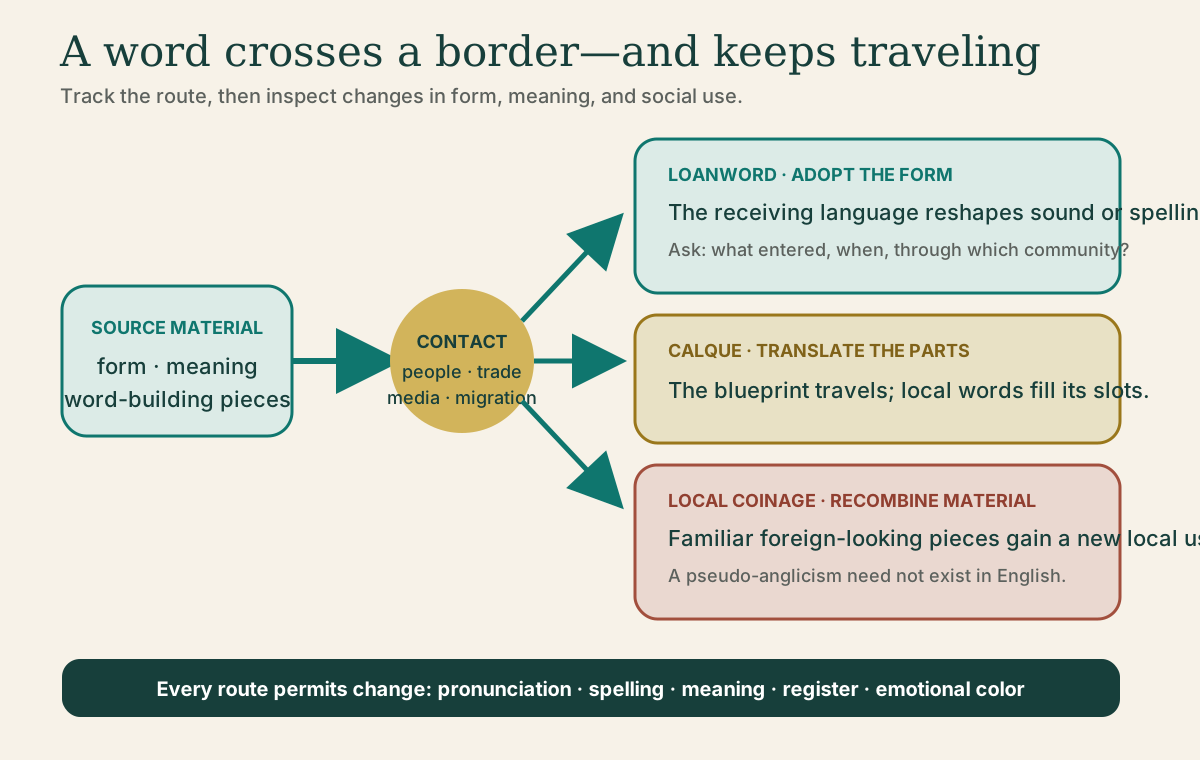
Borrowing can transfer a recognizable form, a pattern of meaning, or raw material for a new local construction.
Route 1: adopt the form
A loanword carries some version of the donor form. Exact copying is unlikely because languages divide sounds differently and permit different syllable shapes. Speakers map unfamiliar material onto available categories. Spelling may follow sound, preserve a source convention, or arrive through a third language.
English skosh, meaning a small amount, is associated with Japanese sukoshi. Its compact English pronunciation reflects use by English speakers, not a failure to reproduce Japanese. A contact history—often linked to U.S. service members encountering Japanese—makes the relationship more than a chance resemblance 1. Once skosh is English vocabulary, it can enter English phrases and styles.
Route 2: translate the blueprint
A calque preserves an expression’s internal plan while replacing its parts with receiving-language words. German Kabelsalat combines the equivalents of “cable” and “salad” for a chaotic tangle of cords. If English speakers adopt the German form Kabelsalat, that is loanword behavior. If they build cable salad after the German model, that is calquing 2.
The historical proviso matters: two communities can independently build the same transparent metaphor. Similar structure suggests a calque; dated evidence and a plausible channel of contact support one.
Route 3: recombine foreign-looking material locally
Japanese has borrowed many English forms, but it also combines English-derived pieces into wasei-eigo. The result belongs to Japanese. The A Way with Words discussion uses examples such as paper driver—a licensed person who drives rarely or not at all—and American dog, a Japanese term for a corn-dog-like food 3. An English speaker may recognize every piece and still miss the expression.
Calling these forms “fake English” asks the wrong question. They are genuine Japanese vocabulary with a particular material history. Pseudo-anglicism describes the mismatch between English-looking form and actual English use; it does not mean pseudo-language.
Borrowing changes more than pronunciation
After adoption, at least five dimensions can move:
- Sound: speakers fit the word to familiar contrasts and syllables.
- Spelling: writing may follow the donor, the recipient, or a later standardization.
- Grammar: a borrowed noun acquires local plurals, articles, and positions.
- Meaning: one sense may narrow, broaden, become metaphorical, or pick up an attitude.
- Register: a word can sound technical, fashionable, old-fashioned, intimate, or ordinary.
This is ordinary lexical change. Borrowing joins coinage, compounding, shortening, and shifts in word class as ways a lexicon grows 4. The receiving community is active at every step.
Consider salsa. In Spanish its broad food meaning relates to sauce; in many English settings it first evokes a narrower category of Mexican-style table condiment, and it also names a music and dance tradition through a different cultural history. Asking “What does salsa really mean?” is less useful than asking which language, period, community, and activity you mean.
Worked investigation: classify before you explain
Suppose you encounter this claim in a travel blog:
“The Japanese phrase paper driver is bad English imported into Japanese.”
Use a three-pass repair.
Pass 1: describe
The expression contains English-derived forms, but its established Japanese meaning is not compositionally obvious to most English speakers. That makes wasei-eigo or pseudo-anglicism a useful descriptive starting point—not “bad English.”
Pass 2: reconstruct a route
Ask when the expression appears in Japanese records, what form it has in Japanese writing and pronunciation, and what institutions made paper credentials salient. Search Japanese dictionaries or corpora and scholarship, not only English lists of amusing phrases. The English-looking pieces are evidence; they are not a complete derivation.
Pass 3: state change without ownership
A careful result might read: “Japanese speakers formed an expression from English-derived elements for someone whose driver’s license exists mainly on paper. The expression is conventional in Japanese but not in general English.” That explains the cross-language relationship without treating English as the judge of Japanese legitimacy.
The BORDER method
When a word looks traveled, stamp a BORDER card:
- B — Baseline: Record the form, meaning, pronunciation, and setting where you actually found it.
- O — Older evidence: Find dated attestations in the receiving and proposed donor languages.
- R — Route: Identify people, places, media, or institutions that could carry it.
- D — Differences: Note changes in sound, spelling, grammar, meaning, and register.
- E — Explanation type: Choose loanword, calque, local recombination, inherited cognate, chance resemblance, or unresolved.
- R — Report confidence: Separate documented facts from your inference.
Mnemonic: A border changes paperwork, not a word’s right to belong.
The route category can remain uncertain. A Way with Words’ broad loanword collections are excellent hypothesis generators, but a polished etymology should follow their leads into dictionaries, dated texts, and contact history 5.
Practice: a three-item language passport
Choose three items from a menu, workplace, hobby, or game. Include one that feels completely ordinary in English. For each:
| Item in context | Proposed source | Route type | What changed? | Best evidence still needed |
|---|---|---|---|---|
| sample: café in “internet café” | French, earlier history beyond it | loanword + new compound use | accent mark optional; broadened venue types | dated English uses |
Then test one tempting resemblance. Find two words from different languages that look alike and ask what evidence would distinguish borrowing from coincidence. If you cannot show dated forms or a contact route, label it resemblance only.
For an extra challenge, take a vivid expression in another language. Write its original form, a literal translation, and a natural English paraphrase. The literal version may reveal the metaphor while the paraphrase better serves a real conversation. Translation does not require choosing only one.
Rule of thumb
Track route, not resemblance. A loanword carries form, a calque carries structure, and a pseudo-anglicism uses imported-looking material for local work. In every case, the receiving community gets a creative vote.
Practice
A loanword adopts form, while a calque translates a model’s parts. Actual history still needs evidence because similar expressions can be coined independently.
Practice
Wasei-eigo is made in Japanese from English-derived elements; English-looking pieces do not make the result an English expression.
Practice
Resemblance generates a hypothesis. Historical attestations and a plausible route of contact are needed to support it.
Lesson complete
Nice work.
Sources for this lesson
- 1Foreignisms and Loanwords. A Way with Words. verifiedSegment on the movement of words and expressions across languages. Cited at: segment discussion.
- 2Cable Salad. A Way with Words. verifiedSegment on the German compound Kabelsalat and the appeal and limits of so-called untranslatable words. Cited at: segment overview.
- 3Wasei-Eigo. A Way with Words. verifiedSegment on Japanese expressions built from English material but used with locally developed meanings. Cited at: segment examples.
- 4Lexical Change. Essentials of Linguistics 2e, eCampusOntario. verifiedOpen textbook chapter on coinage, borrowing, word loss, and other changes in a language's vocabulary. Cited at: borrowing and lexical innovation.
- 5Loanwords and Borrowed Words. A Way with Words. verifiedSegment on how borrowed forms become ordinary parts of a receiving language. Cited at: segment overview.