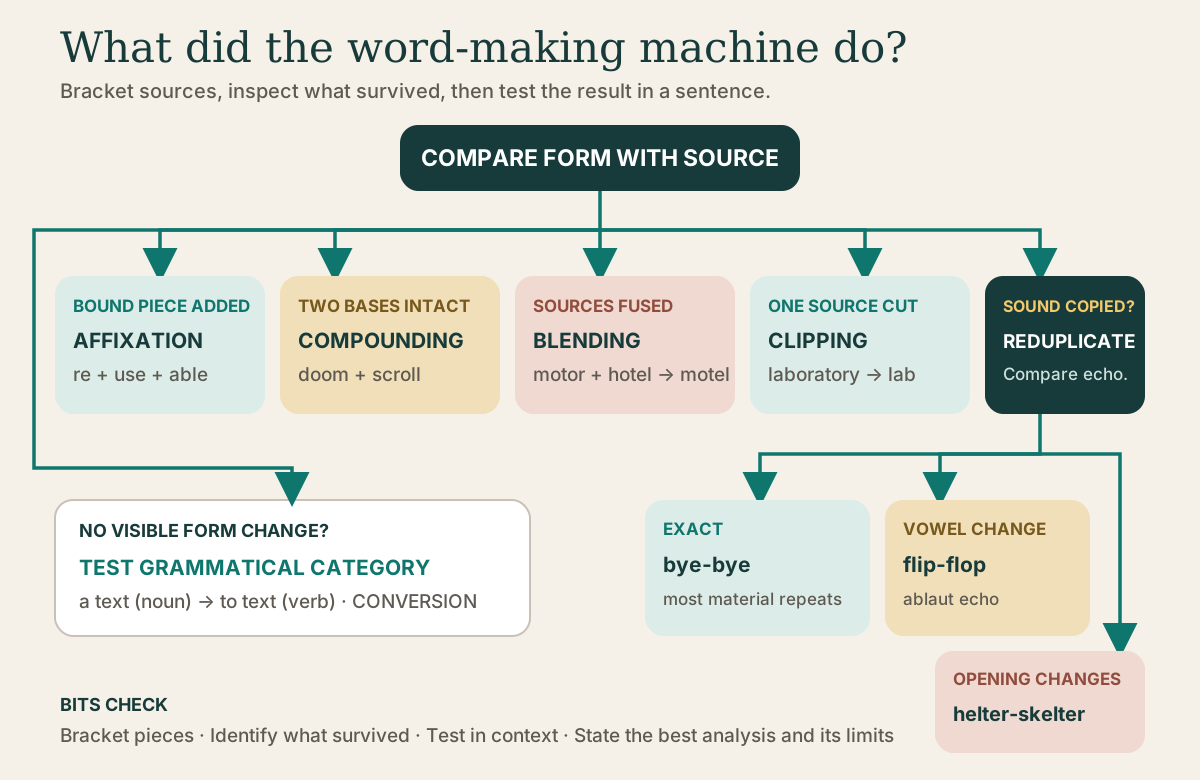
The Word-Making Machine
How English builds new words: morphemes, affixation, conversion, compounding, blending, clipping, and reduplication, why compounds aren't blends, a method for bracketing a word's parts, and running the machine both backward and forward.
- 8 min
- 8 steps
- 3 questions
- Lesson 3 of 36
In this lesson
- Start smaller than the word
- Word Cabinet
- Echoes with jobs
- Compounds are not blends
- The BITS analysis method
- Practice: run the machine in reverse and forward
- Rule of thumb
Open alongside this lesson
-
Helter-Skelter Reduplicatives (opens in a new tab)
Sort the examples into exact, vowel-changing, and rhyming patterns, then notice which meanings are playful or expressive.
-
Fancy-Schmancy and Deserve-Schmerve (opens in a new tab)
Hear how a repeatable form contributes attitude, not merely sound.
-
Portmanteau Word Blends (opens in a new tab)
Start with motel, then compare true blends with compounds whose source words remain intact.
-
Compounding (opens in a new tab)
Use the chapter to move from clever examples to analysis of compound words and their heads.
Picking up where you left off.
English does not keep its vocabulary in a sealed warehouse. Speakers assemble, shorten, echo, repurpose, and splice material every day. The results can feel whimsical—teeny-weeny, fancy-schmancy, brunch—but the operations are patterned. You already possess a word-making machine: a grammar that tells you which forms sound possible, what they are likely to mean, and how they behave in sentences.
The goal of this lesson is not to memorize a bag of terminology. It is to reverse-engineer a word. Given a form and a context, identify its source pieces, the operation applied to them, and the new meaning or attitude the result contributes.
Start smaller than the word
A morpheme is the smallest recurring unit that contributes meaning or a grammatical function. In reusable, we can identify re-, use, and -able. The central form use can stand alone, while the affixes cannot normally do so with the same function. A base is the material an operation attaches to; a root is the core remaining when additional morphological structure is removed. Those labels sometimes identify the same string and sometimes do not, so use them for an analysis rather than as eternal properties 1.
Two cautions prevent many errors:
- A word’s spelling does not guarantee its structure. A sequence that resembles an affix may be accidental.
- A historical source and a present-day pattern are different questions. Speakers may productively analyze a form one way even if its remote history is more tangled.
Word Cabinet
| Operation | What changes | Example |
|---|---|---|
| affixation | a bound form attaches to a base | re- + use + -able |
| compounding | two bases combine while remaining substantially intact | doom + scroll |
| blending | source words are shortened and fused, often with overlap | motor + hotel → motel |
| clipping | a longer form is shortened without changing its core referent | laboratory → lab |
| conversion | a form changes grammatical category without a visible affix | text (noun) → to text (verb) |
| exact reduplication | all or most of a form repeats | bye-bye, no-no |
| ablaut reduplication | an echo changes its vowel | flip-flop, tick-tock |
| rhyming reduplication | an echo changes its opening to create a rhyme | helter-skelter, super-duper |
These are analytical prototypes, not boxes that nature promises will never overlap. A playful word can combine shortening and blending; a repeated form can become conventional enough that speakers no longer feel its pieces equally strongly.
Echoes with jobs
Reduplication means copying some phonological material. English uses it less systematically than many languages, yet it supports recognizable families. Exact repetition can make an expression child-directed, iterative, or bounded: night-night, no-no. Vowel-changing—or ablaut—pairs include chit-chat, flip-flop, and wishy-washy. Rhyming pairs change the opening: lovey-dovey, willy-nilly, and helter-skelter. A Way with Words groups these echo patterns and notes that the origin of helter-skelter, attested for centuries, remains mostly unknown 2. Pattern recognition does not require a tidy origin story.
The order of vowels in pairs such as tick-tock and flip-flop is strongly conventional. “Tock-tick” is interpretable but sounds marked to many English speakers. Treat that ordering as a tendency learned from many words, not a magic rule that predicts every playful form.
Schm-reduplication makes the social job especially visible. A speaker takes a base and echoes it with schm- or shm-: “Deadline, schmeadline.” The result does not merely repeat deadline. It distances the speaker from its importance, often humorously. A Way with Words traces this dismissive construction through Yiddish and illustrates its later English productivity with forms such as fancy-schmancy 3. The source history explains how the construction traveled; the live pattern explains why a speaker can coin a new instance instantly.
Compounds are not blends
In a compound, recognizable bases combine: toothbrush, snow day, doomscroll. Spacing and hyphenation vary, so orthography is only one clue. English compounds also have internal organization. A birdhouse is a kind of house, while a houseboat is a kind of boat; the right-hand base often acts as the head, supplying the core category and many grammatical properties. The open linguistics text uses such structural and meaning tests to distinguish compounds from ordinary phrases 4.
A blend compresses and fuses sources. Motel preserves material from motor and hotel; brunch combines portions of breakfast and lunch. A Way with Words uses motel to introduce the familiar label portmanteau for this kind of blend 5. The suitcase image is memorable, but the structural test matters more: if both full bases simply sit together, you probably have a compound, not a blend.
Compare:
- doomscroll: doom + scroll remain visible. Compound.
- smog: parts of smoke and fog overlap and disappear. Blend.
- lab: one source, laboratory, is shortened. Clipping.
- to message: an existing noun form is used as a verb without a visible derivational affix. Conversion.
The BITS analysis method
Use BITS whenever a word’s construction is unclear.
- B — Bracket candidate pieces. Write possible source forms:
doom + scroll,sm(oke) + (f)og,re + use + able. - I — Identify what survived. Are the sources intact, shortened, overlapped, repeated, or unchanged while the grammatical category shifted?
- T — Test in context. Put the form in a full sentence. Check part of speech, plural or tense behavior, stress, literal meaning, and speaker attitude.
- S — State the analysis and its limit. Name the best-supported operation. If two analyses remain plausible, give both and say what evidence would distinguish them.
Worked example: “planning-schmanning”
Imagine: “Planning-schmanning—we’ll decide when we arrive.”
Bracket: the first base is planning. The echo begins with schm- and retains a rhyming remainder.
Identify: this is partial, patterned echoing rather than ordinary pluralization or compounding.
Test: the construction can follow many contextually available words. It does not name a new type of planning. It communicates the speaker’s dismissive stance toward planning’s relevance.
State: a productive instance of schm-reduplication used pragmatically to downgrade the base. We can classify the present construction confidently without claiming the speaker knows its Yiddish history.
Now test doomscrolling: “I was doomscrolling at midnight.” The past progressive syntax shows verb behavior. The compound combines the negative content field doom with the activity scroll. The form may also be used as a noun in another sentence. Its category is therefore a fact about a particular use, not simply its letters.
Practice: run the machine in reverse and forward
Reverse-engineer
Classify each highlighted form with BITS. More than one process may be relevant.
- “After the update, the app was unusable.”
- “We booked a staycation.”
- “Let’s have a quick confab after lunch.”
- “The toddler said night-night.”
- “Forecast, schmorecast—bring a raincoat anyway.”
Suggested starting points: unusable invites affixation; staycation blends material associated with stay and vacation; confab is a shortening; night-night copies; schmorecast instantiates a dismissive echo construction. Then use a dictionary or corpus to check histories rather than assuming your present-day segmentation tells the whole story.
Build deliberately
Choose a base such as calendar, snack, or weather. Make:
- one transparent compound;
- one blend that genuinely removes or overlaps material;
- one reduplicative with an identifiable attitude;
- one sentence that converts a noun to a verb.
For each, write what a listener could infer and what would need explanation. A structurally possible word is not guaranteed to be useful, tasteful, or adopted.
Rule of thumb
Form + function + evidence. Identify what material changed, explain what the result does in its sentence, and keep a present-day structural analysis separate from a historical origin claim. That three-part habit turns a cute word list into linguistics.
Practice
Doom and scroll remain recognizable bases in a compound; motel is a blend whose source words lose and overlap material.
Practice
The construction is productive because speakers can apply its form and dismissive stance to new bases; using it does not establish the history of the base word.
Practice
Distribution and behavior are evidence for word structure, though no single test settles every ambiguous case.
Lesson complete
Nice work.
Sources for this lesson
- 1Catherine Anderson, Bronwyn Bjorkman, Derek Denis, Julianne Doner, Margaret Grant, Nathan Sanders, Ai Taniguchi. Roots, Bases, and Affixes. Essentials of Linguistics 2e, eCampusOntario. verifiedOpen textbook chapter on morphemes, roots, affixes, and other word-building operations. Cited at: section 5.2 on roots, bases, and affixes.
- 2Helter-Skelter Reduplicatives. A Way with Words. verifiedSegment on playful repeated forms, sound alternation, and patterned word formation. Cited at: segment summary.
- 3Fancy-Schmancy and Deserve-Schmerve. A Way with Words. verifiedSegment on productive schm-reduplication and its dismissive or ironic social meaning. Cited at: segment summary.
- 4Compounding. Essentials of Linguistics 2e, eCampusOntario. verifiedOpen textbook chapter on compound structure and the relationship between the parts and the whole. Cited at: section 5.8.
- 5Portmanteau Word Blends. A Way with Words. verifiedSegment on words formed by overlapping pieces of two existing words. Cited at: segment summary.