The New Name for the Old Thing: Retronyms and Category Splits
Retronyms like acoustic guitar and landline: the sequence from default to split category, markedness, borderline cases, why objects don't set categories by themselves, a five-part test, and writing a contrast biography for one term.
- 5 min
- 8 steps
- 3 questions
- Lesson 33 of 36
In this lesson
- The category sequence
- Retronyms reveal markedness
- Borderline cases
- Objects do not determine categories
- The RETRO test
- Practice lab: build a contrast biography
- Rule of thumb
Open alongside this lesson
-
Retronyms for New Inventions and Ideas (opens in a new tab)
Collect examples, but ask what new contrast made each older label necessary.
-
Retronym (opens in a new tab)
Compare the definition with borderline cases such as whole milk, landline phone, and in-person meeting.
-
Google Books Ngram Viewer — Information and Usage Guide (opens in a new tab)
Use corpora to test whether a modifier actually rose after the supposedly category-changing innovation.
Picking up where you left off.
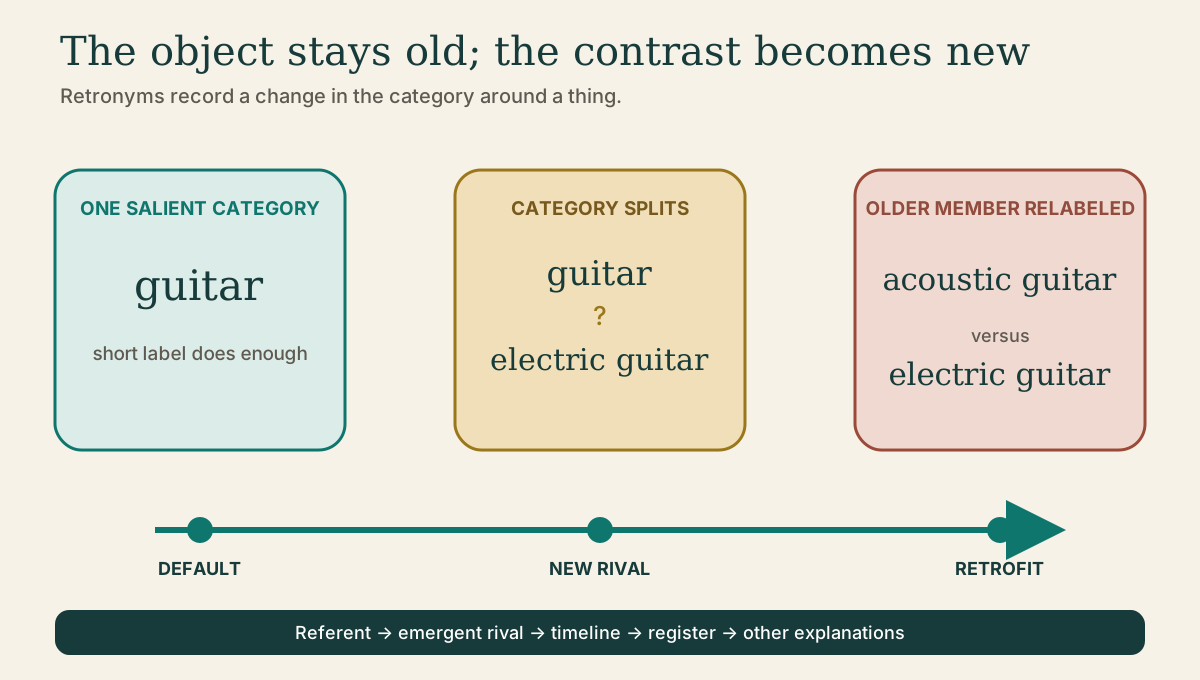
Before electric guitars, speakers rarely needed the everyday label acoustic guitar. Guitar usually did enough work. Once a salient new kind entered the category, the old kind acquired a new name.
That backward-looking label is a retronym: a term adopted to distinguish an older or original version from a later alternative. The object may remain physically unchanged. What changes is the contrast a speaker must manage.
A Way with Words offers a compact collection: acoustic guitar, black-and-white television, silent movie, bar soap, and World War I 1. Each is more than a lexical curiosity. It records a moment when a once-unmarked category split.
The category sequence
- Default stage: one familiar category member carries the short name—guitar.
- Innovation stage: a salient alternative arrives—electric guitar.
- Ambiguity stage: the short form can mean the whole category or one member.
- Retrofit stage: the older member gains a contrastive label—acoustic guitar.
- Normalization stage: later speakers may learn both labels together and never experience the original default.
Merriam-Webster defines a retronym through exactly this relation: a newly created or adopted term distinguishing an older version from newer versions 2. The word retronym itself is traced in edited sources to 1980, but the process is much older.
Retronyms reveal markedness
An unmarked label is the form used when a contrast need not be stated. A marked label adds information. Before the category split, guitar was enough. Afterward, either member may need a modifier.
This does not mean the unmarked member is natural, superior, or statistically dominant. Defaults are built from communities and situations. In a recording studio, guitar may default to electric; in a bluegrass session, it may default to acoustic. Markedness is relative to a contrast set and an activity.
Retronyms make shifting defaults visible:
| Short form before | New contrast | Backward-looking label |
|---|---|---|
| electronic mail | postal mail, snail mail | |
| phone | mobile phone | landline phone |
| store | online store | brick-and-mortar store |
| meeting | remote meeting | in-person meeting |
| camera | digital camera | film camera |
Not every row has one clean birth date. New terms can coexist, arise in specialist communities, or spread gradually. Snail mail also carries playful or evaluative meaning, while postal mail is more neutral. Retronymy identifies the contrastive history; it does not erase register and stance.
Borderline cases
Test four conditions:
- Older referent: Did the thing or category member exist before the proposed label became common?
- New competitor: Did a later alternative create a useful contrast?
- Backward modifier: Was a label added or repurposed for the older member?
- Dated evidence: Does usage history support that sequence?
Red car is ordinarily just descriptive; red cars did not need to be renamed after blue cars were invented. Manual transmission is a stronger candidate if the modifier became necessary as automatic transmission established a salient competing category. Whole milk is plausible, but its history involves regulation, processing, and changing product categories, so the neat story needs evidence.
Objects do not determine categories
A physical feature can be old while its categorical importance is new. Film cameras always used film, but speakers did not need film in the everyday name until digital imaging made medium contrastive. Black-and-white televisions always lacked color display, but black-and-white became more useful when color television entered ordinary comparison.
This is why retronyms matter beyond technology. They show contrastive categorization: naming attends to whatever difference a community currently needs to manage.
The same process can expose ideology. Terms such as offline life, biological parent, or traditional classroom may appear to neutrally label an older arrangement, but their boundaries and implications can be contested. Calling something a retronym explains its temporal contrast; it does not settle the politics of the category.
The RETRO test
- R — Referent: what older thing now needs specification?
- E — Emergent rival: what new alternative changed the category?
- T — Timeline: did the rival precede growth of the modified label?
- R — Register: where and by whom is the label used?
- O — Other explanations: ordinary description, technical classification, marketing, or legal terminology?
Practice lab: build a contrast biography
Choose one candidate: landline phone, film camera, in-person meeting, or one from your own work.
- Find dated evidence for the original short form.
- Date the emerging rival category.
- Search when the modified form begins rising.
- Inspect five examples; do they genuinely contrast old and new?
- Note register and evaluative tone.
Google Books Ngram can suggest a frequency curve but does not explain it. Its documentation warns that the corpus consists of published books, includes OCR and metadata limits, and changes across datasets 3. Confirm with actual passages, dictionaries, newspapers, manuals, or archives.
Rule of thumb
A retronym is a fossil of a category split. Find the old default, the new rival, and the dated moment when language had to look backward and add a name.
Practice
The innovation reorganized the category and prompted a backward-looking label for the older member.
Practice
Retronym claims are chronological and contrastive, so dated use and the history of the new category matter.
Practice
Retronyms are a historical-pragmatic subtype of modification, not every noun phrase with an adjective.
Lesson complete
Nice work.
Sources for this lesson
- 1Retronyms for New Inventions and Ideas. A Way with Words. 2008. verifiedTranscript with acoustic guitar, black-and-white television, silent movie, bar soap, and World War I as category-changing examples. Cited at: transcript.
- 2Retronym. Merriam-Webster. verifiedDictionary definition, usage history, and attested examples for labels added to distinguish an older category member from newer alternatives. Cited at: definition and first-use note.
- 3Google Books Ngram Viewer — Information and Usage Guide. Google Books. verifiedOfficial corpus documentation covering scope, OCR and metadata revisions, tokenization, search behavior, smoothing, and known analytical limits. Cited at: tool documentation.
Previous: Pointing with Words: Deixis, Joint Attention, and Vocatives