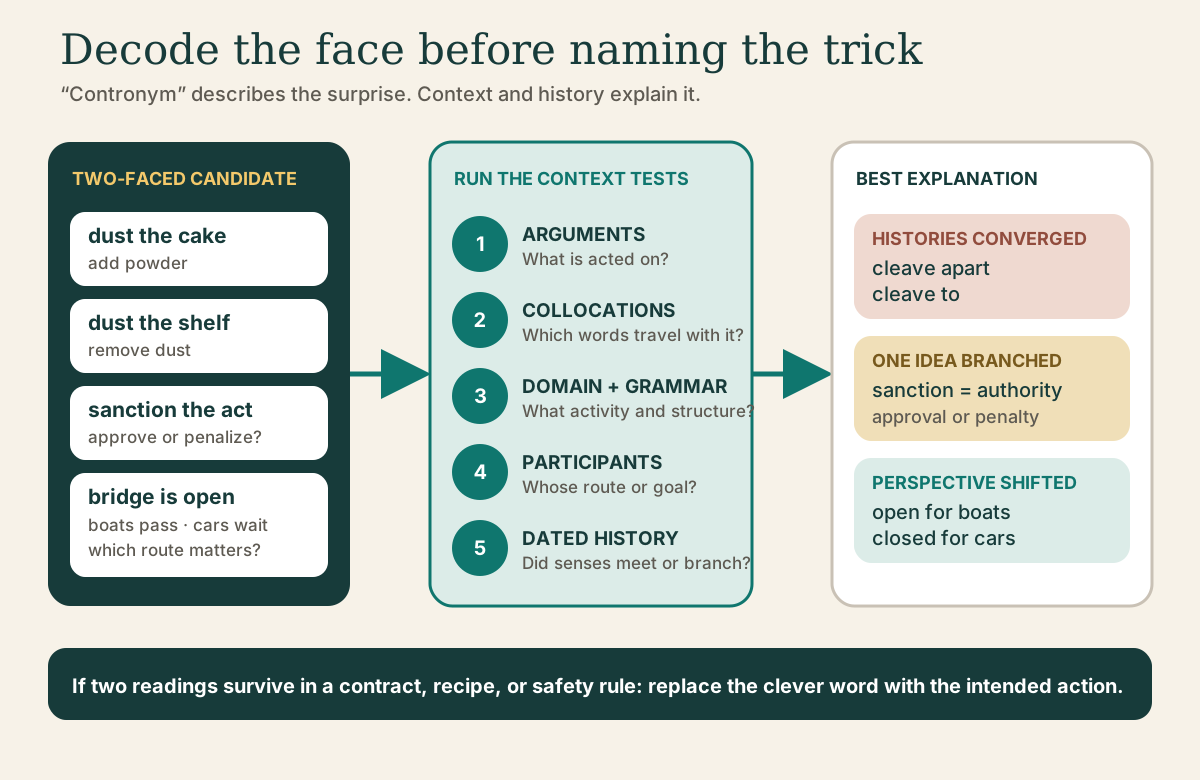
Words with Two Faces: Contronyms, Polysemy, and Context
Contronyms like sanction, cleave, and dust: three ways a word comes to mean opposites, the drawbridge that's both open and closed, context as an active decoder, a six-step method for decoding two-faced words, and a context switchboard.
- 8 min
- 8 steps
- 3 questions
- Lesson 6 of 36
In this lesson
- The Word Cabinet
- Three roads to a two-faced word
- The bridge that opens and closes at once
- Context is an active decoding system
- Use the C-L-E-A-V-E method
- Practice: make a context switchboard
- Rule of thumb
Open alongside this lesson
-
Auto-Antonyms (opens in a new tab)
Start with cleave and dust, then sort the examples by historical mechanism rather than treating contronym as one origin story.
-
The Bridge is Open but Closed (opens in a new tab)
Use the drawbridge case to see how participant perspective can create an apparent opposition without two dictionary entries.
-
Words That Are Their Own Opposites (opens in a new tab)
Use the examples as candidates, then verify each sense and history rather than assuming every pair arose the same way.
-
Semantic Change (opens in a new tab)
Review narrowing, broadening, metaphor, and other pathways before assigning two meanings to coincidence.
Picking up where you left off.
A government may sanction a program by approving it or impose sanctions by penalizing conduct. You can dust a cake by adding sugar and dust a shelf by removing dust. Cleave can describe splitting apart or holding fast. These words are called contronyms, auto-antonyms, Janus words, or two-faced words.
The label names the surprise, not its cause. Some examples combine two historically different words that converged in sound and spelling. Some began with one broad idea whose senses branched. Some depend on whether an action adds or removes the thing named by a noun. Others only look opposite because two participants care about different paths through the same situation.
A list is entertaining. An analysis asks what made both readings possible and how a listener knows which one is active.
The Word Cabinet
- contronym: a word with uses that can appear opposite in meaning;
- polysemy: one lexical form having multiple related senses;
- homonymy: historically or lexically distinct words sharing a form;
- sense: one conventional interpretation of a lexical form;
- argument: a participant selected by a predicate, such as the thing being dusted;
- collocation: words that occur together more often or more characteristically than chance would suggest;
- perspective: the participant, route, scale, or goal from which a situation is described;
- ambiguity: the availability of more than one interpretation in a given form;
- vagueness: an interpretation with flexible boundaries rather than two clearly separable readings.
Not every word with multiple senses is a contronym. Mouth can name part of a face or the opening of a river without those senses being opposites. Not every possible double reading creates practical ambiguity either. Ordinary sentences supply strong constraints.
Three roads to a two-faced word
1. Two histories converge
The classic cleave example conceals two older verbs: one associated with splitting and another with adhering. Changes in pronunciation and spelling left them sharing a modern form. “Cleave the log” and “cleave to the agreement” therefore look like one word reversing itself, but their histories are not a single sense turning around.
This is why etymology belongs in the diagnosis. A dictionary’s numbered meanings may describe present use, while the etymology explains whether those meanings share a lineage 1. A Way with Words introduces cleave, dust, and screen as the delightful surface category, but each still needs its own historical account 2.
2. One idea branches
Sanction developed around authoritative or binding action. Authority can ratify an act, and authority can attach a penalty to an act. The resulting senses—approve and penalize—pull in opposite practical directions while retaining a relation to official force. “The board sanctioned the plan” may be clear in a supportive report; “The agency sanctioned the company” may suggest a penalty. “The regulator can sanction the operation” is dangerously underspecified.
Semantic change frequently produces multiple senses through broadening, narrowing, metaphor, and repeated bridge contexts 3. The history is rarely “people accidentally chose the opposite.” A context once made a use reasonable; repetition made the use conventional.
Trim shows how an older broad idea such as preparing or arranging can support apparently opposed results. Trimming a hedge removes growth; trimming a holiday tree adds decoration; trimming a sail adjusts it for conditions. The direct object and activity select which preparation counts 4.
3. The named material changes roles
English readily turns nouns into verbs. When the noun names a material, the verb can describe putting that material somewhere or removing it:
- dust the pastries with sugar: apply a dust-like layer;
- dust the shelves: remove dust;
- seed the lawn: add seed;
- seed the pepper: remove its seeds;
- skin the drum: add a skin covering;
- skin the tomato: remove its skin.
There is no universal rule saying noun-derived verbs add or subtract. Speakers learn conventional event frames, and the object helps retrieve them. A pastry is a likely destination for powdered sugar. A dusty shelf is a likely source of unwanted particles.
The bridge that opens and closes at once
A traffic report says a drawbridge is open. Drivers discover that the roadway is raised and their route is closed. Boat operators, however, find the channel open. Has open become its own opposite?
The A Way with Words caller correctly identifies context as the crucial clue, while the hosts notice that this case differs from two historically separate senses of cleave 5. One physical arrangement changes access for two routes:
| Structure state | Cars | Tall boats |
|---|---|---|
| roadway lowered | route open | route closed |
| roadway raised | route closed | route open |
The contradiction disappears when the missing participant and path are restored. This is perspective reversal, not necessarily a stable new lexical sense. Do not export that diagnosis automatically: a “fast” computer versus a rope held fast reflects established polysemy, a transparent material versus a transparent process is metaphorical extension without an opposition, and a file “public” within one team but restricted outside it leaves the relevant access group unstated. The surface puzzle is a prompt to investigate, not the classification itself.
Context is an active decoding system
Readers do not normally scan every dictionary sense and choose at random. They integrate several signals:
- Arguments: What is acted on? Dusting a cake and dusting a shelf recruit different event frames.
- Collocations: Sanctions against strongly predicts penalties; officially sanctioned event predicts approval.
- Grammar: Cleave to selects adherence; a direct object after cleave often favors splitting.
- Domain: A marine traffic report activates a boat route; a road alert activates drivers.
- Shared situation: A raised bridge visible to both speakers makes some descriptions immediately recoverable.
- Prosody and gesture: Stress, timing, gaze, and pointing can disambiguate speech even when a transcript remains unclear.
Ambiguity exists when two readings remain live in the actual context, not merely because a dictionary lists two senses. “Please dust the room” may be unclear if a theatrical crew could either remove debris or apply scenic powder. “Dust the chocolate cake with two tablespoons of sugar” is not.
Use the C-L-E-A-V-E method
Decode a two-faced candidate with CLEAVE:
- C — Capture the whole context. Preserve the sentence, neighboring turns, genre, and situation.
- L — List plausible senses. Paraphrase each without using the target word.
- E — Examine arguments and collocations. Identify the object, prepositions, domain, and participant goals.
- A — Ask how the senses arose. Test homonymy, semantic branching, noun-to-verb event frames, and perspective.
- V — Verify with edited evidence. Consult dictionary entries, etymologies, and dated examples rather than a contronym list alone.
- E — Eliminate risk in high-stakes prose. If both readings survive, replace the word or state the intended action.
Mnemonic: A clever contronym should not cleave clarity from the sentence.
Worked example: sanction
Sentence: “The committee sanctioned the vendor after the audit.”
Capture: The sentence follows an audit but supplies no outcome.
List: The committee approved the vendor; the committee penalized the vendor.
Examine: After the audit supports either. There is no complement such as for continued work or for violations.
Ask and verify: Edited dictionaries record both authorization and penalty senses, historically linked to authoritative confirmation or enforcement. This is not simply two unrelated spellings colliding.
Eliminate: Revise to “The committee approved the vendor for another year” or “The committee penalized the vendor for two violations.” The repair adds the result readers need.
Practice: make a context switchboard
Choose three words from dust, sanction, cleave, trim, screen, oversight, seed, and fast.
For each word, collect four genuine sentences representing at least two senses. Then complete:
| Token | Sense paraphrase | Argument/collocation clue | Proposed pathway | Could a reader misread it here? | Clear revision if needed |
|---|---|---|---|---|---|
Requirements:
- include the full sentence and source date;
- distinguish shared-history polysemy from converged homonyms when evidence permits;
- mark “uncertain” rather than forcing a pathway;
- include one apparent opposition caused by participant perspective;
- revise one sentence from a safety rule, contract, recipe, or instruction where the wrong reading would matter.
Finish by writing a one-paragraph finding that begins, “This word is called a contronym because…, but that label does not tell us….”
Rule of thumb
Contronym is the beginning of the explanation, not the end. Let arguments, collocations, participants, and history identify the active sense—and replace the word when context cannot safely do the work.
Practice
Arguments and collocations reveal whether material is being applied or removed. The word by itself does not settle the event.
Practice
The apparent contradiction can arise from which route and user matter, rather than from two unrelated lexical entries for open.
Practice
Context often resolves a contronym, but high-stakes writing should not make readers infer which opposite action controls the procedure.
Lesson complete
Nice work.
Sources for this lesson
- 1Etymology FAQ. Merriam-Webster. verifiedConcise explanation of what dictionary etymologies report and why similar-looking forms do not prove ancestry. Cited at: Etymology FAQ.
- 2Auto-Antonyms. A Way with Words. verifiedSegment introducing contronyms, auto-antonyms, and Janus words through examples such as cleave, dust, and screen while noting that some apparent opposites are historically separate homographs. Cited at: segment and transcript.
- 3Semantic Change. Essentials of Linguistics 2e, eCampusOntario. verifiedOpen textbook chapter on narrowing, broadening, amelioration, pejoration, metaphor, and other paths of meaning change. Cited at: semantic change.
- 4Words That Are Their Own Opposites. Merriam-Webster. verifiedLexicographic overview of contronyms such as fast, sanction, oversight, and cleave, explaining pathways including semantic broadening, parallel specialization, and the merger of unrelated homographs. Cited at: dictionary usage guide.
- 5The Bridge is Open but Closed. A Way with Words. verifiedSegment using a raised drawbridge to show how open can describe access for boats while implying closure for cars, illustrating context, perspective, polysemy, and Janus-word effects. Cited at: segment and transcript.