Gruntled, Ruthful, and Other Missing Partners
Why 'disgruntled' has no ordinary 'gruntled': partners that faded like ruthful, words borrowed with only one side, prefixes that did another job, speakers rebuilding the pattern for fun, and why 'not in my vocabulary' isn't 'not a word.'
- 8 min
- 10 steps
- 3 questions
- Lesson 5 of 36
In this lesson
- The Word Cabinet
- Path 1: a partner fades
- Path 2: English receives only one side
- Path 3: the prefix did another job
- Path 4: speakers rebuild or repurpose the pattern
- “Not in my vocabulary” is not “not a word”
- Use the P-A-I-R method
- Practice: build a missing-partner ledger
- Rule of thumb
Open alongside this lesson
-
Gruntled and Disgruntled (opens in a new tab)
Follow the caller's apparently logical reconstruction, then notice why the history of dis- changes the answer.
-
Ruthless and Ruth (opens in a new tab)
Use this case to distinguish an obsolete or rare partner from a form that never existed.
-
Uncommon Opposites (opens in a new tab)
Compare uncommon positive counterparts while keeping historical attestation separate from present-day frequency.
-
Google Books Ngram Viewer — Information and Usage Guide (opens in a new tab)
Review tokenization, OCR, metadata, and smoothing limits before comparing a rare positive with its common partner.
-
Etymology FAQ (opens in a new tab)
Use entry histories to test whether visible modern pieces reflect the word's actual route into English.
Picking up where you left off.
If someone is disgruntled, why can they not simply become gruntled? If a person is ruthless, where did their ruth go? Why are people often unkempt but seldom kempt, and uncouth but rarely couth?
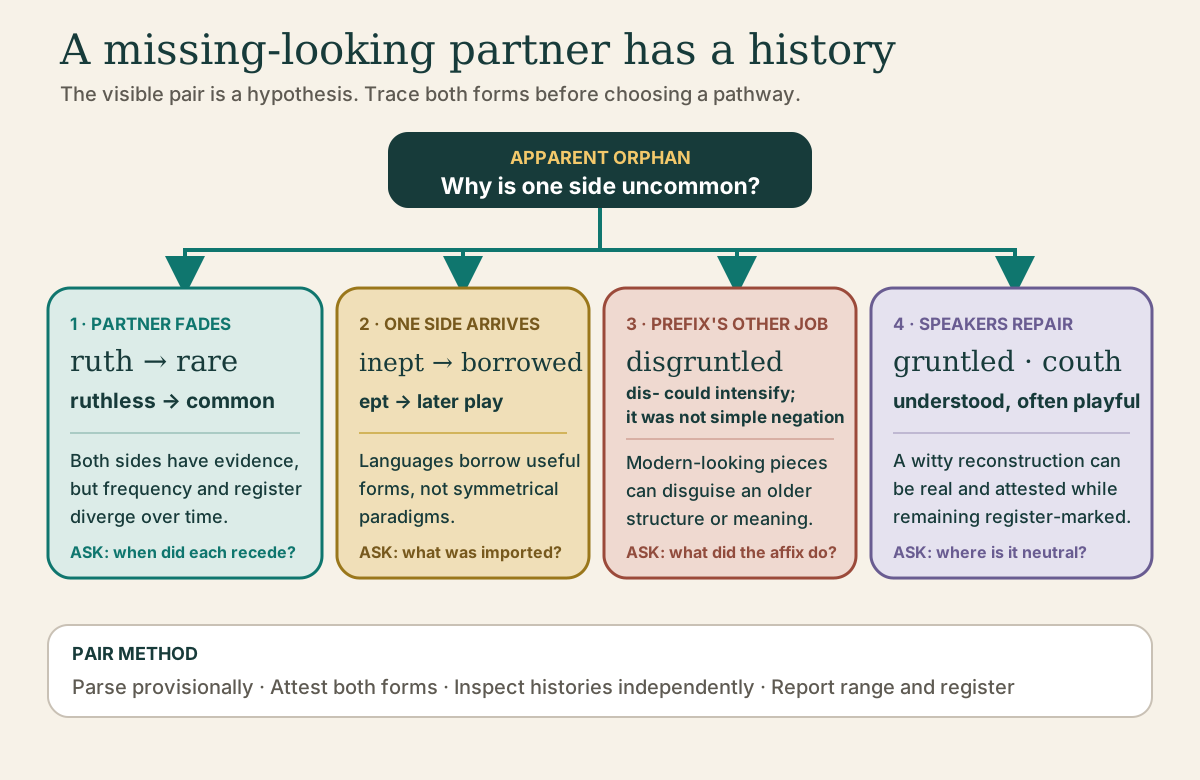
These are commonly called unpaired words, orphaned negatives, or missing opposites. The names are memorable, but they can smuggle in a false assumption: that every apparent negative began as one member of a tidy pair. Sometimes a partner faded. Sometimes English borrowed only one form. Sometimes the first syllable was never the simple negative prefix a modern speaker sees. Sometimes speakers notice the imbalance and create a witty repair.
The uneven pair is the clue. History still has to explain it.
The Word Cabinet
- unpaired word: a conventional form that appears to lack an equally ordinary counterpart expected from its shape;
- orphaned negative: an informal label for a negative-looking unpaired form;
- attestation: a contextualized instance showing that a form was used;
- obsolete: no longer in ordinary use, although historically documented;
- archaic: associated with an earlier period and retained mainly for an old-fashioned effect or limited contexts;
- rare: attested but infrequent in the relevant variety or corpus;
- back-formation: creation of a new form by removing what speakers interpret as an affix from an older form;
- reanalysis: assigning a form a new internal structure or relationship;
- register: the association between a form and a situation, genre, activity, or social stance.
“It is a word” is therefore not the final verdict. A better description may be “historically attested, now rare,” “a later humorous back-formation,” or “ordinary in this community but unfamiliar in mine.”
Path 1: a partner fades
The noun ruth once named pity, compassion, or sorrow for another. Ruthful and ruthless were both possible, but the negative form remained far more useful and familiar while the positive forms receded. A Way with Words uses the case to explain that the members of an apparent pair live separate lives: one may persist while another becomes rare 1.
That history makes “a ruth-filled world” excellent wordplay. It does not make ruthful a newly invented error. The form has a history, and a present-day writer may revive it deliberately. The important distinction is between attestation and current neutrality. An older dictionary can establish that a form existed; it cannot by itself show that the form will pass unnoticed in a contemporary staff memo.
The same pattern can affect pronunciation, meanings, and constructions. Language does not maintain symmetrical inventory for our convenience. Speakers keep the forms that remain useful in recurring situations.
Path 2: English receives only one side
Borrowing does not arrive as a matched luggage set. English speakers can adopt one useful word from another language without importing every related base and affix. A negative-looking beginning may be transparent in the source language, partly transparent to specialists, and opaque to most present-day English speakers.
This is one reason visual subtraction is dangerous. Removing in- from inept produces ept, but that operation does not prove ept was the everyday English ancestor. Speakers can later create or revive ept because the apparent contrast is irresistible. The result may be understandable, funny, and attested while still sounding playful.
Ask two separate questions:
- Diachronic: By what route did each form enter or develop in English?
- Synchronic: How do speakers analyze and use each form now?
A new analysis can become productive even when it does not reproduce the old history. That is ordinary language change, not historical time travel 2.
Path 3: the prefix did another job
Disgruntled tempts a simple equation: dis- = “not,” therefore gruntled = content. Historically, however, the dis- in disgruntled did not behave like the straightforward negative in a modern contrast such as agree/disagree. The older verb was connected with grumbling or complaint, and the prefix could intensify that unpleasant activity. The cheerful positive use of gruntled came later through playful reinterpretation.
The A Way with Words discussion captures the key result: gruntled is findable and usable, but the sailor caller’s proposed history—“it must be the original opposite”—does not follow from the visible shape 3. A correct conclusion can rest on an incorrect argument.
This is the same guardrail used in etymology generally. Similar-looking pieces invite a hypothesis, but dated forms, sound history, meanings, and borrowing routes must support it 4.
Path 4: speakers rebuild or repurpose the pattern
Once speakers notice a gap, they often fill it for effect:
- “I am not overwhelmed or underwhelmed—merely whelmed.”
- “Her desk was organized, her notes were kempt, and the whole plan was surprisingly ept.”
- “After lunch and good news, the crew felt thoroughly gruntled.”
These sentences work because the missing partner is recoverable. The listener recognizes the familiar form, subtracts the apparent negative material, and appreciates the mismatch between formal-looking morphology and playful context. Repeated playful use can eventually broaden a word’s range, but one clever sentence does not prove that the form is neutral everywhere.
The repair does not always restore an old meaning. Whelm is an old verb meaning to engulf or submerge; “merely whelmed” playfully assigns it a middle position between underwhelmed and overwhelmed. A revived-looking form can likewise acquire a new contrastive sense. Check the history of the form and the history of the intended sense separately 5.
Dictionary editors collect this sort of deliberate repair alongside uncommon positive counterparts 5. The humor itself is linguistic evidence: it shows speakers have a productive expectation about pairs. It does not erase the register signal that makes the joke work.
“Not in my vocabulary” is not “not a word”
Suppose you have never heard couth used positively. Several explanations remain open:
- the form may be obsolete or rare;
- it may be conventional in another variety or genre;
- it may occur mainly as conscious wordplay;
- it may be a recent innovation;
- it may be a one-time invention that listeners can still interpret.
Dictionary editors look for sustained, widespread, meaningful evidence rather than requiring a word to pass a logical assembly test 6. A corpus can help compare the two sides of a pair, but raw frequency needs context. Google Books data may include OCR errors, changing corpus composition, uncertain dates, and tokens whose sense is invisible from the graph 7. Open the books. Read the sentences. Separate quotations of old material from new use.
Also decide what you are counting. The personal name Ruth is not the compassion noun ruth. A graph that merges them will create an impressive answer to the wrong question.
Use the P-A-I-R method
Investigate an apparent orphan with PAIR:
- P — Parse provisionally. Bracket the pieces you think you see, and label the analysis a hypothesis.
- A — Attest both forms. Find dated, contextual examples of the familiar word and the proposed partner. Search spelling and inflection variants.
- I — Inspect histories independently. Determine whether one faded, one was borrowed, the prefix had another job, or speakers rebuilt the pair later.
- R — Report range and register. Say where, when, how often, and with what social effect each form occurs.
Mnemonic: A visible PAIR may have two biographies.
Worked example: gruntled
Parse provisionally: dis + gruntled, with an apparent negative prefix.
Attest: disgruntled is common in serious prose. Positive gruntled occurs, but often where writers are visibly playing with the expected pair.
Inspect: the negative-opposite story fails because older disgruntled is tied to grumbling and an intensifying use of the prefix. Positive gruntled is a later reconstruction, not the missing original required by logic.
Report: “Gruntled is attested and intelligible as ‘pleased,’ especially in humorous or self-conscious use; it is not simply the historically prior positive half of disgruntled.”
That sentence preserves both the delight and the evidence.
Practice: build a missing-partner ledger
Choose four from gruntled, ruthful, couth, kempt, ruly, ept, whelmed, and sheveled. Create one row per form:
| Proposed partner | Familiar form | Earliest reliable evidence located | Three current contexts | Likely pathway | Register/confidence |
|---|---|---|---|---|---|
Requirements:
- use at least one edited dictionary entry for each pair;
- inspect at least three full corpus passages rather than snippets;
- mark personal names, quotations, and scanning errors separately;
- distinguish “not found in this search” from “never existed”;
- write one playful sentence, then explain what knowledge makes it funny.
Finish with a two-sentence finding: one sentence about history and one about present-day use. If the evidence conflicts, preserve the conflict.
Rule of thumb
Word families are historical households, not matching sets. Before inventing a missing partner—or declaring one impossible—trace both biographies and describe the register in which each now lives.
Practice
Apparent pieces are hypotheses. The history of disgruntled and the later playful use of gruntled must be checked independently.
Practice
Attestation answers “has it been used?” Frequency and context answer “how ordinary is it now?” Those are different questions.
Practice
A form can be intelligible and attested while remaining playful or rare. Contextual, dated, independent evidence reveals its actual range.
Lesson complete
Nice work.
Sources for this lesson
- 1Ruthless and Ruth. A Way with Words. verifiedSegment tracing ruthless to the once-common noun ruth, meaning compassion or sorrow for another, and showing how one member of an apparent pair can survive after the other becomes archaic. Cited at: segment and transcript.
- 2Lexical Change. Essentials of Linguistics 2e, eCampusOntario. verifiedOpen textbook chapter on coinage, borrowing, word loss, and other changes in a language's vocabulary. Cited at: lexical change.
- 3Gruntled and Disgruntled. A Way with Words. verifiedSegment on orphaned words and unpaired negatives such as disgruntled, unruly, and unkempt, including why modern gruntled is often a playful later formation rather than the historical source of disgruntled. Cited at: segment and transcript.
- 4Etymology FAQ. Merriam-Webster. verifiedConcise explanation of what dictionary etymologies report and why similar-looking forms do not prove ancestry. Cited at: Etymology FAQ.
- 5Uncommon Opposites. Merriam-Webster. verifiedLexicographic survey of forms including gruntle, whelm, kempt, couth, ruly, committal, and flappable, with histories that caution against mechanically removing a negative-looking piece or assigning the resulting form a new opposite sense. Cited at: whelm history; usage overview.
- 6How Does a Word Get into a Merriam-Webster Dictionary?. Merriam-Webster. verifiedEditors describe sustained, widespread, meaningful usage evidence as the basis for dictionary entry. Cited at: dictionary evidence.
- 7Google Books Ngram Viewer — Information and Usage Guide. Google Books. verifiedOfficial corpus documentation covering scope, OCR and metadata revisions, tokenization, search behavior, smoothing, and known analytical limits. Cited at: Ngram documentation.