Lethologica: The Word You Know but Cannot Reach
The word you know but can't reach: tip-of-the-tongue states, Brown and McNeill's classic experiment, why names and rare words are vulnerable, workarounds like 'Arctic cabbage,' a method for recovering the word, and a two-week log.
- 5 min
- 8 steps
- 3 questions
- Lesson 19 of 36
In this lesson
- Transcript lab: Arctic cabbage
- The classic experiment
- Word Cabinet
- Why names and rare words are vulnerable
- Use REACH
- Mini field study
- Rule of thumb
Open alongside this lesson
-
Lethologica (opens in a new tab)
Notice how meaning survives while the conventional spoken label fails to arrive.
-
The Tip of the Tongue Phenomenon (opens in a new tab)
Follow the evidence for partial recall of letters, syllables, stress, and related words.
-
On the Tip of the Tongue: What Causes Word Finding Failures in Young and Older Adults? (opens in a new tab)
Examine frequency, recency of use, proper names, persistent alternatives, and age without turning a model into a diagnosis.
Picking up where you left off.
You can describe the tool, picture where it sits, and hear the rhythm of its name—yet the word itself refuses to arrive. The popular label lethologica evokes Greek Lethe, the river of forgetting. Experimental psychologists usually call the episode a tip-of-the-tongue state, or TOT.
A true TOT is not simply “I do not know.” It includes a feeling that the target is known and retrieval is imminent, often with partial access to its form.
Transcript lab: Arctic cabbage
The A Way with Words segment collects two revealing workarounds. One person forgets banana but can describe a yellow food that comes in its own case. Another substitutes Arctic cabbage for iceberg lettuce 1.
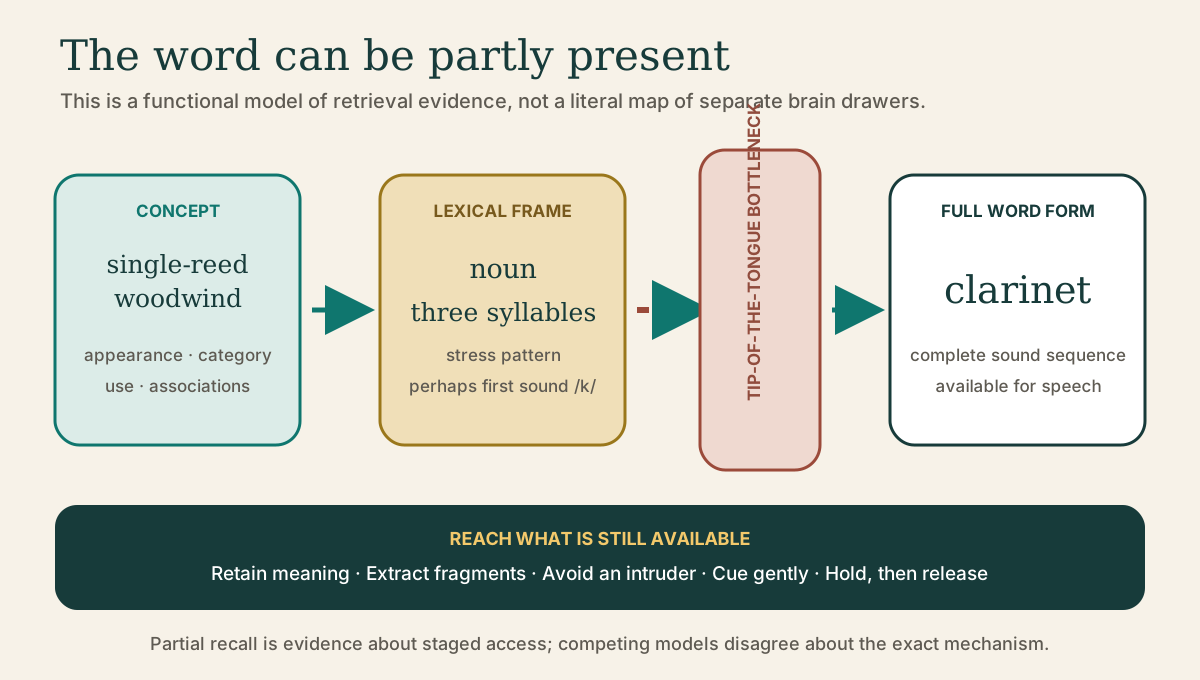
Both speakers retain conceptual structure. They know category, appearance, use, or related words. The missing element is the conventional lexical form. The transcript suggests that word forms and their attributes are not retrieved as one indivisible package. The academic version is more cautious: language production is distributed and staged, and competing models disagree about the exact representations involved.
The classic experiment
Brown and McNeill gave participants definitions of uncommon words and asked for the target. When participants reported a TOT, the researchers collected partial information before revealing the answer. People could often estimate the first letter, number of syllables, stress location, or similar-sounding words better than chance; accuracy rose as they approached successful recall 2.
This result makes TOT states valuable evidence. Retrieval can fail at the full form while leaving fragments accessible.
Word Cabinet
| Term | Working meaning | Evidence it predicts |
|---|---|---|
| conceptual representation | the intended person, object, event, or idea | accurate description despite missing label |
| lemma | an abstract lexical representation often modeled as carrying meaning and grammar | knowing the target is a noun or verb |
| lexeme/word form | the stored phonological or orthographic form in a production model | sounds, syllables, and stress |
| TOT state | felt imminent retrieval with incomplete access | partial form knowledge and later resolution |
| persistent alternate | an incorrect candidate that repeatedly intrudes | delayed access to the target in some studies |
| circumlocution | describing around a missing word | communication can continue without exact retrieval |
The lemma–form distinction is a model, not a tiny labeled drawer visible in a brain scan. TOT data support staged or partial retrieval, but researchers still debate direct-access, blocking, transmission, and metacognitive accounts.
Why names and rare words are vulnerable
Burke and colleagues combined four-week diaries with laboratory tasks. Their targets were often infrequent words and proper names; older adults reported more TOTs, and names of less recently contacted acquaintances were especially common targets. Their transmission-deficit hypothesis proposes that infrequent, nonrecently used, or age-weakened connections may fail to transmit enough activation from lexical to phonological levels 3.
The account predicts why you may retrieve every fact about an actor but not the actor’s name. Many descriptive routes converge on the person, while the arbitrary sound sequence of the name has fewer substitutes.
Use REACH
- R — Retain meaning: State what the target means or refers to.
- E — Extract reliable fragments: Part of speech, first sound, syllable count, stress, rhyme, or context.
- A — Avoid feeding an intruder: Do not rehearse one wrong candidate indefinitely.
- C — Cue gently: Revisit the sentence, alphabet, category, associated place, or a neutral external reference.
- H — Hold, then release: Pause and return later; record whether retrieval was spontaneous or cue-driven.
Worked case: the missing instrument
You know it is a woodwind, usually black, played with a single reed, and has three syllables. Clarinet feels close but remains unavailable.
- Retain: instrument, woodwind, single reed.
- Extract: likely three syllables, perhaps initial /k/.
- Avoid: do not loop clarion if it intrudes.
- Cue: imagine the orchestra seating or complete “bass ___.”
- Hold: if it does not resolve, continue the conversation with single-reed woodwind and check later.
The circumlocution is not failure. It demonstrates preserved conceptual access and keeps communication accurate.
Mini field study
For two weeks, log naturally occurring TOTs:
| Target when recovered | Person/name/common noun | Last used recently? | Partial cues available | Intruder | Resolution |
|---|---|---|---|---|---|
Do not infer a medical condition from a small personal log. The exercise tests whether your cases resemble research patterns: rare forms, names, nonrecent use, partial sound access, and spontaneous resolution.
Rule of thumb
A word on the tip of the tongue is partly present. Preserve the fragments you genuinely know, distinguish the experience from ordinary ignorance, and treat retrieval models as explanations to test rather than anatomical fact.
Practice
Classic experiments found above-chance access to parts of a target’s form during reported TOT states.
Practice
Infrequency and nonrecent use weaken access in the transmission-deficit account; proper names were a major target category in diary data.
Practice
Structured partial cues preserve what is genuinely known; a pause avoids strengthening an intrusive competitor.
Lesson complete
Nice work.
Sources for this lesson
- 1Lethologica. A Way with Words. 2019. verifiedFull segment transcript about retaining a word's meaning or fragments of its sound while the complete spoken form remains unavailable. Cited at: full transcript.
- 2Roger Brown, David McNeill. The Tip of the Tongue Phenomenon. Journal of Verbal Learning and Verbal Behavior. 1966. verifiedClassic experiment eliciting tip-of-the-tongue states and showing partial access to letters, syllable count, stress, and related forms before full retrieval. Cited at: experiment and abstract.
- 3Deborah M. Burke, Donald G. MacKay, Joanna S. Worthley, Elizabeth Wade. On the Tip of the Tongue: What Causes Word Finding Failures in Young and Older Adults?. Journal of Memory and Language. 1991. verifiedDiary and laboratory studies linking tip-of-the-tongue states especially with infrequent words, proper names, nonrecent use, and aging within a transmission-deficit account. Cited at: abstract and study design.
Previous: Frequency and Recency Illusions: Did Everyone Start Saying That?