Grammar Has Geography
Regional grammar as a system: constructions like 'needs washed' and multiple modals such as 'might could,' a five-part test before calling something bad grammar, what 'I might could' actually adds, matching register to the document, and a grammar mini-lab.
- 8 min
- 9 steps
- 3 questions
- Lesson 9 of 36
In this lesson
- Grammar is a system of contrasts
- Word Cabinet: six constructions and choices
- Work the S-C-O-P-E test
- Worked analysis: needs washed
- Multiple modals are not meaningless doubles
- Correct for the document, not the human
- Practice: a grammar mini-lab
- Rule of thumb
Open alongside this lesson
-
Pittsburgh Language (opens in a new tab)
Begin with a speaker's experience of needs washed sounding ordinary at home and being corrected elsewhere.
-
Grammatical Diversity (opens in a new tab)
Shift the regional-language lens from memorable words to repeatable sentence structures.
-
You-uns, Yunz, and Yinz (opens in a new tab)
Explore one of several systematic solutions to singular/plural ambiguity in English you.
-
Boughten (opens in a new tab)
Use this linguistic heirloom to separate inherited grammar from formal-writing expectations.
-
Yale Grammatical Diversity Project (opens in a new tab)
Browse mapped constructions and follow each page into examples, distribution, syntax, history, and references.
-
Multiple Modals (opens in a new tab)
Compare might could and related forms as constrained constructions rather than redundant accidents.
-
Needs Washed (opens in a new tab)
Inspect the construction's geographic core, allowed verbs, and syntactic tests.
-
Standard Language Ideology Statement (opens in a new tab)
Use this to distinguish teaching a powerful register from ranking speakers or varieties.
Picking up where you left off.
Regional language is not just which word do you use? It is also which sentence patterns feel complete, which combinations carry a particular shade of meaning, and which pronoun marks a group? Those patterns are grammar.
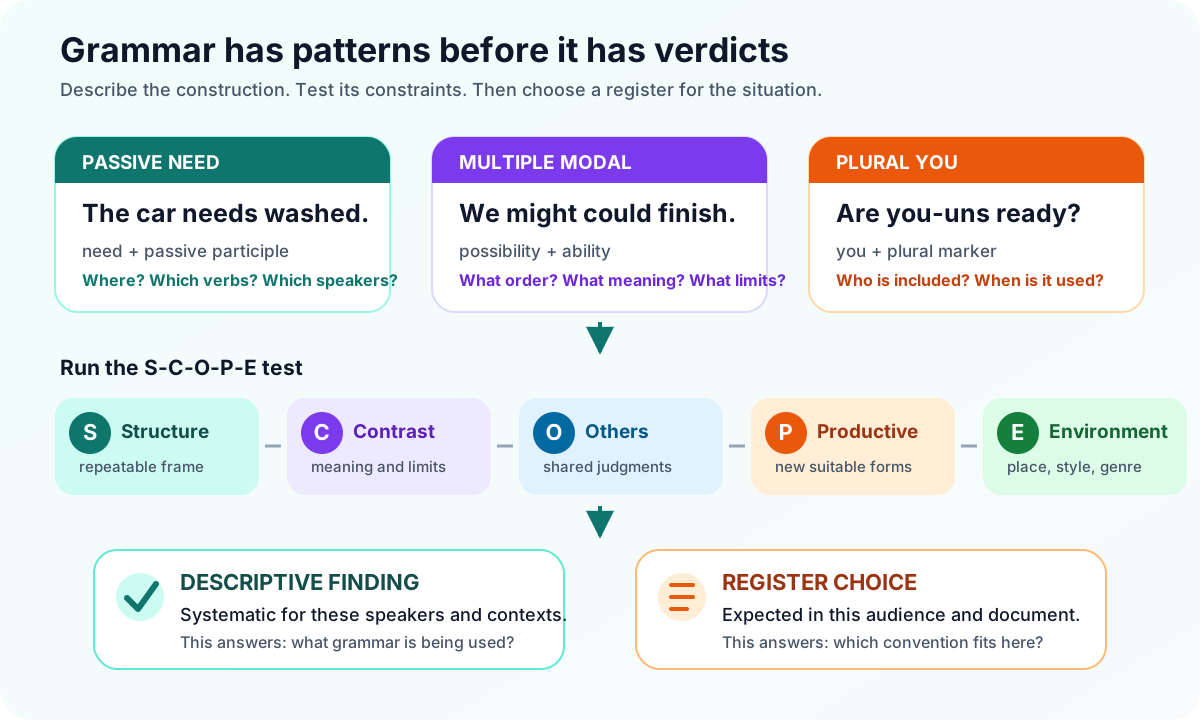
Consider:
- The car needs washed.
- We might could finish tonight.
- Are you-uns ready?
If one sentence sounds unfamiliar, unfamiliarity describes your experience - not the sentence’s absence of structure. The central test is whether a community uses a recurring form with shared meanings and constraints.
Dialect grammar is grammar. A convention can be powerful without being linguistically superior.
A caller raised around Pittsburgh described the car needs washed and the kids need picked up as completely ordinary until people elsewhere corrected the pattern 1. That collision between home competence and outside expectation is exactly why grammar needs a geographic and social map.
Grammar is a system of contrasts
Grammar is not a list of sentences an editor approves. It is the largely unconscious system speakers use to build and interpret utterances. Evidence for a construction includes:
- form: parts appear in a repeatable arrangement;
- meaning: the arrangement contributes a stable interpretation;
- productivity: speakers can apply it to new words or situations;
- constraints: some theoretically possible combinations feel unacceptable;
- community: judgments and uses recur among a network of speakers;
- context: rates may shift by audience, genre, age, place, or identity.
The Yale Grammatical Diversity Project maps precisely these kinds of North American English constructions and connects examples to research on their distribution and syntax 2. An A Way with Words segment highlights the project because maps can make sentence-level differences easier to compare 3.
Word Cabinet: six constructions and choices
Needs washed
The pattern is roughly:
noun phrase + NEED/WANT/LIKE + passive participle
Examples include the car needs fixed and, for some speakers, the dog likes petted. Other varieties may prefer needs to be fixed or needs fixing. The short form is not random deletion. YGDP documents a Midlands core, especially Indiana, Ohio, and western Pennsylvania, along with smaller pockets elsewhere; it also describes which main verbs and participles speakers accept 4. Geographic concentration and internal restrictions are evidence of a construction.
Might could
In a multiple-modal construction, two modal forms can occur together. Might could can layer possibility with ability: a speaker may present an action as tentatively possible rather than confidently promise it. YGDP reports might or may frequently in the first position, though other orders exist, and shows that question and negation behavior varies in patterned ways 5. If speakers were merely stuttering, there would be no shared ordering or interpretation to map.
Y’all, you-uns, yinz, you guys
Standard edited English uses you for one person and more than one. Many varieties build an overt plural. DARE traces you-uns to the Midlands and Ohio River Valley, while related forms have distinct histories and social distributions 6. These forms solve a communicative problem, but they are not interchangeable decorations. Speakers may distinguish a plural addressee from an associated group or reserve a form for familiar settings.
Boughten
Some speakers inherit boughten in family speech where another speaker uses bought. The A Way with Words discussion treats it as a legitimate linguistic heirloom in informal conversation while recommending the conventional bought in formal writing 7. That is a register distinction, not a claim that the family transmitted no grammar.
Standard edited English
This is a learned, institutionally powerful set of conventions used across many schools, workplaces, publications, and public documents. It is useful to control. It is not a place-free language and no one speaks a style manual in every situation.
Style shifting
Speakers adjust language for audience and purpose: a text to a sibling, a city memo, a job interview, and a story among hometown friends may activate different resources. Style shifting demonstrates competence. It does not make one style the person’s “real” language and the rest fake.
Work the S-C-O-P-E test
When a form is called “bad grammar,” pause and test its S-C-O-P-E.
- S - Structure: What repeatable frame contains the form?
- C - Contrast: Does changing an element change meaning or acceptability?
- O - Other speakers: Who uses or recognizes it, and in which communities?
- P - Productivity: Can speakers extend it to a new but suitable item?
- E - Environment: In which regions, relationships, genres, and levels of formality does it occur?
Mnemonic: Systems Carry Order, Patterns, and Environments. A real grammar has more than a memorable example.
Worked analysis: needs washed
Start with a judgment someone reports:
The porch needs painted sounds natural to me.
Structure: The subject names the thing requiring an action. Needs is followed by a passive participle, painted.
Contrast: Compare the porch needs painting and the porch needs to be painted. The three forms express similar needs with different structures. Now test the porch enjoys painted. If speakers reject it, the rejection shows that the short pattern does not accept any verb at random.
Other speakers: Ask for judgments without telling participants which answer is “correct.” Record whether they would say it, only accept it, or reject it. Those are different data.
Productivity: Try a new suitable event: the application needs reviewed. If a speaker accepts a novel example, they are using a rule, not retrieving one memorized phrase.
Environment: A speaker may use the construction at home, recognize it in Pittsburgh speech, and revise it to needs to be reviewed in a national policy document. The register choice does not erase the home construction.
The result is a compact grammatical account: a regionally distributed need-plus-passive-participle construction with lexical and syntactic restrictions. That explanation predicts more than “people leave words out.”
Multiple modals are not meaningless doubles
Suppose a friend says, I might could help Saturday. Compare:
- I can help Saturday - relatively direct ability or availability.
- I might help Saturday - possibility, without asserting ability as strongly.
- I might could help Saturday - for speakers who use it, a carefully hedged possibility of ability.
Context determines the exact force, and researchers do not assume every combination works for every speaker. The useful point is methodological: ask what the combination accomplishes and where each element can appear. YGDP’s catalog of common combinations and negative-clause patterns supplies testable detail 5.
Correct for the document, not the human
Institutions can require a conventional register so readers across regions meet familiar forms. A copyeditor may change the report needs reviewed to the report needs to be reviewed. That can be a practical genre decision.
The mistake is converting that decision into a ranking of minds: “People who say this do not know grammar.” The University of Michigan’s statement on standard language ideology argues that varieties are not intrinsically superior or inferior and warns that language hierarchies can reproduce social discrimination 8.
Use two labels:
- descriptive: grammatical for these speakers, with this structure and distribution;
- editorial: expected or unexpected in this specific audience, genre, or institution.
This lets you teach a high-power convention plainly without recasting a community’s language as damage.
Practice: a grammar mini-lab
Choose one construction from the YGDP atlas. Before reading its analysis, write three hypotheses about its form and meaning.
- Create four examples: two you predict users will accept and two minimal contrasts you predict they will reject.
- Ask three willing speakers for separate judgments: “would say,” “sounds possible,” or “unlikely/impossible for me.”
- Do not imitate an accent or announce the prestige answer.
- Read the project’s distribution and syntax sections. Revise your rule.
- Write one sentence for a casual conversation and one for a formal document, explaining the register choice without calling either speaker intelligent or careless.
If your examples do not match the published description, keep them. You may have a bad prompt, a different speaker population, changing usage, or a genuinely interesting counterexample. Small samples generate questions; they do not overturn maps by themselves.
Rule of thumb
Find the pattern before giving the verdict. Regional grammar has structures, meanings, limits, and histories. Learn those first. Then, when a situation demands a conventional form, edit for the situation while leaving the speaker’s competence intact.
Practice
Recurring structure, productivity, constraints, shared judgments, and distribution are signatures of a grammatical construction.
Practice
Describing a variety and choosing a context-appropriate register are compatible; neither requires treating a speaker’s home grammar as defective.
Practice
The variants supply an overt second-person plural, though their distributions, social meanings, and grammatical details differ.
Lesson complete
Nice work.
Sources for this lesson
- 1Pittsburgh Language. A Way with Words. verifiedSegment on regional vocabulary and grammar associated with Pittsburgh English. Cited at: segment overview.
- 2Yale Grammatical Diversity Project. Yale University. verifiedResearch project documenting systematic grammatical variation across North American English. Cited at: project overview.
- 3Grammatical Diversity. A Way with Words. verifiedSegment introducing systematic grammatical constructions that differ across English-speaking communities. Cited at: segment overview.
- 4Needs Washed. Yale Grammatical Diversity Project. verifiedEvidence and analysis for the needs washed construction and its geographic distribution. Cited at: Who says this? and Syntactic Properties.
- 5Multiple Modals. Yale Grammatical Diversity Project. verifiedEvidence and analysis for constructions such as might could in varieties of North American English. Cited at: Overview and Syntactic Properties; Modal Combinations and Negative Clauses.
- 6You-uns, Yunz, and Yinz. A Way with Words. verifiedSegment on regional second-person plural pronouns and their histories. Cited at: segment overview.
- 7Boughten. A Way with Words. verifiedSegment on a productive dialect form and its contrast with edited-standard conventions. Cited at: segment overview.
- 8Standard Language Ideology Statement. Department of Linguistics, University of Michigan. verifiedDepartmental statement explaining that stigmatized varieties are structured systems and that judgments about language can reproduce social inequality. Cited at: Our position and Equity across varieties.