What Do You Call Someone from There? Demonyms, Endonyms, and Local Authority
Demonyms, endonyms, and exonyms: the suffixes English uses for people from places, toponym versus demonym versus language name, local, official, and outsider naming authority, a method for checking a name, and a Stoughton naming dossier.
- 5 min
- 7 steps
- 3 questions
- Lesson 35 of 36
In this lesson
- The productive toolkit
- Three different “name of a place” questions
- Endonym and exonym
- Local, official, and outsider authority
- The LOCAL method
- Practice lab: a Stoughton naming dossier
Open alongside this lesson
-
The Rules for Forming Demonyms (opens in a new tab)
Compare productive endings such as -an, -ian, -ite, and -er with borrowed, historical, and locally preferred forms.
-
Glossary of Terms for the Standardization of Geographical Names (opens in a new tab)
Use precise definitions for endonym and exonym and notice that naming standards serve administrative purposes as well as linguistic description.
-
Ethics (opens in a new tab)
Collect local forms with consent, attribution choices, context, and respect for community authority.
Picking up where you left off.
A person from New York is a New Yorker. A person from Wisconsin is a Wisconsinite. A person from Phoenix may be called a Phoenician, a form that reuses an ancient name rather than transparently attaching the most obvious modern suffix.
Words for inhabitants are demonyms. They look like a simple suffix exercise until history and local preference intervene. A Way with Words reviews productive tendencies while stressing that exceptions multiply quickly 1.
The productive toolkit
English forms many demonyms with:
- -an / -ian: American, Canadian, Bostonian;
- -ite: Wisconsinite, Brooklynite;
- -er: New Yorker, Londoner;
- -ese: Japanese, Portuguese;
- -i: Iraqi, Israeli in English borrowing patterns;
- suppletion or historical inheritance: a form not predictably built from the current English place name.
These are tendencies, not a decision tree. Sound shape matters: suffixes may trigger deletion, stress change, or spelling adjustment. Analogy matters: a new local form may copy another familiar city. Borrowing matters: English may adopt a resident term through another language. Above all, convention matters. A well-formed invention is not automatically the form residents use.
Three different “name of a place” questions
Keep these categories apart:
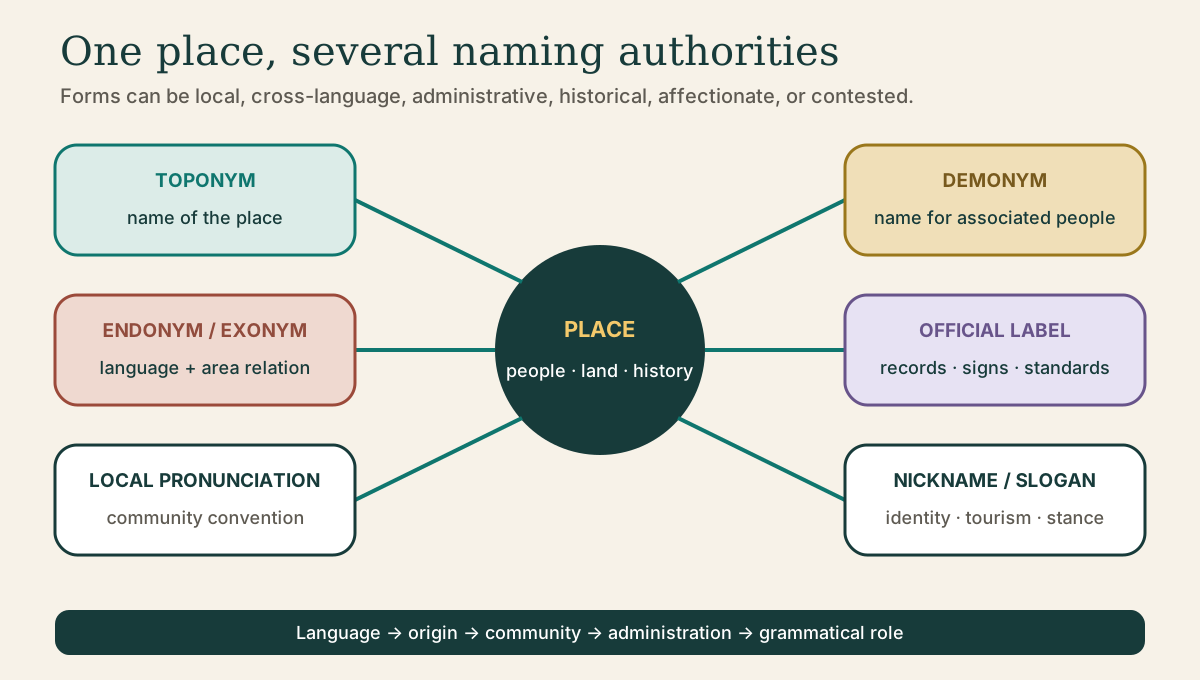
- Toponym: a place name—Wisconsin, Stoughton, Yahara River.
- Demonym: a name for a person associated with a place—Wisconsinite.
- Adjectival form: a modifier associated with the place—Wisconsin law. It may match the demonym, but need not.
One form can occupy several roles. American can be noun or adjective. New Yorker is normally a person noun, while New York itself serves attributively in New York street. Do not force one suffix to do every grammatical job.
Endonym and exonym
An endonym is a geographical name used in an official or well-established language of the area where the feature is located. An exonym is a name used in a particular language for a feature outside the area that differs from the relevant endonym. The United Nations geographical-names glossary supplies the technical definitions used in standardization work 2.
Familiar cross-language pairs show the relation:
- English Germany versus German Deutschland;
- English Florence versus Italian Firenze;
- English Munich versus German München.
Do not equate endonym with universally correct and exonym with disrespectful. Exonyms are normal products of language history. But names can also be bound to conquest, displacement, sovereignty, or community revitalization. A style decision should consider the people, language, and political context involved—not only ease for outsiders.
Local, official, and outsider authority
A place can have:
- an official administrative name;
- one or more names in Indigenous or heritage languages;
- a resident demonym;
- a tourism slogan;
- an affectionate or hostile nickname;
- a local pronunciation that outsiders routinely miss;
- historical names still present in archives.
These labels do different jobs. A city council can standardize forms for signage and records; it does not mechanically determine every community nickname. A national map can record an official form while residents use another in ordinary speech. A reclaimed Indigenous name may carry authority that older official documents failed to recognize.
For Stoughton, Wisconsin, suffix rules generate plausible resident-name candidates, but this lesson deliberately does not crown one from morphology alone. Search city documents, local journalism, school publications, historical societies, and ordinary resident usage. If forms vary, the variation is the finding.
The LOCAL method
- L — Language: in which language is the name being used?
- O — Origin evidence: what dated records support the proposed history?
- C — Community use: what do residents and relevant communities actually say?
- A — Administrative status: what form is official, and for which purpose?
- L — Linguistic role: toponym, demonym, adjective, nickname, endonym, or exonym?
Do not let etymology replace present identity. A historically accurate origin does not tell you how a community now interprets a name.
Practice lab: a Stoughton naming dossier
Build a one-page dossier without assuming the answer:
- Gather ten resident-reference tokens from at least three local source types.
- Record exact form, date, speaker or publication, grammatical role, and tone.
- Ask consenting residents which forms they use and whether any feel official, playful, dated, or outsider-made.
- Check historical records for the city name and local pronunciations.
- Add relevant Ho-Chunk, Norwegian, and other community language histories only from responsible sources; do not treat heritage as decoration.
- Report dominant form, alternatives, uncertainty, and source limits.
Professional linguistic ethics guidance emphasizes consent, community impact, and responsibility in collecting and sharing language data 3. A personal learning project still owes speakers privacy and accurate representation.
Rule of thumb
Morphology proposes; communities conventionalize. Build candidate names with suffixes, then let documented local use, language history, and speaker authority determine what the names actually do.
Practice
Rules create plausible candidates, but conventional forms are lexical and socially established.
Practice
Endonym and exonym concern the relationship between a geographical name, language, and area—not whether a form sounds foreign.
Practice
Morphology proposes forms; local documented usage and speaker evidence establish convention and variation.
Lesson complete
Nice work.
Sources for this lesson
- 1The Rules for Forming Demonyms. A Way with Words. 2012. verifiedTranscript on resident names, productive suffixes, local forms, and the large number of exceptions. Cited at: transcript.
- 2Glossary of Terms for the Standardization of Geographical Names. United Nations Group of Experts on Geographical Names. 2007. verifiedOfficial terminology for place-name study and standardization, including endonym and exonym. Cited at: official glossary.
- 3Ethics. Linguistic Society of America. verifiedProfessional ethics resources for linguists, including responsibilities to research participants and language communities. Cited at: ethics statement.
Previous: Speaking Around the Taboo: Euphemism, Dysphemism, and Context