Folk Etymology: When an Opaque Word Learns Familiar Clothes
When an opaque word is reshaped to look familiar: Colorado's Purgatoire River becoming Picketwire, false etymology versus folk etymology, eggcorns and related categories, tracing forms through time, and auditing a too-perfect origin story.
- 5 min
- 8 steps
- 3 questions
- Lesson 16 of 36
In this lesson
- Transcript lab: three languages in one canyon
- Word Cabinet
- False etymology versus folk etymology
- Nearby categories
- Use FOLK
- Practice: audit a too-perfect origin
- Rule of thumb
Open alongside this lesson
-
Picketwire (opens in a new tab)
Follow a multilingual place-name through Spanish, French, and an English reinterpretation.
-
Holistic vs. Wholistic (opens in a new tab)
Separate a meaning association that makes sense today from the word's documented ancestry.
-
The Inevitability of Folk Etymology: A Case of Collective Reality and Invisible Hands (opens in a new tab)
Connect individual reinterpretation with shared cultural knowledge and community transmission.
Picking up where you left off.
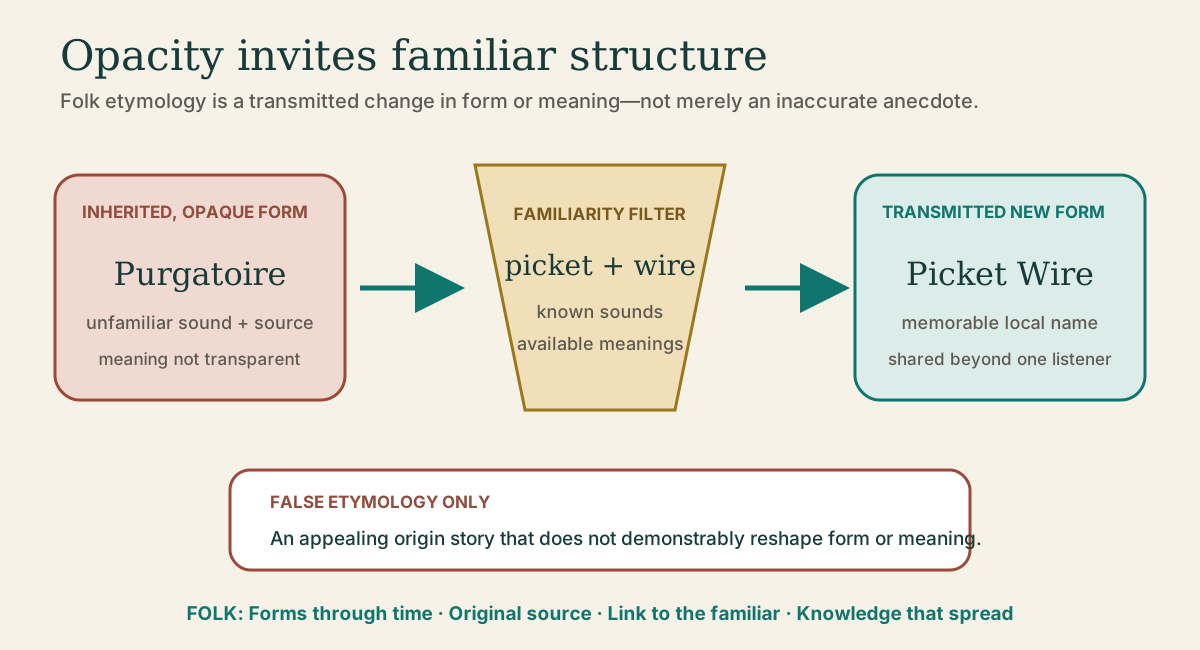
An unfamiliar form is cognitively expensive. Speakers may pull it toward words they already know, making its sound, spelling, or meaning more transparent. When that reinterpretation becomes conventional, the result is folk etymology.
The label does not mean “an etymology invented by foolish people.” It names ordinary pattern-seeking. The same ability that lets you recognize meaningful parts in dishwasher can detect parts that were not historically there.
Transcript lab: three languages in one canyon
The A Way with Words Picketwire transcript begins with a long Spanish name for the River of Lost Souls in Purgatory, follows a French shortening to Purgatoire, and then shows English speakers mapping the unfamiliar French form onto picket and wire 1. The modern local form is not a translation: fences and wire were not the original meaning. Familiar English sounds supplied a memorable new analysis.
The episode also introduces Hobson-Jobson, a term for reshaping foreign material into familiar-sounding forms. The name is itself traditionally explained as an English rendering of a mourning cry for Hasan and Husayn. The term is memorable, but the mechanism—not the curiosity—is the lesson: contact places listeners at the edge of what their sound and meaning systems can comfortably parse.
Word Cabinet
| Item | Familiar pull | What changed or is proposed to change |
|---|---|---|
| Purgatoire → Picket Wire | English picket + wire | place-name pronunciation and form |
| holistic → wholistic | association with whole | spelling and perceived structure |
| sparrowgrass for asparagus | familiar sparrow + grass | sound and segmentation |
| bridegroom | familiar groom | an older second element was replaced by a known word |
| Hobson-Jobson | English-like names | foreign cry recast as familiar sound material |
The holistic/wholistic transcript is an excellent warning. The modern idea of treating a whole system makes the whole association semantically attractive, but resemblance does not establish ancestry 2. A folk reinterpretation can be motivated and historically wrong at the same time.
False etymology versus folk etymology
A false etymology is an inaccurate claim about origin. The story that rule of thumb came from a legal permission to beat one’s wife is false whether or not anyone changes the phrase.
A folk etymology affects the linguistic item: its form, segmentation, spelling, or meaning is remodeled under pressure from a familiar association. A false story may motivate such remodeling, but the story alone is not the change.
Rundblad and Kronenfeld describe the route from individual construction to collective reality: a reinterpretation spreads more readily when other speakers can fit it into shared semantic and cultural knowledge 3. “Folk” therefore points to social conventionalization.
Nearby categories
- Eggcorn: an individual or community substitutes meaningful familiar material in an expression, such as eggcorn for acorn; often discussed as a present-day subtype of analogical reshaping.
- Mondegreen: a misheard stretch of speech, especially a lyric, without requiring a new etymological analysis.
- Metanalysis: a boundary moves, as [a] [napron] becomes [an] [apron].
- Calque: speakers translate meaningful parts from another language rather than reshape its sound.
- Borrowing: a form enters through contact; adaptation alone is not automatically folk etymology.
These labels diagnose different parts of a pathway. Picket Wire involves borrowing history, contact adaptation, and a familiarizing reanalysis.
Use FOLK
- F — Forms through time: Locate the earliest and intermediate spellings or pronunciations.
- O — Original language and meaning: Identify the source without assuming today’s segmentation.
- L — Link that felt familiar: State the sound or meaning association available to later speakers.
- K — Knowledge that spread: Find evidence that the remodeled form circulated beyond one person’s guess.
Worked case: wholistic
Forms: holistic predates the spelling wholistic.
Original: the word belongs to the family of holism, formed from Greek material meaning whole or entire, but it is not historically derived from English whole.
Link: contemporary meaning makes the English word whole feel explanatory.
Knowledge: writers adopt the w-spelling to display that analysis. The association affects form, so this is more than an incorrect story.
The correct research response is not “people are illogical.” It is “a strong semantic neighbor attracted an opaque form.” Use dictionary etymologies to check the earlier chain and label unknown steps rather than filling them with a good anecdote 4.
Practice: audit a too-perfect origin
Choose one place-name or word with an origin story that maps neatly onto familiar English pieces. Build a FOLK table with dated evidence. Then classify your result:
- documented folk etymology;
- plausible familiarizing influence;
- false etymology with no demonstrated form change; or
- unresolved.
Add one sentence about what the familiarized form hides—an earlier language, cultural practice, person, or landscape feature.
Rule of thumb
A folk etymology must do more than sound like a good story. Show the inherited form, the familiar attractor, the resulting change, and evidence that other speakers carried it forward.
Practice
The association with familiar forms affected the conventional name itself, not just an explanation told afterward.
Practice
The mechanisms differ, though a single historical change may involve both familiarity and boundary reinterpretation.
Practice
Historical claims require dated forms and a plausible chain of transmission, not just present-day similarity.
Lesson complete
Nice work.
Sources for this lesson
- 1Picketwire. A Way with Words. verifiedMinicast on a place-name reshaped by speakers into a more familiar English form. Cited at: full transcript.
- 2Holistic vs. Wholistic. A Way with Words. 2012. verifiedFull segment transcript about a form reshaped because speakers associate holistic with the familiar word whole. Cited at: full transcript.
- 3Gabriella Rundblad, David B. Kronenfeld. The Inevitability of Folk Etymology: A Case of Collective Reality and Invisible Hands. Journal of Pragmatics. 2003. verifiedResearch article treating folk etymology as an individually motivated reinterpretation that can spread when it fits shared semantic and cultural knowledge. Cited at: article abstract.
- 4Etymology FAQ. Merriam-Webster. verifiedConcise explanation of what dictionary etymologies report and why similar-looking forms do not prove ancestry. Cited at: etymology guide.