The Words We Wish Existed
Coining a word for a real gap: defining the distinction first, building a candidate that's easy to say and spell, a listener's proposed 'mico' from A Way with Words, why dictionaries record words rather than approve them, and testing a coinage in use.
- 7 min
- 8 steps
- 3 questions
- Lesson 2 of 36
In this lesson
- Word Cabinet
- First define the hole
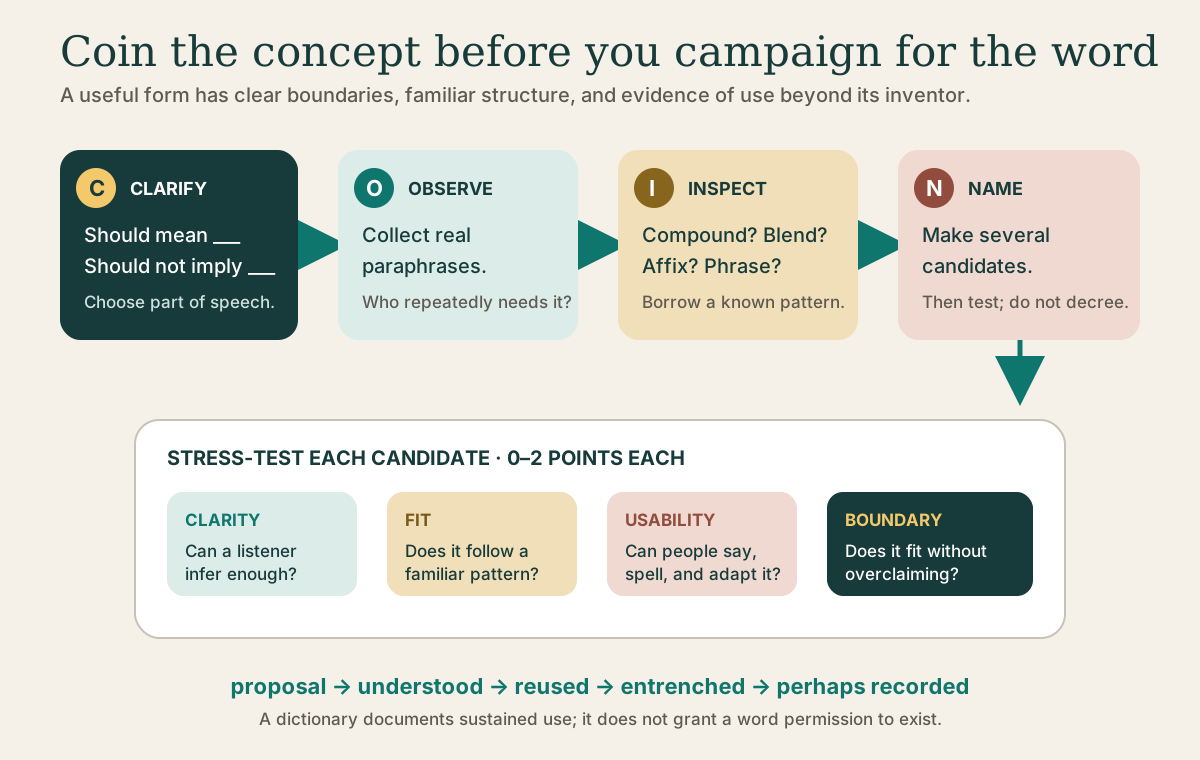
- The COIN method
- Worked example: mico
- Coining is not dictionary admission
- Practice: design, compare, observe
- Rule of thumb
Open alongside this lesson
-
A Word for Loving Loneliness (opens in a new tab)
Compare an elaborate classical-root proposal, the compact coinage gladlorn, and a related German expression.
-
A Word for Nighttime Wakefulness (opens in a new tab)
Explore dorveille and neighboring terms while keeping their meanings distinct.
-
Lexical Gaps, Mico, and the Mom Happy-Sads (opens in a new tab)
Hear two contemporary attempts to package recurring experiences into memorable forms.
-
How Does a Word Get into a Merriam-Webster Dictionary? (opens in a new tab)
Use the criteria as a reality check after inventing a candidate; coinage comes before widespread adoption.
Picking up where you left off.
You wake at 2:17 a.m., not quite sleepy and not ready to begin the day. You watch a child reach a milestone and feel pride braided with loss. You enjoy being alone while also aching with loneliness. English can describe every one of these experiences, yet a speaker may still ask, “Isn’t there a word for that?”
This perceived hole is a lexical gap: a concept or contrast for which a language variety lacks a conventional, conveniently packaged expression. “Gap” does not mean incapacity. A phrase, gesture, story, or metaphor can do the work. Nor does it mean every speaker agrees on what is missing. One person may accept middle-of-the-night wakefulness while another wants a noun as compact as nap.
The productive question is not merely “Which exotic word can I import?” It is: What distinction do I want to make, and what form could a community realistically use for it?
Word Cabinet
| Item | Useful sense | Investigative caution |
|---|---|---|
| lexical gap | a missing conventional word or fixed expression for a distinction | State which language, variety, and intended meaning. |
| gladlorn | a proposed analogical compound for happy and painful solitude | A memorable proposal is not automatically established usage. |
| Waldeinsamkeit | German compound conventionally associated with solitude in a forest | It overlaps the desired feeling; it is not a perfect capsule for every context. |
| dorveille | a French portmanteau of dormir “to sleep” and veiller “to stay awake” | Borrowing the label does not prove the experience is culturally unique. |
| semisomnous | half-asleep | A rare existing word may be precise but hard to retrieve. |
| hypnopompic | relating to the transition out of sleep | Neighboring terms should not be stretched just to fill a gap. |
| mico | proposed name for a voice-to-text mishearing | Its shape analogizes microphone error to typo. |
| mom happy/sads | a community phrase for pride mixed with sadness at a child’s milestone | Multiword expressions can fill lexical needs too. |
First define the hole
A caller to A Way with Words wanted a term for being terribly lonely yet delighting in solitude. The discussion considered a long classical-root construction, the plainspoken coinage gladlorn, and German Waldeinsamkeit, literally built around forest solitude 1. These candidates do not have identical boundaries. Forest solitude might be peaceful without desperate loneliness; gladlorn foregrounds emotional opposition but does not specify a forest.
That is not a problem to wave away. It is the central design decision. Before naming a gap, write:
The word should mean ___ but should not automatically imply ___.
For example: “The word should name wakefulness between two stretches of intended nighttime sleep, but should not automatically imply insomnia, anxiety, or leaving bed.” A Way with Words offers French dorveille for a sleep–wake interval and distinguishes it from semisomnous “half-asleep” and hypnopompic “associated with waking” 2. The words occupy neighboring territory; none should be declared an exact answer until the desired concept is bounded.
Be especially cautious with claims that another language has “an untranslatable word.” A compact label may lack a one-word English equivalent while remaining perfectly explainable. The interesting lesson is often not mystical untranslatability but lexicalization: one speech community has conventionalized a compact form where another commonly uses a phrase.
The COIN method
Use COIN to build a candidate without pretending adoption has already occurred.
- C — Clarify the concept. Write the inclusion and exclusion sentence. Decide part of speech: do you need a noun for a state, an adjective for a person, or a verb for an action?
- O — Observe the need. Collect several naturally occurring paraphrases. Who needs the expression, how often, and in what setting? One clever thought is not necessarily a recurring communication problem.
- I — Inspect familiar patterns. Could speakers use a compound, blend, affix, shortening, semantic extension, or multiword phrase? English speakers recognize roots, bases, and affixes as meaningful building material, though not every combination is equally acceptable 3.
- N — Name and test. Make two or three candidates. Test clarity, structural fit, pronounceability, unwanted associations, and actual uptake.
Four stress tests
Score each candidate from 0 to 2 on four questions:
- Clarity: Can a new listener infer something useful from context?
- Fit: Does the form follow a pattern speakers already use?
- Usability: Can people say, spell, inflect, and remember it?
- Boundary: Does it name the intended concept without smuggling in a false claim?
A score of eight does not make a word “official.” It only identifies a promising design. Language adoption is social, not a patent office.
Worked example: mico
A Way with Words reports a listener’s proposed mico, pronounced “MIKE-oh,” for the kind of error a speech-to-text system makes when it mishears dictated language. Another listener uses mom happy/sads for mixed pride and sadness as a child moves into a new stage 4. Apply COIN to mico:
Clarify. A mico is the wrong textual output caused by speech recognition, not any factual mistake and not necessarily the speaker’s slip.
Observe. People regularly explain “dictation changed that” or “voice-to-text heard me wrong.” The paraphrases indicate a repeatable repair problem.
Inspect. Mico borrows the compact two-syllable profile of typo. Its opening cues mic or microphone. That analogy helps a listener guess both the technology and the error category.
Name and test. It is pronounceable and can pluralize as micos. But spelling may compete with existing names and abbreviations, and a listener without context may not infer the meaning. Most important, appearing on a program documents a proposal, not widespread adoption.
Contrast mom happy/sads. It is longer and socially specific, but transparent: its parts announce the mixed emotion. A parent other than a mother might prefer parent happy/sads, revealing a boundary the original phrase builds into the form. The “best” candidate depends on the community and purpose.
Coining is not dictionary admission
A common myth imagines that a dictionary decides whether a word may exist. In practice, lexicographers collect evidence of how people already use forms. Merriam-Webster describes tracking citations and looking for use that is frequent, widespread, and meaningful; it also notes that regional, professional, and family words can be entirely real without qualifying for a general dictionary 5.
Keep four stages separate:
- Coined: someone produces a new form intentionally or spontaneously.
- Understood: another person interprets it in context.
- Entrenched: speakers retrieve and reuse it as a familiar unit.
- Recorded: a dictionary or glossary documents that use for its intended audience.
A word may thrive in a family, workplace, game community, or town without reaching stage four in a national dictionary. Conversely, a dictionary entry records evidence; it does not force anyone to adopt the word.
Practice: design, compare, observe
Choose one recurring paraphrase from your own life: the second trip back inside after forgetting something, the uncertainty after sending a delicate message, or the tiny task completed while waiting for a larger process.
- Write the “should mean / should not imply” sentence.
- Collect three phrases people already use for it.
- Create one compound, one blend, and one transparent multiword candidate.
- Score each with Clarity, Fit, Usability, and Boundary.
- Put the best candidate into two natural sentences, then ask two people what they think it means before explaining it.
- Record their interpretations. Do not count politeness as adoption; wait to see whether anyone reuses it later.
Rule of thumb
Name the distinction before naming the word. A coinage succeeds first as careful concept design, then—only if other speakers find it useful—as a shared piece of language. You can propose the package; the community decides whether to keep carrying it.
Practice
People can usually describe the idea with a phrase. The gap concerns a conventional lexical package, and its boundaries depend on the language, variety, and sense under discussion.
Practice
Analogy gives a new form structure: speakers can connect microphone with the established error-word typo even before the coinage is widespread.
Practice
Entrenchment is a usage pattern. Independent, sustained, meaningful use matters more than pedigree or one burst of attention.
Lesson complete
Nice work.
Sources for this lesson
- 1A Word for Loving Loneliness. A Way with Words. verifiedSegment prompted by a search for a word naming the pleasure of being alone, useful for studying lexical gaps and translation claims. Cited at: segment summary.
- 2A Word for Nighttime Wakefulness. A Way with Words. verifiedSegment exploring dorveille and related terms for the state between sleeping and waking. Cited at: segment summary.
- 3Catherine Anderson, Bronwyn Bjorkman, Derek Denis, Julianne Doner, Margaret Grant, Nathan Sanders, Ai Taniguchi. Roots, Bases, and Affixes. Essentials of Linguistics 2e, eCampusOntario. verifiedOpen textbook chapter on morphemes, roots, affixes, and other word-building operations. Cited at: section 5.2.
- 4Lexical Gaps, Mico, and the Mom Happy-Sads. A Way with Words. 2026. verifiedRecent segment about proposed words for recognizable experiences that English does not package in one familiar word. Cited at: segment summary.
- 5How Does a Word Get into a Merriam-Webster Dictionary?. Merriam-Webster. verifiedEditors describe sustained, widespread, meaningful usage evidence as the basis for dictionary entry. Cited at: criteria and discussion of non-entry words.