Pointing with Words: Deixis, Joint Attention, and Vocatives
Words that point: deixis of person, place, and time, why this and that aren't just near and far, reference as collaboration, streamers addressing 'chat,' meaning versus inference, a method for placing the deictic center, and removing the scene.
- 6 min
- 9 steps
- 3 questions
- Lesson 32 of 36
In this lesson
- The deictic field
- This and that do more than measure distance
- Reference is collaborative
- Chat is an address, not a new person
- Semantics versus inference
- The POINT method
- Practice lab: remove the scene
- Rule of thumb
Open alongside this lesson
-
Is Chat a Collective Noun for Livestream Viewers? (opens in a new tab)
Test the claim by replacing chat with audience, listeners, or friends and examining the address slot.
-
Demonstratives, Joint Attention, and the Emergence of Grammar (opens in a new tab)
Connect this, that, pointing, attention, child language, discourse, and grammatical change.
-
Implicature (opens in a new tab)
Distinguish a context-anchored semantic reference from additional conclusions inferred in use.
Picking up where you left off.
“Put that there tomorrow.” The sentence is grammatical, but without a scene it is nearly useless. What object? Which place? Tomorrow relative to when?
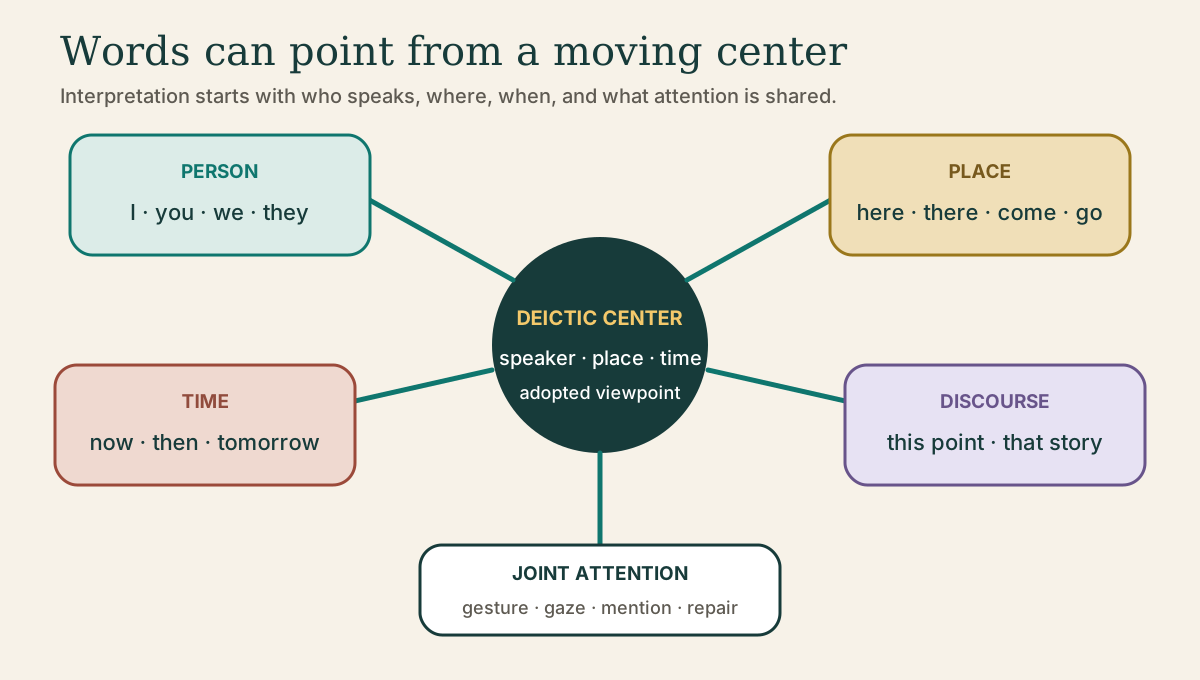
Words such as I, you, here, there, now, then, this, and that are deictic: they direct a listener to recover a referent from a context. They are less like labels printed on objects and more like coordinates whose zero point moves with the speaker, time, place, discourse, or adopted perspective.
The deictic field
| Dimension | Examples | Coordinate needed |
|---|---|---|
| person | I, you, we, they | participant roles |
| place | here, there, come, go | relevant location or viewpoint |
| time | now, then, today, tomorrow | time of speaking or adopted time |
| demonstrative | this, that, these, those | attention, accessibility, contrast, or distance |
| discourse | this point, that story, as follows | location in the unfolding text or talk |
| social | titles, honorifics, familiar forms | relationship and social positioning |
The usual deictic center is the current speaker at the current place and time. But language shifts centers easily. In “Maya called from Milwaukee and said, ‘I’ll be here tomorrow,’” I, here, and tomorrow inside the quotation are anchored to Maya’s reported speech situation, not automatically to the present narrator.
This and that do more than measure distance
Beginner rules often define this as near and that as far. Physical distance matters, but real use also tracks:
- whether the referent is currently visible;
- who is attending to or holding it;
- whether it was just mentioned or is about to be introduced;
- emotional or interactional stance;
- contrast with another candidate;
- the speaker’s adopted viewpoint.
A server can say “How is that tasting?” about a plate physically near the diner. A storyteller can say “And this is the surprising part” about an event decades away. Diessel argues that demonstratives are fundamentally tied to coordinating joint attention, often with gesture, and that this communicative role connects their spatial, discourse, developmental, and grammatical behavior 1.
Joint attention is not merely two people looking in the same direction. Each participant has evidence that the focus is shared. Pointing, gaze, demonstratives, naming, and repair can establish or update that common focus.
Reference is collaborative
Suppose two mugs sit on a table:
A: Pass me that mug.
B: The blue one?
A: Yes, thanks.
The phrase that mug underdetermines the referent. B proposes a candidate; A confirms it. Successful reference emerges across turns.
This explains why “be more specific” is sometimes impossible in advance. Speakers design a reference from what they believe is mutually available; recipients display whether that belief was sufficient. When it is not, repair refines the description.
Chat is an address, not a new person
Streamers say things such as “Chat, is this real?” or “What do you think, chat?” Some observers playfully call this a fourth-person pronoun. A Way with Words offers a simpler analysis: chat is a noun used vocatively to address the audience 2.
Run the substitution test:
- “Audience, should we continue?”
- “Friends, should we continue?”
- “Chat, should we continue?”
The noun changes; the first-person plural subject we and the sentence’s grammar do not. That is evidence for a vocative, not a new grammatical person.
A vocative can sit outside the clause’s argument structure:
- “Maya, the door is open.”
- “The door is open, Maya.”
Maya is addressed but is not the grammatical subject of is open. Prosody and punctuation often set the vocative apart.
The page also describes chat as standing for the larger audience or streaming community. Be cautious with terminology: meronym normally names a part in a part–whole relation, while metonymy is the broader figure in which one associated expression stands for another. Here, the secure grammatical claim is vocative noun; the exact semantic pathway can be analyzed separately.
Semantics versus inference
If a person points at two chairs and says “I like that one,” the demonstrative helps identify a referent. A listener may additionally infer distance, disapproval of the other chair, or a request to buy the selected one. Those conclusions are not all encoded in that.
Keep two layers:
- Semantic instruction: locate a contextually salient distal or contrastive referent.
- Pragmatic inference: use the activity and conversational expectations to infer stance or intended action.
The scholarly literature on implicature provides tests and cautions for that second layer 3. Do not stuff every recurring inference into the dictionary definition.
The POINT method
- P — Place the center: whose person, time, and location organize the expression?
- O — Observe attention: gaze, gesture, visibility, prior mention, and contrast.
- I — Identify the grammatical job: pronoun, demonstrative determiner, adverb, vocative, or discourse marker?
- N — Name the referent: what candidate do participants display?
- T — Test uptake: confirmation, action, correction, or repair?
Practice lab: remove the scene
Collect five public examples containing this, that, here, there, now, or a vocative. For each:
- Copy only the sentence and list what cannot be resolved.
- Restore the surrounding scene or turns.
- Mark the deictic center and attention cues.
- Separate encoded reference from inferred stance.
- Note any repair used to secure the referent.
Then write a text message whose here or tomorrow could be ambiguous across time zones. Revise it with an absolute place or date. Deixis is efficient when context is shared and risky when messages travel beyond it.
Rule of thumb
Deictic words do not contain their referents; they contain directions for finding them. Locate the center, follow attention, identify the grammar, and let the next action confirm the result.
Practice
Grammar supplies relational instructions; the speech situation supplies the coordinates.
Practice
The noun occupies an address slot comparable to audience or friends; the rest of the sentence retains ordinary person grammar.
Practice
Demonstratives and pointing often help establish or update this shared focus.
Lesson complete
Nice work.
Sources for this lesson
- 1Holger Diessel. Demonstratives, Joint Attention, and the Emergence of Grammar. Cognitive Linguistics. 2006. verifiedResearch synthesis arguing that demonstratives coordinate joint attention and connect pointing, reference, discourse, and grammar. Cited at: research synthesis.
- 2Is Chat a Collective Noun for Livestream Viewers?. A Way with Words. verifiedSegment analyzing streamer-addressed chat as a vocative noun rather than a newly invented grammatical person. Cited at: transcript.
- 3Implicature. Stanford Encyclopedia of Philosophy. verifiedScholarly overview of Gricean conversational implicature, its contextual inference pattern, and important limits and alternatives to the original theory. Cited at: overview.
Previous: How Conversation Repairs Itself: Huh?, Who?, and I Mean