Can You Not? Indirect Requests, Implicature, and Politeness
How 'Can you close the window?' becomes a request: speech acts and implicature, 'maybe' under a manager's authority, what's missing in 'Can you not?', Brown and Levinson's politeness strategies, performing an apology, and one sentence in four contexts.
- 9 min
- 10 steps
- 3 questions
- Lesson 22 of 36
In this lesson
- The Word Cabinet
- Method: find the FORCE
- Worked case 1: can, could, and a cold room
- Worked case 2: “maybe” under power
- Worked case 3: the missing words in “Can you not?”
- Politeness is an evaluation, not a switch
- Worked case 4: saying and doing an apology
- Practice: one sentence, four contexts
- Rule of thumb
Open alongside this lesson
-
Can You Not? (opens in a new tab)
Use ellipsis and shared context to unpack a short question that commonly performs an exasperated directive or criticism.
-
Softening Imperatives with Maybe (opens in a new tab)
Compare a tentative-looking form with the workplace obligation participants may understand it to impose.
-
What Makes a Good Apology? (opens in a new tab)
Test the difference between saying an apology formula and successfully taking responsibility or repairing harm.
-
Indirectness, Politeness and the Social Context (opens in a new tab)
Connect indirect interpretations to roles, distance, imposition, culture, personality, and the immediate situation.
Picking up where you left off.
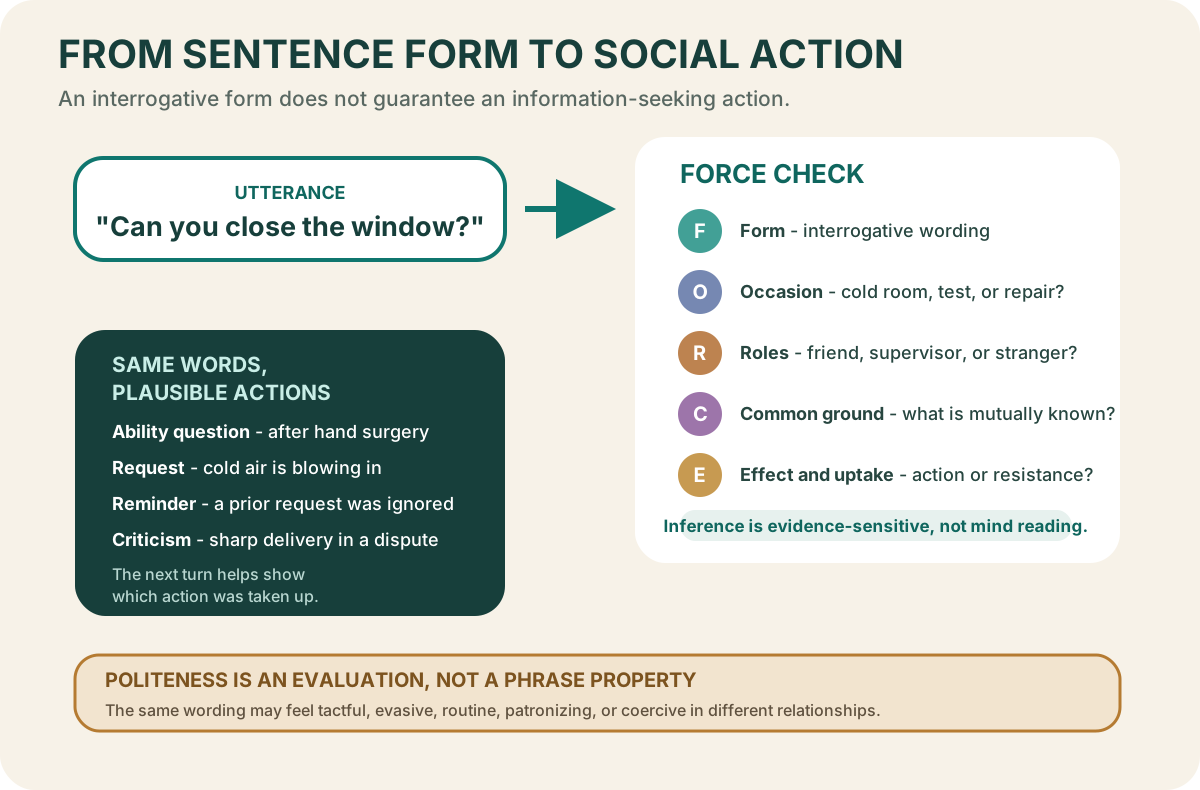
“Can you close the window?” has the grammar of a question about ability. In an ordinary room with an open window, it commonly performs a request. “It’s cold in here” has the grammar of a statement and may perform the same request. “Can you not?” may omit both the troublesome action and an explicit command, yet land as a sharp demand to stop.
Language does more than describe. It invites, promises, warns, apologizes, appoints, refuses, jokes, and directs. The literal sentence gives evidence, but speakers and listeners combine it with occasion, relationship, common ground, delivery, and expected next action. This is the territory of speech acts, indirectness, and implicature.
The point is not to become a mind reader. A good analysis states the plausible action, names the evidence, and checks what participants do next.
The Word Cabinet
- speech act: an action performed through an utterance, such as requesting, asserting, offering, or apologizing;
- locutionary act: producing meaningful words and sentence structure;
- illocutionary force: the socially recognizable action performed in saying them—request, warning, promise, and so on;
- perlocutionary effect: what the utterance brings about, such as persuading, frightening, reassuring, or prompting action;
- direct speech act: an action whose conventional sentence form closely matches its force, as an imperative used for a command;
- indirect speech act: an action performed through a form conventionally associated with another action, as a question used to request;
- implicature: meaning a listener is invited to infer in context rather than meaning fully encoded by the words;
- common ground: information and assumptions participants treat as mutually available for the current interaction;
- hedge: a form that adjusts commitment, precision, strength, or interpersonal stance, such as perhaps, sort of, or I think;
- uptake: a recipient’s displayed understanding of the action;
- felicity conditions: contextual conditions needed for a speech act to succeed appropriately.
J. L. Austin’s lectures established the central insight that speaking can constitute action and distinguished locution, illocution, and perlocution 1. His early contrast between statements and “performative” utterances was a route into a broader theory, not a permanent claim that only ceremonial formulas do things. Contemporary overviews extend and dispute parts of Austin and John Searle while retaining the useful question: what action is this utterance performing under these conditions? 2.
Method: find the FORCE
Use FORCE before assigning an indirect action.
F — Form. Record the wording, sentence type, prosody, gesture, and omissions. Form constrains interpretation without dictating it.
O — Occasion. What physical and conversational problem exists now? An open window, a missed deadline, or a repeated interruption makes different actions relevant.
R — Roles and relationship. Who can reasonably request what from whom? Include institutional power, familiarity, dependency, and the cost of refusal.
C — Common ground. What do participants already know about intentions, routines, and prior attempts? Shared knowledge can license ellipsis; unequal knowledge can make indirectness opaque.
E — Effect and uptake. Does the recipient answer the literal question, perform an action, resist, ask for clarification, or treat the turn as criticism? Uptake is evidence, not proof of private intention.
Mnemonic: form points; FORCE tests.
Worked case 1: can, could, and a cold room
Imagine these sequences:
A: Can you close the window?
B: Yes.
A: …A: Can you close the window?
B: Sure. [closes it]
B’s first answer satisfies the literal ability question but conspicuously leaves the likely practical request undone. The second displays request uptake. That contrast helps explain why the indirect action feels conventional: in the usual setting, both parties can calculate that A’s reason for asking about ability is to obtain the action.
The inference remains defeasible. During rehabilitation, a therapist may genuinely test whether a patient can operate the latch. In a safety drill, a trainer might ask for an ability report before anyone moves. FORCE keeps those alternatives visible.
Gricean theories explain many such inferences by assuming that participants search for a relevant, adequately informative contribution and reason beyond literal content. His “maxims” model conversational cooperation; they are not commandments for moral politeness. Conversational implicatures are context-sensitive and are often cancellable: “Some guests arrived—in fact, all of them did” retracts the usual not all inference without a direct contradiction. The theory is influential but not the final word; rival accounts disagree about where inference, convention, and grammar divide 3.
Worked case 2: “maybe” under power
A manager writes, “Maybe be at the staff meeting by 7:30.” The adverb appears tentative, but the institutional relationship may make the utterance function as a directive. A Way with Words discusses this softening use of maybe 4.
Indirectness can give the recipient room to comply without a blunt order. It can also obscure whether there is a real choice. If punishment follows refusal, soft wording has not erased coercive power. For a worker who prefers explicit expectations, the hedge may add anxiety rather than courtesy.
Research on indirectness emphasizes that interpretation and evaluation vary with power, social distance, size of the imposition, culture, personality, and situation 5. Therefore, do not arrange expressions on a universal ladder from direct-and-rude to indirect-and-polite. In an emergency, “Get out!” may be caring and appropriate. A winding hint may feel manipulative when a direct request would be clearer.
Worked case 3: the missing words in “Can you not?”
Picture someone repeatedly tapping a pen during a recording. Another person says, with falling intonation, “Can you not?” The hearer can reconstruct something like “Can you not tap that pen?” Yet the turn usually does more than ask about ability: it demands cessation and often conveys exasperation or criticism. A Way with Words explains how shared context licenses this ellipsis and supplies the omitted action 6.
Change the delivery—“Can you not reach it?”—and not belongs inside an ability question. Change the context—friends laughing after an outrageous pun—and “Can you not?” may be playful admiration disguised as reproach. Form narrows the field; FORCE selects among live possibilities.
Politeness is an evaluation, not a switch
An influential model by Penelope Brown and Stephen Levinson describes strategies oriented toward face: a person’s socially recognized wants for approval and room to act. It made power, distance, and imposition central to analysis 7. It also inspired substantial criticism, especially when broad tendencies were treated as universal predictions or whole cultures were reduced to one face system.
Later work on relational work asks how participants evaluate behavior against local expectations. Ordinary appropriate conduct may pass without being noticed as especially polite; a ceremonious hedge may be praised, mocked, resisted, or judged insincere. Polite, impolite, and merely expected are participant judgments negotiated in context 8. Centering local participant evaluations can reduce—but does not eliminate—the risk of treating one professional-class or neurotypical script as neutral.
Hedges illustrate the point. “Don’t get me wrong” or “Bless their heart” can preface criticism, but a preface does not neutralize what follows. A Way with Words offers regional examples of conversational softeners 9. Use them as evidence of community routines, not proof that all speakers share one politeness rule.
Worked case 4: saying and doing an apology
“I’m sorry” and “I apologize” can both perform an apology, but neither guarantees sincerity, acceptance, or adequate repair. Did the speaker identify the harm, accept responsibility, address consequences, and avoid repeating it? Was the apology voluntary, intelligible, and directed to the affected person? A Way with Words emphasizes context and conduct over a contest between two formulas 10.
This distinction reaches beyond felicity alone. An utterance may count as an apology yet still be judged evasive or insufficient. Felicity asks whether the act is successfully performed under the relevant conditions; interactional repair asks what happens to responsibility, harm, and the relationship afterward. “I apologize if you were offended” may be heard as evading responsibility. A concise “I missed the deadline. That created extra work for you. I have fixed the schedule and will send updates by noon” may do more repair. Still, recipients are not obligated to accept an apology, and communities differ in preferred forms.
Practice: one sentence, four contexts
Choose “Could you move?”, “It’s getting late,” or “Maybe send that today.” Build four scenes: close friend, supervisor and employee, strangers sharing space, and an urgent safety problem.
For each scene:
- run FORCE and name two possible actions;
- write the likely next turn or physical response;
- identify who bears the cost and whether refusal is genuinely available;
- revise once for greater clarity and once for greater deference;
- explain why neither revision is automatically more polite.
If your judgment depends on imagined tone or history, write that assumption down. Evidence beats intuition disguised as certainty.
Rule of thumb
Form suggests; context and uptake identify the action. Indirectness is not automatically politeness. Ask who can do what, under which conditions, at what cost—and whether the participants treat the utterance as successful.
Practice
Form alone does not settle force. Institutional roles and shared expectations can make tentative wording function as a requirement.
Practice
A context-dependent implicature can often be cancelled, as in “Some guests arrived—in fact, all did,” although real examples and theories require careful analysis.
Practice
Indirectness is one resource among many. It can feel considerate, vague, manipulative, efficient, or ordinary depending on the interaction.
Lesson complete
Nice work.
Sources for this lesson
- 1J. L. Austin. How to Do Things with Words. Oxford University Press. 1962. verifiedFoundational lectures on utterances as actions, including felicity conditions and the distinctions among locutionary, illocutionary, and perlocutionary acts. Cited at: How to Do Things with Words.
- 2Speech Acts. Stanford Encyclopedia of Philosophy. verifiedScholarly overview of direct and indirect force, speaker meaning, uptake, felicity, and major developments beyond Austin and Searle. Cited at: Speech Acts.
- 3Implicature. Stanford Encyclopedia of Philosophy. verifiedScholarly overview of Gricean conversational implicature, its contextual inference pattern, and important limits and alternatives to the original theory. Cited at: Implicature.
- 4Softening Imperatives with Maybe. A Way with Words. 2013. verifiedSegment about a workplace use of maybe that softens a directive without necessarily making compliance optional. Cited at: segment and show notes.
- 5Nicolas Ruytenbeek. Indirectness, Politeness and the Social Context. Cambridge University Press. 2021. verifiedSociolinguistic treatment of how interpersonal and contextual variables shape the production and interpretation of indirect utterances. Cited at: handbook chapter.
- 6Can You Not?. A Way with Words. 2017. verifiedSegment on ellipsis, shared context, and the exasperated action accomplished by the short question Can you not? Cited at: segment and show notes.
- 7Penelope Brown, Stephen C. Levinson. Politeness: Some Universals in Language Usage. Cambridge University Press. 1987. verifiedInfluential face-based account of politeness strategies; best taught with later critiques of universality and context-free prediction. Cited at: Politeness.
- 8Miriam A. Locher, Richard J. Watts. Politeness Theory and Relational Work. Journal of Politeness Research / De Gruyter. 2005. verifiedCritiques the equation of politeness with mitigation and proposes relational work as a framework encompassing appropriate, polite, impolite, and contested behavior. Cited at: relational-work framework.
- 9Linguistic Hedges and Conversational Softeners. A Way with Words. 2020. verifiedSegment about regional forms that preface criticism and the interactional work of hedges, downtoners, and softeners. Broad claims about universal politeness rules require qualification. Cited at: segment and show notes.
- 10What Makes a Good Apology?. A Way with Words. 2019. verifiedSegment emphasizing that the success and sincerity of an apology depend on context and conduct, not merely choosing I am sorry or I apologize. Cited at: segment and show notes.
Previous: Yeah, No, Mm-Hmm: Backchannels and Discourse Markers