Why the Ear Invents Words
How listeners carve continuous speech into words: segmentation, 'a name' versus 'an aim,' mondegreens, eggcorns, malapropisms, and boundary shifts, diagnosing a mishearing from mechanism rather than spelling, and a remove-the-spaces lab.
- 8 min
- 11 steps
- 3 questions
- Lesson 12 of 36
In this lesson
- The Word Cabinet
- The listener’s invisible problem
- Four outcomes from similar sounds
- Worked diagnosis: do not classify from spelling alone
- The TRACE diagnostic
- Practice lab: remove the spaces
- Rule of thumb
Open alongside this lesson
-
Mondegreens and Oronyms (opens in a new tab)
Listen for the difference between an ambiguous sound sequence and the particular alternate wording a listener builds from it.
-
Eggcorns and Not-Quite-Right Phrases (opens in a new tab)
Test whether a recurring form such as from the gecko carries a meaning-preserving reinterpretation or only a puzzling mishearing.
-
Roots, Bases, and Affixes (opens in a new tab)
Use morphemes and word boundaries to explain why a listener favors one analysis of a sound stream over another.
-
Rhythmic Cues to Speech Segmentation: Evidence from Juncture Misperception (opens in a new tab)
Connect mishearings to experimental evidence that English listeners use strong and weak syllables when segmenting continuous speech.
Picking up where you left off.
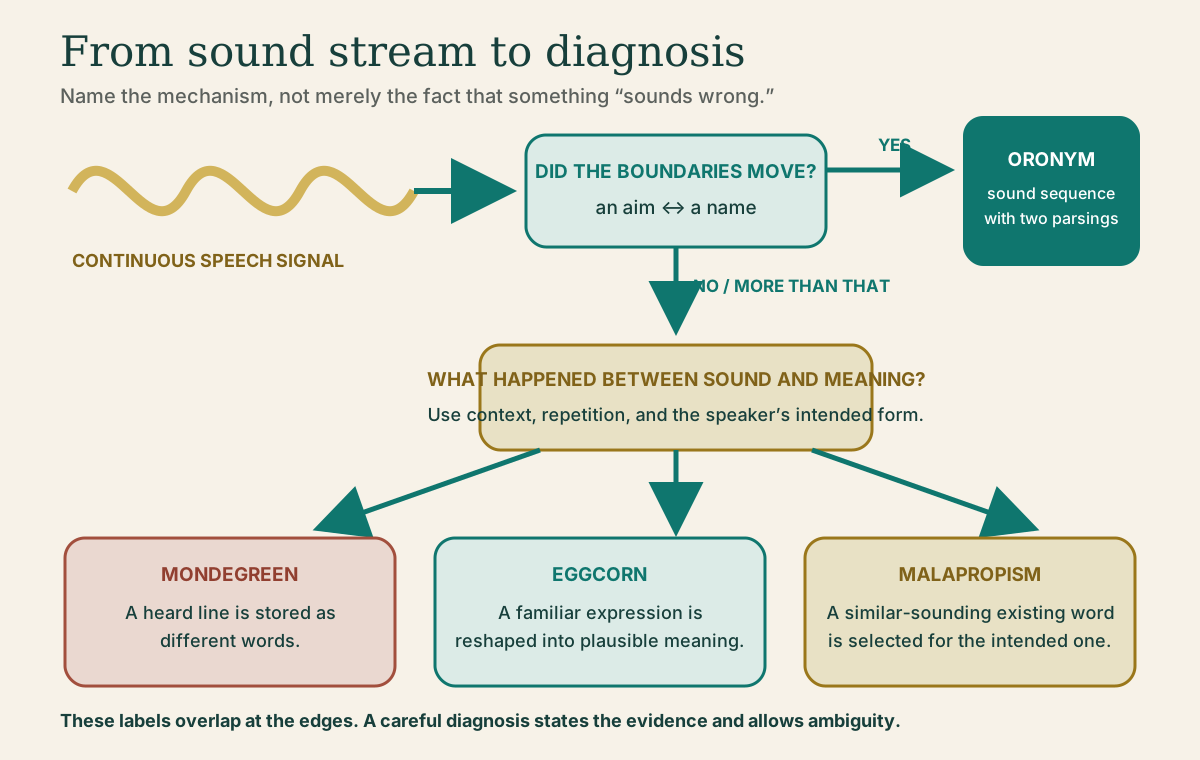
Speech does not arrive with spaces. Air pressure changes continuously; the listener’s mind has to decide where one word ends, which sounds were intended, and which stored meanings fit the moment. Most of the time this prediction is so fast that it feels like direct reception. A spectacular mishearing lets you see the machinery. Experiments with juncture misperception show that English listeners do not guess boundaries blindly: experience with strong and weak syllable patterns biases where they begin searching for words 1.
Mishearings are not proof of laziness or a broken vocabulary. They are the normal language system making a strong guess from incomplete evidence. Noise, unfamiliar names, an unexpected accent, singing, weak context, and competing expectations can all tilt the guess. The interesting question is not “How could anyone hear that?” It is “What made that analysis possible?”
The Word Cabinet
- Segmentation: dividing a continuous speech stream into words and meaningful parts.
- Oronym: one of two or more word sequences with the same or very similar sound, especially when boundaries differ.
- Mondegreen: a line of speech, poetry, or song remembered as different words after a hearing-based reinterpretation.
- Eggcorn: an established expression reshaped into different familiar material that still makes plausible sense to the user.
- Malapropism: an unintended substitution of an existing similar-sounding word for the intended word, often without a coherent reanalysis of a whole expression.
- Morpheme: the smallest unit in a word that contributes meaning or grammatical function, such as kind, un-, or -ness.
- Lexical access: the process of activating and selecting stored words during comprehension or production.
- Reanalysis: assigning a new internal structure or interpretation to material already in use.
These are diagnostic tools, not mutually exclusive species. A mondegreen can exploit an oronym. An eggcorn may begin with a mishearing. One short example may not reveal whether a speaker has a stable reanalysis or simply misspoke.
The listener’s invisible problem
Say a name and then an aim at normal speed. Depending on your pronunciation and timing, the two may be very close. The acoustic signal does not contain a bright line labeled SPACE. Context supplies the likely boundary:
- “Please enter a name.”
- “The project needs an aim.”
The grammar before the sequence, the meanings expected after it, and the situation all compete to select an analysis. That is why unusual proper names are fertile ground for mishearing: they have weak representation in the listener’s vocabulary, while common words are ready alternatives.
Word structure also guides the guess. Speakers learn that English permits recurring pieces such as un-, -er, and -ness, and that compounds join existing bases. Morphological knowledge narrows the set of plausible words even when a listener has never encountered the particular combination 2. It can also tempt the mind toward the wrong familiar pieces.
Four outcomes from similar sounds
Oronym: two parses remain available
An oronym is fundamentally about structural ambiguity in sound. I scream and ice cream can approach the same sequence, but they divide it differently. So can the constructed pair “the coast was clear” and “the ghost was clear” for a listener who does not fully distinguish the initial sounds in noise. Context normally resolves the competition.
An oronym need not be an error. A joke or riddle can deliberately hold both parses open. It describes the relationship between sound sequences, not the intelligence of the person who selects one.
Mondegreen: the alternate hearing becomes the line
A mondegreen is a misheard rendering, classically associated with lyrics or recited language. The term itself came from an essayist’s realization that a line remembered since childhood contained different words, but the useful idea extends beyond that origin. A listener receives a difficult signal and builds a grammatical, meaningful alternative. A Way with Words groups mondegreens with oronyms because alternate boundary placement often supplies the raw material 3.
Imagine an original song line, “The coast was clear when morning came,” heard as “The ghost was near when morning came.” The sound correspondence, story context, and expectation of a dramatic lyric help the alternate version survive in memory. That remembered alternate is a mondegreen; the similar chunks that enable it have an oronym-like relationship.
Eggcorn: a phrase is repaired into sense
An eggcorn is not just any mispronunciation. The new wording creates a plausible semantic model. A Way with Words discusses from the gecko for from the get-go, but the caller reports being puzzled about what a lizard has to do with the phrase 4. That token alone therefore does not prove a meaning-preserving reanalysis; it may be a recurring mishearing, a playful form, or an eggcorn for a different speaker who can explain a coherent “starting gecko” story.
Good eggcorn diagnosis asks whether the user has a repeatable interpretation. Deep-seeded for deep-seated can feel motivated because seeds are planted deep and ideas can metaphorically take root. The reshaping preserves enough meaning to become stable.
Eggcorns reveal what speakers think an expression is made of. They are small, accidental etymologies: familiar pieces replace material that has become opaque.
Malapropism: the wrong lexical neighbor wins
A malapropism occurs when a speaker selects an unintended word that resembles the target in sound: “electrical votes” for “electoral votes,” for example. Both alternatives are real words. The error is primarily selection from the mental lexicon, not a new analysis that makes the political phrase more coherent.
The boundary with eggcorn is fuzzy. If someone builds a stable theory in which votes somehow transmit political power like electricity, the same output begins to look eggcorn-like. Without evidence of that meaningful repair, prefer the modest description: one similar-sounding word replaced another.
Worked diagnosis: do not classify from spelling alone
Suppose a friend writes, “We will solve that problem when we get to that bridge.” You suspect a blend of we’ll cross that bridge when we come to it and we’ll solve that problem when we get to it.
- Recover the event. Was this transcribed from speech, typed quickly, or deliberately playful? A hearing label makes little sense if no listening occurred.
- Identify the target. Ask or use surrounding context. Do not assume there was only one conventional phrase in mind.
- Compare sounds and structure. Here, the words are not especially sound-alike; two constructions share a frame and may have blended during production.
- Check meaning. The result remains understandable, but it does not reinterpret an opaque sound sequence.
- Allow another category. This is better described as a phrase blend than a mondegreen, oronym, eggcorn, or malapropism.
The lesson is useful precisely because the four colorful labels do not cover every speech error.
The TRACE diagnostic
Use TRACE to move from event to mechanism:
- T — Transmission: Did the form arise while hearing, remembering, speaking, reading, or typing?
- R — Rival: What expression or word was probably intended, and how certain is that reconstruction?
- A — Alignment: Line up the sounds. Did boundaries move, or did one lexical item replace another?
- C — Coherence: Does the new form create a plausible meaning that the user repeats or explains?
- E — Evidence: Do you have one slip, a remembered line, repeated use, or the speaker’s own interpretation?
Then classify cautiously:
- Different parsings of a similar sound stream → oronym.
- A heard line remembered as alternate words → mondegreen.
- A stable, meaningful repair of an expression → eggcorn.
- A similar-sounding lexical substitute without clear reanalysis → malapropism.
Mnemonic: Trace the route from ear to meaning.
Practice lab: remove the spaces
Try these with a neutral, curious stance:
- Say “a nice cold hour” and “an ice-cold hour” at conversational speed. Mark where timing or emphasis disambiguates them.
- Diagnose for all intensive purposes. What semantic story could make intensive attractive? What evidence would show stable eggcorn use rather than a one-time slip?
- Create a harmless mondegreen using an original two-line jingle. Record both versions yourself and note which background noise makes the alternate easier to hear.
- Invent a malapropism using two existing technical words. Explain why it lacks the larger meaning repair expected of an eggcorn.
Finish by adding one uncertainty sentence to each verdict: “I would need repeated use,” “This may be deliberate wordplay,” or “The intended form is not recoverable.”
Rule of thumb
Sound supplies candidates; context chooses a meaning. Use TRACE to distinguish alternate boundaries, remembered hearings, meaningful repairs, and wrong-word substitutions—and leave room for overlap when one small example cannot reveal the path.
Practice
Oronyms depend on a sequence being parsed into different words or boundaries; context usually tells the listener which analysis fits.
Practice
The familiar expression has been rebuilt with recognizable material that preserves a plausible overall meaning, the characteristic eggcorn pattern.
Practice
An eggcorn is motivated by a plausible reinterpretation of a familiar expression; a malapropism is principally lexical substitution. Humor is not a diagnostic.
Lesson complete
Nice work.
Sources for this lesson
- 1Anne Cutler, Sally Butterfield. Rhythmic Cues to Speech Segmentation: Evidence from Juncture Misperception. Journal of Memory and Language. 1992. verifiedExperimental study using boundary misperceptions to show that English listeners exploit strong and weak syllable patterns when segmenting continuous speech. Cited at: segmentation experiment.
- 2Catherine Anderson, Bronwyn Bjorkman, Derek Denis, Julianne Doner, Margaret Grant, Nathan Sanders, Ai Taniguchi. Roots, Bases, and Affixes. Essentials of Linguistics 2e, eCampusOntario. verifiedOpen textbook chapter on morphemes, roots, affixes, and other word-building operations. Cited at: roots, bases, and affixes.
- 3Mondegreens and Oronyms. A Way with Words. verifiedSegment on plausible mishearings and ambiguous sound boundaries. Cited at: segment overview.
- 4Eggcorns and Not-Quite-Right Phrases. A Way with Words. verifiedSegment on substitutions that preserve a speaker's plausible interpretation of a familiar expression. Cited at: segment examples.