The Words Families Hand Down
Investigating words that seem to belong to one family: an evidence ladder from a single memory to documented distribution, a method for turning 'Grandma always said this' into a careful inquiry, a worked look at 'pot liquor,' and making a one-page heirloom card.
- 8 min
- 7 steps
- 3 questions
- Lesson 1 of 36
In this lesson
- The evidence ladder
- Word Cabinet
- The HEIRLOOM method
- Worked example: investigate “pot liquor”
- Practice: make a one-page heirloom card
- Rule of thumb
Open alongside this lesson
-
Etymology of Sirsee (opens in a new tab)
Hear how a caller's family word becomes a question about region, pronunciation, spelling, and origin.
-
Ackempucky (opens in a new tab)
Notice the difference between a well-attested meaning and an unknown etymology.
-
I Swanee, I Swan, and I Swow (opens in a new tab)
Use the segment to study how a phrase can carry family, regional, and social information at once.
-
Folklife and Fieldwork: An Introduction to Cultural Documentation (opens in a new tab)
Consult the interviewing and documentation guidance before recording someone else's language story.
Picking up where you left off.
You may know a word that seems to belong to only three people: your grandmother, your sibling, and you. Perhaps it names the crust around a jam jar, a small gift bought for no occasion, or the mild exclamation someone uses instead of swearing. Such expressions are easy to dismiss as mistakes or private jokes. They are better treated as linguistic heirlooms: forms passed through relationships, carrying memories alongside meaning.
An heirloom is not automatically ancient, rare, or unique to one family. The important fact is transmission. You learned it from a person, not from a vocabulary list. Your first research task is therefore double: preserve the human story and determine how far the expression travels beyond it.
The evidence ladder
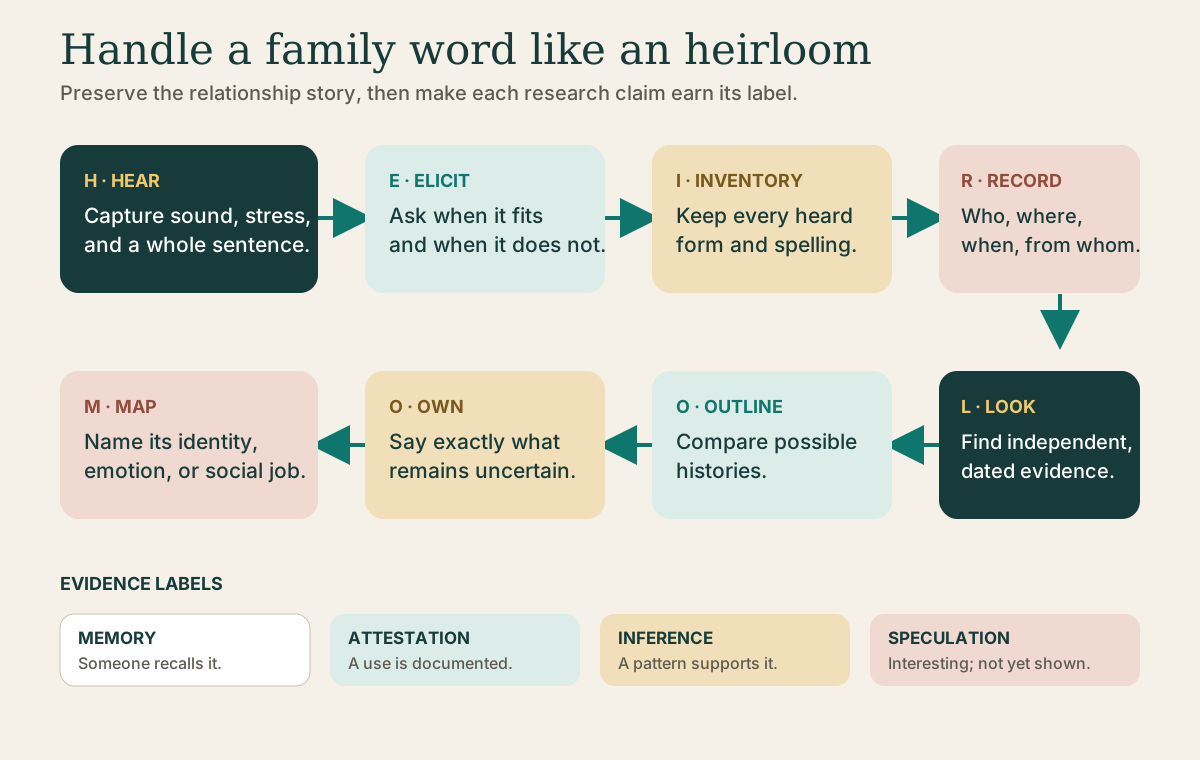
Language investigation becomes much clearer when every claim is placed on one of four rungs:
- Memory: “My grandfather said it when the sink was clogged.” Valuable testimony, but vulnerable to ordinary gaps in recall.
- Attestation: a dated, locatable example of the expression in use. An interview recording, letter, newspaper, novel, or dictionary citation can attest a form.
- Inference: an explanation supported by patterns in the attestations. If most examples cluster in one region, regional association is a reasonable inference.
- Speculation: a possible explanation that lacks enough evidence to choose it over alternatives.
These rungs are not a ranking of personal worth. A family memory may matter more to you than a printed citation. The ladder instead marks what a piece of evidence can prove. Attestations show that a word was used; they do not necessarily reveal who invented it. Similar sounds can suggest a source; resemblance alone cannot establish one.
Word Cabinet
| Item | Working meaning | What it teaches |
|---|---|---|
| sirsee | a small, spontaneous gift | Oral words may acquire spellings such as sursie, sussie, or surcy. |
| ackempucky | sticky or pasty gunk | A meaning can be documented even when the origin is unknown. |
| I swanee | a mild oath or exclamation | Social purpose—avoiding a stronger swear—is part of meaning. |
| linguistic heirloom | an expression passed through a relationship | Transmission can be studied without claiming family ownership. |
| idiolect | one person’s characteristic language repertoire | No two speakers have exactly the same vocabulary and habits. |
| attestation | a documented instance of use | Examples need context, date, speaker or author, and source. |
| variant | an alternate form related to the same expression | Variation in sound or spelling is data, not debris. |
| etymology | the evidence-based history of a word or form | “Origin unknown” is a successful boundary, not a failed answer. |
The sirsee case shows why these distinctions matter. A caller knew a spoken form for a just-because gift and was unsure whether it was “a real word.” The segment documents several spellings, places the word mainly in the American South, and presents derivation from surprise as a possibility rather than a certainty 1. A form need not appear in everyone’s vocabulary to be real. Regional and family words are simply less likely to be encountered by outsiders.
Ackempucky offers a different pattern. A Wisconsin caller associated it with her grandfather and with material caught where it should not be. A Way with Words points to regional-dictionary evidence for sticky liquid or pasty substances, records many spellings, dates examples at least to the twentieth century, and says the etymology is unknown 2. Here the responsible result is asymmetrical: high confidence in the meaning; low confidence in the origin.
I swanee adds a social job. The phrase functions as a softened oath. The program describes it as a mainly Southern expression, with related forms including I’ll swanny and I’ll swan, and cautiously connects it with an older expression meaning roughly “I warrant” or “I swear” 3. Its force cannot be reduced to a dictionary gloss. Who said it, around whom, and instead of what stronger expression are part of the evidence.
The HEIRLOOM method
Use HEIRLOOM to turn “Grandma always said this” into a modest, repeatable investigation.
- H — Hear precisely. Ask the speaker to repeat the expression naturally. Mark syllables, stress, and pauses in ordinary spelling; a phonetic alphabet is optional.
- E — Elicit context. Ask for a whole sentence, a typical situation, and a situation where the expression would not fit.
- I — Inventory variants. Record alternate pronunciations, spellings, plurals, tenses, and related phrases without deciding too early which is “correct.”
- R — Record metadata. Note who used it, where and when they grew up, who they learned it from, and the interview date.
- L — Look independently. Search each variant in regional dictionaries, dated books and newspapers, archives, and corpora. Search meanings as well as spellings.
- O — Outline competing accounts. List more than one possible history. Ask what evidence each account predicts.
- O — Own uncertainty. Label memory, attestation, inference, and speculation. Do not silently promote one rung to another.
- M — Map the social meaning. Was the form affectionate, comic, taboo-avoiding, old-fashioned, occupational, or used only with certain people?
The Library of Congress fieldwork guide treats documentation as a combination of preparation, interviewing, field notes, labeling, and responsible preservation 4. That is useful even for a ten-minute family interview. A recording named audio2.m4a will soon lose its story; a file labeled with date, speaker, place, interviewer, topic, and permission can remain interpretable.
Worked example: investigate “pot liquor”
Suppose an aunt says pot liquor for the liquid left after cooking greens.
Hear and elicit. She pronounces both words clearly and gives: “Save the pot liquor for cornbread.” She would not use it for dishwater or soup stock in general.
Inventory. You search pot liquor, potlikker, and pot likker. Do not assume the eye-catching spelling is older or more authentic.
Record. She heard it from relatives in northern Alabama in the 1960s. That is family testimony about transmission, not yet the word’s first use.
Look. A broad web search finds recipes, but a regional reference is more useful for distribution and dated citations. The Dictionary of American Regional English is designed around regional vocabulary and evidence gathered from speakers across the United States 5. Record exact entries you consult rather than citing “the internet.”
Outline and own uncertainty. One claim may be secure: the expression refers to the cooking liquid in multiple independent sources. A regional distribution may be supported but porous. An appealing tale about its inventor may remain unsupported. State each separately.
Map. Your aunt’s direction also conveys thrift, taste, and competence. That social layer explains why replacing the phrase with liquid loses something even if the basic reference remains.
Practice: make a one-page heirloom card
Choose one expression from someone you can ask. Get permission before recording or identifying them. Then create:
- the expression and all heard spellings;
- two complete example sentences;
- speaker, place, approximate period, and relationship of transmission;
- one independent attestation, or an honest note that none was found;
- one supported inference and one tempting speculation;
- a one-sentence account of its social job.
Do not correct the speaker’s wording during the interview. Avoid leading questions such as “You learned this in Wisconsin, right?” Ask “Where were you living when you remember hearing it?” If you publish or share the result, confirm what name, audio, and personal details the speaker permits you to use.
Rule of thumb
Keep the affection; grade the evidence. A family story can remain precious even when its proposed etymology does not survive checking. The strongest word history is not the one with the neatest ending. It is the one that lets a documented meaning be documented, a plausible inference be provisional, and an unknown origin remain unknown.
Practice
Attestation can establish that people use a form with a meaning without revealing where the form originally came from.
Practice
Writers regularize unfamiliar sounds in different ways; spelling variation can therefore be evidence about oral transmission, not proof that a word is unreal.
Practice
An open question elicits speaker, setting, meaning, and contrast without forcing the informant to accept the researcher’s theory.
Lesson complete
Nice work.
Sources for this lesson
- 1Etymology of Sirsee. A Way with Words. verifiedSegment about a family word for a small surprise gift and the difficulty of tracing words preserved mainly through speech. Cited at: segment summary and discussion of variants.
- 2Ackempucky. A Way with Words. verifiedSegment tracing a regional word for sticky, pasty gunk and considering evidence from family memory and regional records. Cited at: segment summary.
- 3I Swanee, I Swan, and I Swow. A Way with Words. verifiedSegment on minced-oath variants that travel through families and regions with unstable spelling. Cited at: segment summary.
- 4Folklife and Fieldwork: An Introduction to Cultural Documentation. American Folklife Center, Library of Congress. 2016. verifiedPractical guide to planning community documentation, interviewing, recording, describing materials, and caring for the resulting collection. Cited at: Folklife and Fieldwork, 2016.
- 5Dictionary of American Regional English. University of Wisconsin–Madison. verifiedMajor research dictionary documenting regional vocabulary across the United States from fieldwork and written evidence. Cited at: project description.