How Conversation Repairs Itself: Huh?, Who?, and I Mean
How talk fixes its own trouble: who starts a repair and who completes it, self-repair with cut-offs and 'I mean,' other-initiated repair from 'huh?' to specific questions, correction as one outcome among several, and a diagnostic for repairs.
- 5 min
- 7 steps
- 3 questions
- Lesson 31 of 36
In this lesson
- Two questions, four routes
- Self-repair can begin before a turn ends
- Other-initiation ranges from open to specific
- Correction is only one repair outcome
- The FIX diagnostic
- Practice lab: preserve the repair
Open alongside this lesson
-
Is Huh? a Universal Word? Conversational Infrastructure and the Convergent Evolution of Linguistic Items (opens in a new tab)
Examine recordings from ten languages and the distinction between a learned repair word and an involuntary grunt.
-
The Preference for Self-Correction in the Organization of Repair in Conversation (opens in a new tab)
Separate who notices trouble from who supplies the replacement, then trace the positions where repair can occur.
-
Using Uh and Um in Spontaneous Speaking (opens in a new tab)
Compare a planning signal with a repair initiation and avoid treating every hesitation as noise.
Picking up where you left off.
Conversation survives bad audio, ambiguous names, wrong dates, word searches, and competing interpretations because participants can repair trouble while talk is underway.
In ordinary usage, repair may sound like correcting bad grammar. Conversation analysis uses it more broadly: practices for dealing with problems of speaking, hearing, and understanding. The trouble need not be an objective error. “Sam is coming” can be perfectly formed and still prompt “Which Sam?”
Two questions, four routes
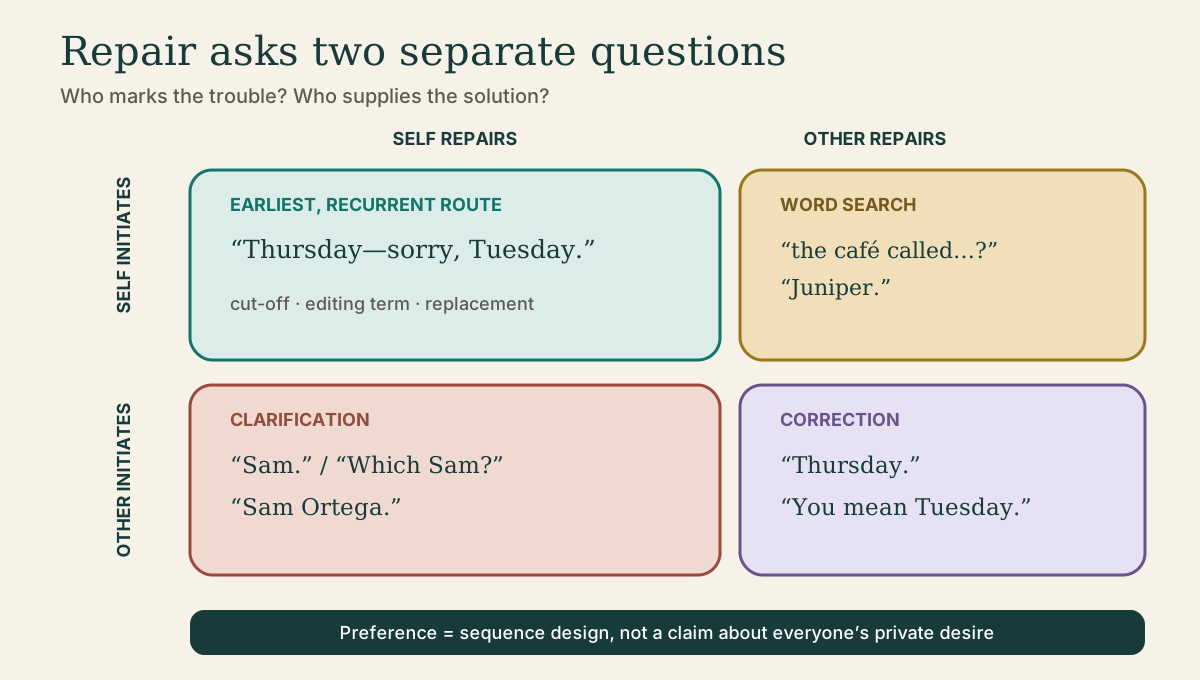
Every repair sequence separates:
- Who initiates repair? Who first marks that something needs attention?
- Who completes repair? Who supplies the clarification, replacement, or confirmation?
That yields four logical combinations:
| Route | Invented example |
|---|---|
| self-initiated, self-repair | “Thursday—sorry, Tuesday.” |
| other-initiated, self-repair | “Sam.” / “Which Sam?” / “Sam Ortega.” |
| self-initiated, other-repair | “Meet at the… what is that café called?” / “Juniper.” |
| other-initiated, other-repair | “Thursday.” / “You mean Tuesday.” |
The 1977 study by Schegloff, Jefferson, and Sacks showed recurrent organization favoring opportunities for the original speaker to repair their own talk 1. Preference here is structural: one route is provided earlier, more routinely, or with less overt correction. It is not a survey of what every speaker consciously enjoys.
Self-repair can begin before a turn ends
Listen for:
- cut-offs: “I ordered the gre— the blue one”;
- editing terms: “I mean,” “rather,” “sorry”;
- repeats: “We met on—on Friday”;
- replacements: “north of town—well, northwest”;
- word searches: “the tool for… tightening the fitting.”
These forms make production visible. A cut-off can stop an emerging error. A repeat can buy planning time. Uh and um may publicly signal an expected delay, though researchers disagree about how lexical and intentional every use is 2. Do not remove all disfluency and then claim the transcript contains no evidence of planning.
A Way with Words notices glottalization and reduction in didn’t 3, but a listener who says “Did you say didn’t or did?” is not necessarily correcting pronunciation. They are initiating repair on a contrast made difficult by the signal.
Other-initiation ranges from open to specific
Repair initiators differ in how precisely they locate trouble:
| Form | Scope | What it asks the prior speaker to do |
|---|---|---|
| “Huh?” / “Sorry?” | open | revisit the prior turn broadly |
| “Who?” | restricted | repair a person reference |
| “Where?” | restricted | repair a place reference |
| “Juniper?” | candidate hearing | confirm or reject a proposed item |
| “Which Tuesday?” | specific | refine one identifiable component |
Specificity is efficient when the listener heard most of the turn. Open repair is useful when the entire signal or action failed.
Dingemanse, Torreira, and Enfield compared naturally occurring conversation in ten languages and found huh-like repair initiators with strikingly similar form and function. They argue that the item is a conventional word shaped by a conversational environment shared across languages—not an innate reflex identical in every mouth 4. The finding is convergent cultural evolution, not “everyone grunts the same.”
Correction is only one repair outcome
Compare:
- hearing: “Did you say fifteen?” — “Fifty.”
- reference: “She approved it.” — “Who?” — “Marta.”
- meaning: “It’s light.” — “Light in weight?” — “No, light in color.”
- fact: “The meeting is Thursday.” — “The calendar says Tuesday.”
- usage policing: “Alice and me went.” — “You should say Alice and I.”
Only the last example necessarily turns toward a prescriptive language norm, and it may derail the activity even though the meaning was clear. The others restore hearing, reference, semantics, or shared facts. Treating all repair as grammar correction hides the system’s main job: sustaining intersubjectivity.
The FIX diagnostic
Use FIX:
- F — Find the trouble source: which word, reference, sound, fact, or action became problematic?
- I — Identify initiation and outcome: who marked trouble, who supplied the repair, and what form did it take?
- X — eXamine uptake: was the repair accepted, rejected, refined, or left unresolved?
Do not infer resolution because a correction was spoken. The next turn may show that it introduced new trouble.
Practice lab: preserve the repair
Choose sixty seconds from a public interview with a reliable transcript. Compare audio and text:
- Circle cut-offs, repeats, delays, and editing expressions in the audio.
- Note which ones the published transcript removes.
- Mark each trouble source and repair initiation.
- Classify initiator and repairer separately.
- Inspect the next turn for acceptance or further repair.
Then rewrite the transcript twice: one readable version and one interactional version. The readable transcript is not dishonest if its purpose is clear; the interactional transcript is necessary when timing and repair are the evidence.
Rule of thumb
Repair is not failure after conversation; it is infrastructure inside conversation. Locate the trouble, separate initiation from solution, and inspect the uptake before declaring understanding restored.
Practice
The original speaker both marks the trouble and supplies the replacement within the same turn.
Practice
A restricted repair initiator identifies the problematic component and lets A clarify it.
Practice
Preference names an observable structural organization, not a claim about private desire or an absolute ban.
Lesson complete
Nice work.
Sources for this lesson
- 1Emanuel A. Schegloff, Gail Jefferson, Harvey Sacks. The Preference for Self-Correction in the Organization of Repair in Conversation. Language. 1977. verifiedFoundational conversation-analysis study separating repair initiation from correction and documenting recurrent opportunities for speakers to repair their own talk. Cited at: foundational study.
- 2Herbert H. Clark, Jean E. Fox Tree. Using Uh and Um in Spontaneous Speaking. Cognition. 2002. verifiedCorpus-based proposal that uh and um can conventionally announce expected delays and help speakers manage planning and the conversational floor. Cited at: corpus-based proposal.
- 3No You Di-int!. A Way with Words. verifiedTranscript examples of glottalization and consonant reduction in forms such as didn't and Martin. Cited at: segment.
- 4Mark Dingemanse, Francisco Torreira, N. J. Enfield. Is Huh? a Universal Word? Conversational Infrastructure and the Convergent Evolution of Linguistic Items. PLOS ONE. 2013. verifiedCross-linguistic study of short questioning interjections used to initiate repair when hearing or understanding fails. Cited at: open study.
Previous: Who Speaks Next? Turn-Taking, Gaps, and Cooperative Overlap