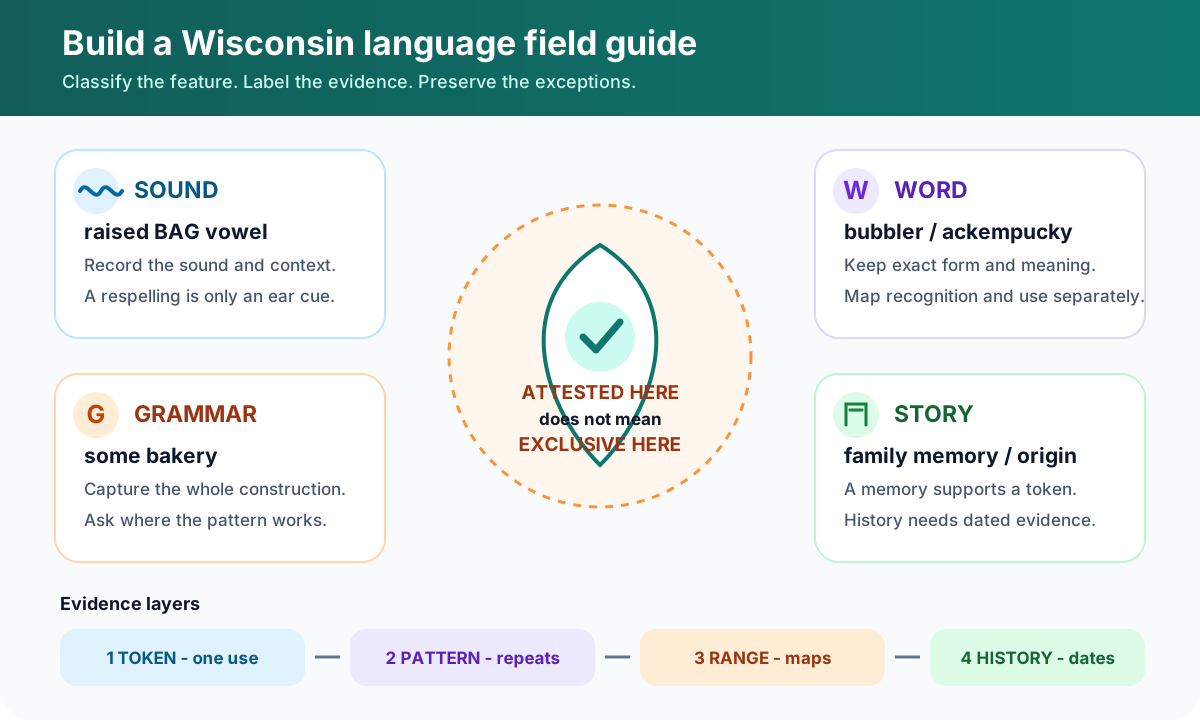
A Wisconsin Language Field Guide
A careful Wisconsin language field guide: seven Wisconsin-connected features including bubbler, four layers of evidence from a single token to survey data, building an evidence-rich entry, why German contact didn't freeze a phrase, and three field cards.
- 8 min
- 13 steps
- 3 questions
- Lesson 8 of 36
In this lesson
- Word Cabinet: seven Wisconsin-connected features
- Four evidence layers
- Worked entry: investigate bubbler with H-E-R-E
- Contact does not mean a language stayed frozen
- Practice: make three field-guide cards
- Rule of thumb
Open alongside this lesson
-
Bubblers (opens in a new tab)
Follow a Wisconsin-associated word whose discontinuous distribution makes the origin story more interesting, not less.
-
Ackempucky (opens in a new tab)
A family word for sticky gunk becomes a case study in spelling, memory, and regional dictionary evidence.
-
Cattywampus (opens in a new tab)
Compare forms and senses while resisting the urge to invent a tidy origin.
-
German Influence on Wisconsin Dialect (opens in a new tab)
Hear how contact history can remain visible in phrases such as some bakery and from little on up.
-
Bag Raising as a Dialect Feature (opens in a new tab)
Use a vowel pattern to separate a recurring regional feature from a supposed mispronunciation.
-
Wisconsin Words Comparison Maps (opens in a new tab)
Compare older DARE fieldwork with later survey responses and notice change as well as continuity.
-
Wisconsin Englishes (opens in a new tab)
Continue from memorable words into recordings, research, and the state's broader linguistic diversity.
Picking up where you left off.
Wisconsin is an unusually good place to learn how not to make a list of “words only we say.” Its speech reflects Indigenous languages, several regional varieties of English, long histories of European language contact, and newer communities using languages including Spanish, Hmong, and Somali 1. A phrase can feel unmistakably local while also appearing elsewhere. A pronunciation can be widespread within one network and unfamiliar across town.
The responsible field-guide label is therefore:
Attested here is not the same as exclusive to here.
The Wisconsin Englishes Project treats the state as a place of linguistic diversity rather than one uniform accent 2. DARE’s comparison maps make the same point empirically: older fieldwork and later survey data can show both persistence and movement in word distributions 3.
Word Cabinet: seven Wisconsin-connected features
1. Bubbler
In much of eastern Wisconsin, bubbler can mean a drinking fountain. The tempting story says a Wisconsin plumbing manufacturer coined the term and the word belongs to Wisconsin. The evidence is more textured. An early trail involves a Kohler bubbling valve around 1914-1915, and DARE research found a close match between the company’s eastern Wisconsin marketing area and the term’s use there. But bubbler is also associated with Rhode Island and appears in parts of Massachusetts and Portland, Oregon; the route connecting those clusters remains uncertain 4.
Field-guide label: lexical feature; strong eastern Wisconsin association; discontinuous wider distribution; partial historical explanation.
2. Ackempucky
A caller from Neenah remembers a grandparent using a form that sounded like ackempucky for sticky gunk, including food stuck between teeth. DARE records related forms for sticky liquid or pasty substances, with evidence beyond that family and beyond Wisconsin 5. The caller’s spelling attempt is valuable: it preserves perceived sound. It is not proof of the word’s standard spelling or origin.
Field-guide label: family-attested regional lexeme; variable spelling; meaning supported by dialect-dictionary evidence.
3. Cattywampus / catawampus / kittywampus
These playful-looking forms can describe something crooked, askew, diagonally situated, or otherwise out of line. The Dodgeville question featured on A Way with Words opens onto several spellings and related senses. The origin is unresolved; even the attractive idea that wampus connects to a Scots word meaning “twist” or “swerve” remains a possibility, not a verdict 6.
Field-guide label: regional word family; several forms and senses; etymology uncertain. “Unknown” is a successful research outcome when the evidence stops.
4. Some bakery
For some Wisconsin speakers, Let’s get some bakery means “let’s get some baked goods.” Here bakery names the products, not only the shop. An episode on German influence presents this use alongside other contact-shaped phrases in parts of Wisconsin 7.
Field-guide label: lexical-grammar pattern; mass-noun-like product sense; associated with language contact in parts of the state.
5. From little on up
The phrase from little on up can mean “from childhood” or “since I was young.” Its structure is understandable even to someone who would not produce it. It illustrates how contact may leave durable patterns in ordinary phrasing rather than only obvious borrowed words 7.
Field-guide label: multiword construction; local/contact-history association; requires speaker and date evidence.
6. Bag raising
In a raised pronunciation of bag, the vowel moves toward the vowel a different dialect might hear in beg. The same regional pattern can affect words such as bagel. The A Way with Words discussion stresses that when a pronunciation recurs across many speakers, it is a dialect feature rather than an individual failure 8. Written respellings such as “beg” are only rough cues; they do not capture an acoustic measurement.
Field-guide label: phonological feature; conditioned vowel variation; gradient and speaker-variable.
7. The surprising absence
A field guide should include what you expected but did not hear. Perhaps twelve interviewees say drinking fountain, none says bubbler, or younger speakers recognize from little on up but do not use it. Absence in a small sample does not prove disappearance, but recording it prevents nostalgia from selecting only confirming memories.
Field-guide label: negative observation with explicit sample limits.
Four evidence layers
Keep each note attached to its evidence type.
- Token: what one person actually said, in what situation, recorded as exactly as possible.
- Pattern: repeated forms across speakers or contexts.
- Distribution: survey, dictionary, map, or corpus evidence showing where and when a feature appears.
- History: documents or research supporting how the feature developed or traveled.
A family story may establish a token beautifully while leaving distribution and origin open. A map can show distribution while saying little about why the pattern formed. Do not ask one layer to do another layer’s job.
Worked entry: investigate bubbler with H-E-R-E
Use H-E-R-E to build an evidence-rich entry.
H - Hear the exact form. Record bubbler, pronunciation if relevant, the object meant, the sentence, and the setting. Was the speaker recalling childhood or choosing a current everyday term?
E - Establish the speaker context. With permission, note age range and places lived during language-learning years. Do not collect a precise address or infer ethnicity, class, or identity from the form.
R - Research the range. Compare the token with DARE maps, Wisconsin language research, and the episode’s documented clusters. The finding is not “Wisconsin word.” It is “strongly associated with eastern Wisconsin, also established in Rhode Island and elsewhere.”
E - Express uncertainty. Separate the Kohler marketing-area evidence from the still-unresolved path to distant clusters. A plausible route is not the same as a traced route.
Mnemonic: Hear Evidence; Respect Exceptions. That final E keeps the field guide alive rather than turning it into folklore.
Contact does not mean a language stayed frozen
Calling a phrase “German-influenced” should begin a question, not end it. Speakers in Wisconsin did not simply copy a complete German structure and preserve it unchanged. Multilingual people, families, and communities used available patterns over generations; descendants could acquire the resulting English feature without speaking German themselves.
To support a contact claim, look for:
- a plausible source-language pattern;
- documented historical contact intense enough to transmit it;
- dates and locations that fit;
- comparison with neighboring regions; and
- alternatives, including independent development inside English.
The Wisconsin episode connects some bakery and from little on up with parts of the state shaped by German contact 7. Treat that as a researched lead. For a full etymology, follow its sources and compare historical attestations.
Practice: make three field-guide cards
Interview one willing Wisconsin speaker, ideally someone whose language history you do not already know by heart. Explain that you are documenting variation, not testing correctness.
For each of three features:
- Capture an exact example sentence or pronunciation in context.
- Label it sound, word, grammar, or story about language.
- Record whether the speaker uses, recognizes, remembers, or rejects it. These are different observations.
- Check at least one institutional source such as DARE or the Wisconsin Englishes Project.
- Write the narrowest distribution claim the evidence supports.
- Add an uncertainty line: what could another speaker, map, or dated record change?
Bad entry: “Wisconsinites say bubbler.”
Better entry: “Speaker W03, raised in Sheboygan County in the 1980s, produced bubbler without prompting for a school drinking fountain. DARE comparison maps and published discussions associate the term especially with eastern Wisconsin, but it is neither statewide nor Wisconsin-exclusive.”
The better card is longer because it preserves source, time, place, meaning, and limit.
Rule of thumb
Local pride is a research question, not a distribution claim. Enjoy the recognition of ackempucky, some bakery, or a raised bag. Then label the feature type, trace independent evidence, keep spelling and origin tentative where needed, and write attested in Wisconsin until the map earns anything stronger.
Practice
The distribution has strong clusters and puzzling gaps; association is not exclusivity, and part of its historical route remains uncertain.
Practice
Bag raising is a phonological pattern. A spelling imitation may hint at the sound, but the feature is neither a misspelling nor necessarily exclusive to one state.
Practice
Preserve the exact family form and meaning, then distinguish local testimony from dictionary evidence about wider attestation.
Lesson complete
Nice work.
Sources for this lesson
- 1Other Languages in Wisconsin. Wisconsin Languages, University of Wisconsin–Madison. verifiedResearch-based overview of Indigenous, older immigrant, and newer immigrant and refugee languages in Wisconsin, including Hmong, Spanish, and Somali. Cited at: newer immigrant and refugee languages.
- 2Wisconsin Englishes. Wisconsin Languages, University of Wisconsin–Madison. verifiedResearch-based overview of English variation in Wisconsin, including settlement, language contact, vocabulary, and pronunciation. Cited at: Wisconsin English.
- 3Wisconsin Words Comparison Maps. Dictionary of American Regional English, University of Wisconsin–Madison. verifiedMaps comparing Wisconsin responses with nationwide DARE survey patterns. Cited at: Wisconsin Words.
- 4Bubblers. A Way with Words. verifiedSegment on the regional term bubbler for a drinking fountain, especially associated with Wisconsin and parts of New England. Cited at: segment overview.
- 5Ackempucky. A Way with Words. verifiedSegment tracing a regional word for sticky, pasty gunk and considering evidence from family memory and regional records. Cited at: segment overview.
- 6Cattywampus. A Way with Words. verifiedSegment on a vividly variable regional word and the evidence needed to discuss its origin. Cited at: segment overview.
- 7German Influence on Wisconsin Dialect. A Way with Words. verifiedSegment about contact features in Wisconsin English, including constructions associated with German-speaking communities. Cited at: segment overview; examples; Wisconsin examples.
- 8Bag Raising as a Dialect Feature. A Way with Words. verifiedSegment on a vowel feature often noticed in Upper Midwestern speech. Cited at: segment overview.