When Un- Doesn't Mean Not: Meet the Unverb
Why 'unthaw' doesn't mean freeze: the two un- prefixes for adjectives and for reversible verbs, why some unverbs feel natural and others don't, bases that already point toward release, 'unlockable' with two structures, and predicting before looking up.
- 9 min
- 9 steps
- 3 questions
- Lesson 4 of 36
In this lesson
- The Word Cabinet
- Two un- constructions with the same spelling
- Why some unverbs feel natural
- When the base already points toward release
- One spelling, two structures
- Work the U-N-D-O method
- Practice: predict before looking up
- Rule of thumb
Open alongside this lesson
-
When Did People Start Saying “Unthaw” to Mean “Thaw”? (opens in a new tab)
Begin with the caller's puzzle, then compare the show's explanation with the state analysis in this lesson.
-
Does the Prefix “-un” Usually Mean a Reversal? (opens in a new tab)
Use the unsweetened-tea case to separate adjectival absence from verbal reversal.
-
Words in Edgewise (opens in a new tab)
Laurence Horn connects decades of work on negation, lexical pragmatics, and productive un-words.
-
Words for Undoing Actions (opens in a new tab)
Compare un- reversals with particles, unrelated verb pairs, and other ways English names undoing actions.
Picking up where you left off.
If un- simply meant “not,” then unthaw should mean “freeze.” Yet speakers have used unthaw to mean “thaw” for centuries. Ravel and unravel can both describe threads coming apart. People peel or unpeel oranges and loosen or unloosen screws. These forms are not evidence that speakers have stopped thinking. They are evidence that a familiar-looking prefix can do more than one job.
The useful question is not “What does un- always mean?” It is “What structure and event does un- help this word describe?”
The Word Cabinet
- morpheme: a recurring pairing of form with meaning or grammatical function;
- base: the form to which an affix attaches;
- derivation: word formation that creates a new lexeme or changes a base’s category or meaning;
- negative un-: the prefix in forms such as unhappy and unequal, roughly “not” or “lacking”;
- un-verb: a verb conventionally analyzed with verbal un-; the label covers more than one semantic subtype;
- reversative un-: the verb-forming prefix in untie, unwrap, and unlock, describing release from a result state;
- privative un-: a verbal use that removes or deprives something, as in unmask; analyses differ over where privative uses end and reversative ones begin;
- source-oriented (or pleonastic) un-: a use such as unthaw or unloosen, in which the base already points away from a constrained source state and un- reinforces that direction;
- change of state: an event that leaves something in a different condition, such as tying a cord or closing a latch;
- productivity: the degree to which speakers can extend a pattern to new forms;
- lexicalized: established as a conventional word whose behavior may no longer be completely predictable from its visible pieces;
- structural ambiguity: one sequence of morphemes permitting more than one grouping and therefore more than one interpretation.
These terms let us replace the vague complaint “the prefix is backwards” with a testable analysis.
Two un- constructions with the same spelling
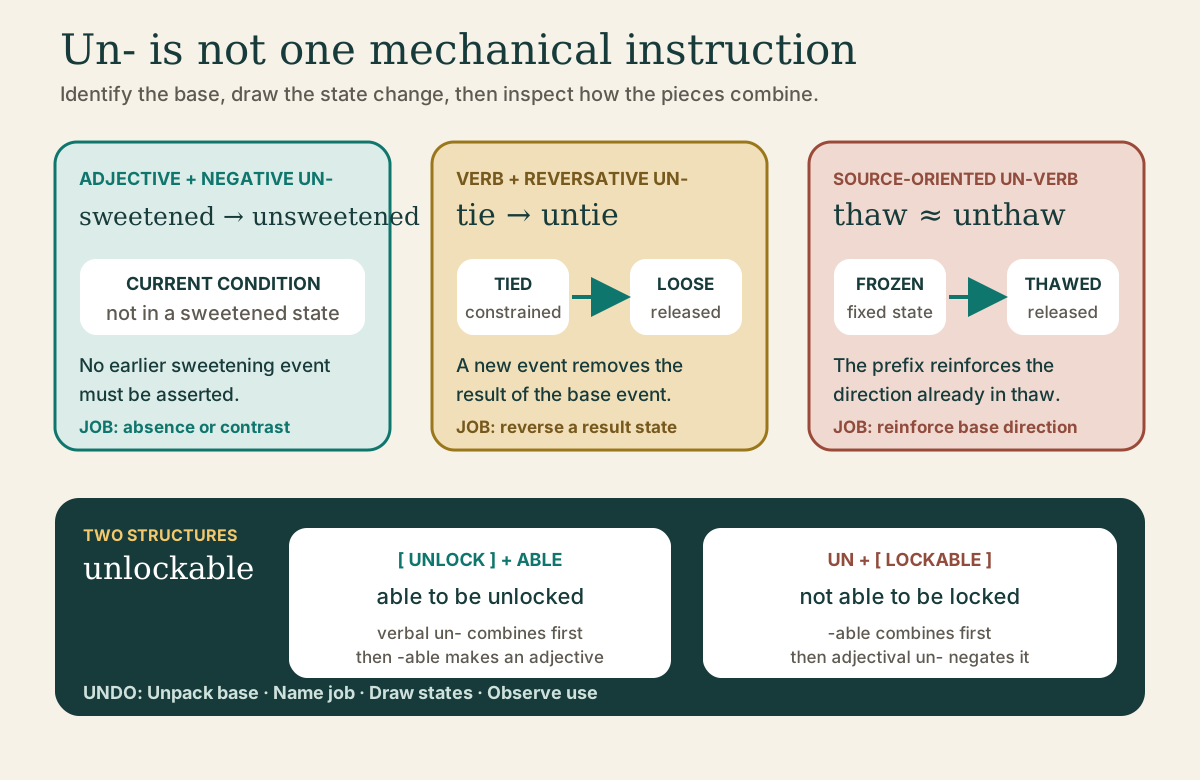
Start with the category of the base. With an adjective, un- commonly indicates that a condition does not hold:
| Base | Derived adjective | Useful paraphrase |
|---|---|---|
| happy | unhappy | not happy |
| even | uneven | not even |
| certain | uncertain | not certain |
| sweetened | unsweetened | not in a sweetened state |
The last example does not require anyone to sweeten tea and then remove the sugar. It classifies the tea by its present condition or by an expectation: in a setting where sweetened tea is ordinary, unsweetened marks the contrasting option. The A Way with Words discussion uses this restaurant puzzle to show why an adjective need not narrate a reversal 1.
With a verb, un- most readily describes an event that releases an object from a result:
| Base event | Result | Un-event |
|---|---|---|
| tie the cord | cord is tied | untie the cord |
| wrap the parcel | parcel is wrapped | unwrap the parcel |
| button the cuff | cuff is buttoned | unbutton the cuff |
| lock the door | door is locked | unlock the door |
This is not truth-table negation. Untie the cord does not mean “do not tie it.” It directs a new event whose endpoint contrasts with the endpoint of tying. The productive center of the un-verb pattern therefore involves change of state and a return toward an earlier, expected, or less constrained condition 2. Clark’s survey of English undoing expressions shows why the available objects, result states, particles, and conventional verb pairs all matter 3.
The verbal subtypes are useful diagnostics, not perfectly sealed drawers. Unlock straightforwardly reverses a locked result. Unmask can be described as privative because it removes a mask, but it can also reverse an earlier masking. Unthaw, by contrast, does not undo thawing at all. Terminology varies at these boundaries, so state the event analysis instead of treating a label as the explanation.
Why some unverbs feel natural
Try attaching un- to every verb: unopen, unpaint, unarrive, unwatch, unboil, unrecognize. The results do not all feel equally ordinary. A productive pattern still has constraints.
The clearest unverbs usually offer three things:
- A visible result state. After locking, a door is locked.
- A plausible release. The latch can move back without requiring time travel.
- A useful contrast. Speakers regularly need to distinguish locking from releasing the lock.
That is why unwrap feels easier than unarrive. Arrival establishes a new location, but ordinary experience offers no single conventional action that erases the arrival. Unboil an egg asks for the reversal of changes that daily life treats as irreversible. The form can still work in a poem, science-fiction story, laboratory announcement, or joke because the context supplies an extraordinary reverse operation. Productivity is a gradient, not a border patrol 3.
Digital interfaces create especially hospitable environments for new unverbs. A system can preserve an earlier state and expose a button that restores it: undelete, unmute, unfollow, unfriend, unlike, and unsend. The software does not literally make the past event unhappen. It defines a practical reversal—remove the deletion flag, restore audio transmission, withdraw a connection, or retract a message from a particular view. The interface makes the endpoint legible.
When the base already points toward release
Now return to unthaw. Plain thaw already describes movement out of a frozen state. In unthaw, the prefix does not reverse thawing. It reinforces the same release-oriented direction. Linguists call this a source-oriented or pleonastic use: the base already moves away from the marked or constrained state that verbal un- usually helps release. The A Way with Words discussion documents the form as longstanding, informal, and dialectal rather than a recent logical accident, and groups it with forms such as unloosen and unravel, in which un- reinforces an undoing already present in the base 4.
The practical editing advice can coexist with the linguistic explanation. In edited prose, thaw is shorter and less likely to distract a reader. In a record of family speech, dialogue, or dialect, replacing unthaw may erase useful evidence. “Less formal” is a statement about register and audience; it is not proof that a form has no history or system.
The same caution applies to unloosen and unpeel. Before declaring a prefix redundant, ask whether it is helping a speaker highlight a source state: tight to loose, covered to bare, frozen to liquid. Natural language often tolerates reinforcement when it makes an event easier to frame.
One spelling, two structures
The two kinds of un- can meet inside a word such as unlockable:
- [unlock] + able: capable of being unlocked;
- un + [lockable]: not capable of being locked.
The difference is not a debate over one dictionary definition. The morphemes combine in different orders: prefixes and suffixes attach to bases, and the resulting form can itself become the base for another derivation 5. Context normally selects one. “The emergency exit must remain unlockable from inside” favors “able to be unlocked.” “The broken hasp makes the cabinet unlockable” may favor “not lockable,” though a careful writer should choose a clearer phrase.
This is why bracketing matters. A string of letters is not yet an analysis.
Work the U-N-D-O method
When an un- word seems illogical, UNDO the first impression:
- U — Unpack the base. Identify the base and its category in this sentence, not merely in a dictionary headword.
- N — Name the prefix job. Is it adjectival negation, reversal of a result, privation or removal, source-oriented reinforcement, or a conventional meaning that needs its own entry?
- D — Draw the states. What is true before and after the base event? What is true before and after the un-event?
- O — Observe real use. Check dated examples, register labels, collocations, and the context that makes the intended state relevant.
Mnemonic: Do not undo a word until you UNDO your assumption.
Worked example: unmute
Unpack. Mute is used as a verb for changing an audio channel from transmitting to silenced.
Name. In “Please unmute your microphone,” un- is reversative.
Draw. transmitting → muted → transmitting again. The second endpoint may not reproduce every technical setting that existed before, but it restores the contrast that matters to participants.
Observe. The form is at home in conferencing interfaces because mute is a frequent, visible, reversible state. “Please make your microphone not muted” conveys a similar truth condition but ignores the conventional action the interface provides.
Practice: predict before looking up
Make a six-row table using unbutton, unsweetened, unthaw, unsend, unrecognize, and one un-word you notice this week.
| Form in a complete sentence | Base category | Before → after | Predicted un- job | Ordinary, marked, or playful? | Evidence checked |
|---|---|---|---|---|---|
For each item:
- write the sentence before assigning a label;
- bracket the form if more than one structure is possible;
- predict how conventional it will be and why;
- consult two edited dictionaries or one dictionary plus a corpus;
- record whether the evidence changed your prediction.
Do not grade a form solely by whether you personally use it. Your judgment is one data point about one speaker. The investigation asks how a community has made the pattern work.
Rule of thumb
An affix is not a keyboard operator. With un-, inspect the base, the result state, the structure, and the setting. “Not,” “reverse,” and “release” overlap, but they are not interchangeable instructions.
Practice
Unbutton names an event that reverses a buttoned state. The other examples use un- with adjectives to indicate absence or negation.
Practice
In one structure, verbal un- first reverses lock; in the other, adjectival un- negates lockable. Different structures support different meanings.
Practice
A sent-message state and a visible reversal operation make unsend interpretable. That does not mean every event verb can form an equally ordinary un-verb.
Lesson complete
Nice work.
Sources for this lesson
- 1Does the Prefix “-un” Usually Mean a Reversal?. A Way with Words. verifiedSegment distinguishing reversative un- on verbs from adjectival un- that can mean “not,” indicate an absent condition, or frame a contrast with expectations. Cited at: segment and transcript.
- 2Laurence R. Horn. Words in Edgewise. Annual Review of Linguistics. 2018. verifiedScholarly review connecting lexical pragmatics, negation, polarity, word formation, and unwords, with attention to how context and speakers’ intentions shape lexical interpretation. Cited at: research retrospective.
- 3Eve V. Clark. Words for Undoing Actions. Cambridge University Press. 1993. verifiedChapter 12 of The Lexicon in Acquisition, surveying how English expresses reversal with un-, particles such as off and back, unrelated verb pairs, and mixed constructions. Cited at: undoing actions; systems for undoing actions.
- 4When Did People Start Saying “Unthaw” to Mean “Thaw”?. A Way with Words. verifiedSegment explaining that un- does not always negate or reverse an action; in forms such as unthaw, unpeel, and unloosen it can instead reinforce or intensify the base meaning. Cited at: segment and transcript.
- 5Catherine Anderson, Bronwyn Bjorkman, Derek Denis, Julianne Doner, Margaret Grant, Nathan Sanders, Ai Taniguchi. Roots, Bases, and Affixes. Essentials of Linguistics 2e, eCampusOntario. verifiedOpen textbook chapter on morphemes, roots, affixes, and other word-building operations. Cited at: roots, bases, and affixes.