Etymology Without the Fairy Tales
Etymology as documented history, not the best story: a five-part test for origin claims, the 'rule of thumb' wife-beating myth, quesadilla and resemblance without lineage, speakers remodeling opaque forms, why first use is the wrong prize, and an evidence ledger.
- 7 min
- 10 steps
- 3 questions
- Lesson 24 of 36
In this lesson
- The Word Cabinet
- Method: use the SOUND test
- Case 1: a rule defeats a good story
- Case 2: resemblance without lineage
- Case 3: speakers remodel an opaque form
- Why first use is usually the wrong prize
- Build an evidence ledger
- Practice: audit an origin story
- Rule of thumb
Open alongside this lesson
-
The Origin of Rule of Thumb (opens in a new tab)
A model for rejecting a vivid, widely repeated origin story when dated evidence does not support it.
-
Quesadilla Is Not from Nahuatl (opens in a new tab)
Practice checking whether similar sounds, historical contact, and documented forms actually connect.
-
Etymology FAQ (opens in a new tab)
Learn what the compact history printed in an entry does—and does not—claim.
-
Language Research Resources (opens in a new tab)
Move from a show segment into dictionaries, archives, corpora, and specialist references.
Picking up where you left off.
An etymology is a history of a linguistic form, not the best story that can be made from its modern spelling. It may trace earlier forms, meanings, sound changes, borrowing routes, and related words. The work is historical: what form existed where, when, with what meaning, and through what documented pathway could it become this one?
Folk etymologies reverse that method. They begin with a satisfying tale and recruit resemblance as proof. The tale often supplies a named inventor, a dramatic event, or an acronym. It spreads because it explains both form and meaning in one scene—not because the scene is documented.
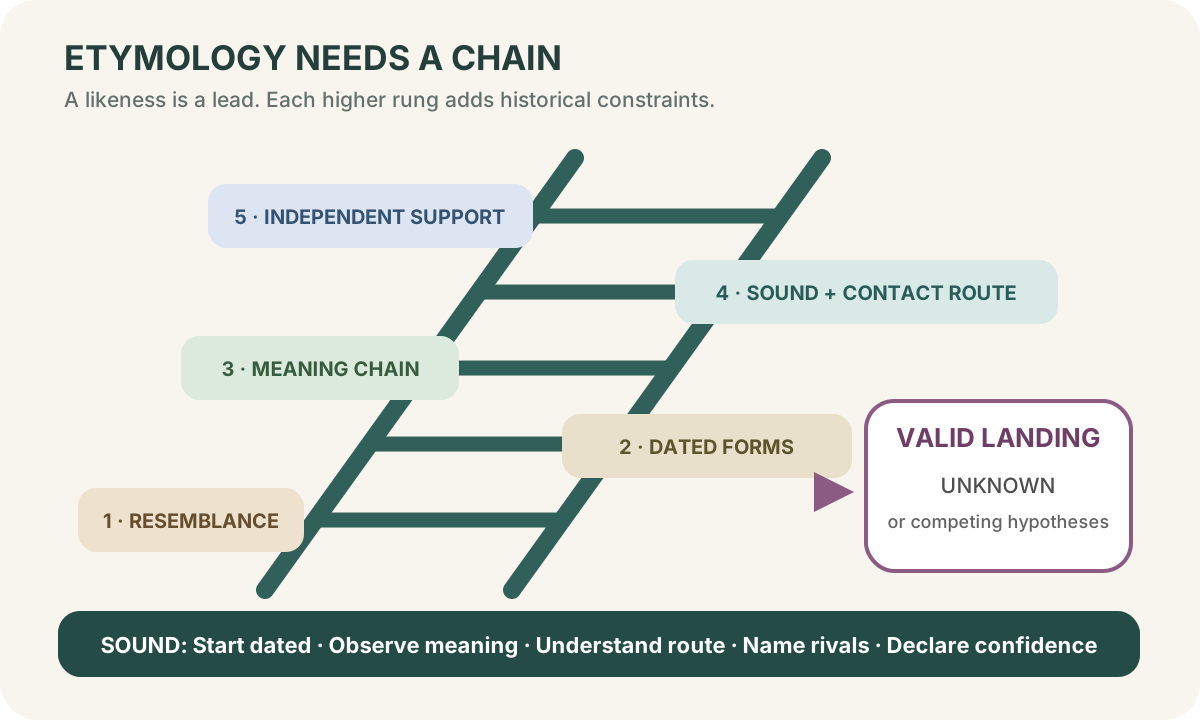
The cure is not cynicism. It is an evidence ladder.
The Word Cabinet
- etymology: the documented history and relationships of a word or expression;
- attestation: a datable instance of a form in speech or writing;
- antedating: finding evidence earlier than the previously known first use;
- cognate: a form historically related to another through common descent;
- loanword: a form adopted through language contact;
- folk etymology: reshaping or explaining an unfamiliar form through more familiar material;
- semantic bridge: an intermediate use that makes a proposed meaning development plausible;
- ghost word: a form created by error and then treated as if it had ordinary usage.
A dictionary etymology is compressed. Merriam-Webster explains that its histories may identify source languages and earlier forms while acknowledging that the remote origin can be uncertain 1. Read “origin unknown” as editorial discipline, not failure.
Method: use the SOUND test
Use SOUND to keep a promising hunch from becoming a fairy tale.
S — Start with dated forms. Locate the oldest reliable examples you can, then search spelling and spacing variants. A claimed coinage cannot be the origin if the expression already existed.
O — Observe the meaning chain. Write what each early token means in context. Similar spelling with an unrelated meaning does not prove continuity; a plausible semantic bridge is required.
U — Understand the contact route. If borrowing is proposed, when and where did speakers of the languages interact? Through what community, trade, migration, text, or intermediary language could the form move?
N — Name regular sound relationships and rivals. Historical changes normally recur across groups of words. Compare more than one pair, and list chance resemblance, independent formation, and later reshaping as alternatives.
D — Declare confidence. Separate established steps, reasonable inference, speculation, and unknowns. The final label should match the weakest necessary link.
Mnemonic: sound-alike is the start line, not the finish line.
Case 1: a rule defeats a good story
A persistent claim connects rule of thumb with a supposed legal permission for a husband to beat his wife with a stick no thicker than his thumb. The moral horror makes the story memorable, but repetition is not a citation. A Way with Words reviews the expression’s history and rejects that tale as its origin 2.
Apply SOUND:
- Dated forms: versions of the expression occur before the period or legal episode usually named in the story.
- Meaning: early uses concern rough measurement or practical estimation, which fits the thumb as an available measuring tool.
- Route: no documented act or ruling provides the necessary coinage event.
- Rival: a practical measurement metaphor explains the wording without an invented law.
The lesson is narrower than “old law was humane.” It is simply that this expression is not evidence for the claimed origin story. Rejecting bad etymology does not erase real histories of violence.
Case 2: resemblance without lineage
A neat online claim can divide Spanish quesadilla into pieces from Nahuatl and assign them a phrase-like meaning. But modern sound-alike segmentation is not historical analysis. A Way with Words points instead to the transparent Spanish relationship with queso and the recorded history of the form 3.
For any cross-language claim, demand:
- attested earlier forms in both languages;
- meanings that connect across time;
- a plausible contact setting;
- sound correspondences, not just one attractive match; and
- specialist sources independent of the viral claim.
Borrowing is common, and Nahuatl has profoundly influenced Mexican Spanish. Neither fact makes every proposed Nahuatl derivation true. General contact establishes possibility; the particular word still needs a chain.
Case 3: speakers remodel an opaque form
Etymology can also explain a form that genuinely changed because speakers made unfamiliar material familiar. The southeastern Colorado name Picketwire is associated with reinterpretations of the French Purgatoire place-name. The A Way with Words minicast treats it as a case of oral reshaping rather than a literal fence-wire origin 4.
This is folk etymology in a technical, non-insulting sense: people reproduce an opaque sequence using recognizable sounds and words. Similar processes can create sparrow grass from asparagus or reinterpret a phrase boundary. The remodeled form becomes real usage even though its internal story is historically secondary.
Why first use is usually the wrong prize
The earliest surviving printed token is not necessarily the first time anyone said the word. It is the earliest found attestation in the searched record. Print collections overrepresent publishers, institutions, and communities whose materials were preserved and digitized. Family expressions and stigmatized dialect forms may circulate orally for decades before appearing in searchable text.
Use calibrated verbs:
- attested by 1884, not “invented in 1884”;
- apparently borrowed through, not “definitely came straight from”;
- origin uncertain; perhaps related to, not “must be from”;
- the evidence rules out, when a dated fact truly does.
The show’s discussions of cattywampus and fair to middling are useful because their histories involve variants, regional use, and documentary trails rather than a single cinematic birth moment 5 6.
Build an evidence ledger
For an origin claim, keep one row per piece of evidence:
| Date | Exact form | Meaning in context | Place/community | Source + locator | What it supports | Limit |
|---|---|---|---|---|---|---|
Add negative findings carefully: “not found in the database’s 1800–1850 results with these searches” is honest; “never used before 1850” is not. Record OCR errors, inaccessible sources, and spelling variants you tried.
Then grade the full proposal:
- Established: several independent evidence lines and no serious gap.
- Probable: the chain fits well but one link remains indirect.
- Possible: compatible with evidence but live rivals remain.
- Unsupported: repeated claim without the needed historical chain.
- Disproved as stated: decisive chronology or form evidence contradicts it.
- Unknown: no hypothesis currently earns more.
Practice: audit an origin story
Choose a claim involving an acronym, famous person, law, military unit, or foreign phrase. These are folk-etymology magnets.
- Quote the claim exactly and identify its necessary date.
- Check two edited dictionaries, including their etymology notes.
- Search earlier form and spelling variants in dated collections.
- Read each promising hit in context; do not trust a search snippet.
- Draw the proposed form–meaning–place chain.
- Write the strongest rival explanation.
- Assign one confidence grade and name the evidence that would change it.
Rule of thumb
A story can explain why people repeat an origin without explaining the origin itself. Let chronology rule out what it can, require a plausible chain for what remains, and give “unknown” a respected place in the answer.
Practice
Chance resemblance, borrowing through another language, sound symbolism, and common ancestry are competing possibilities that require historical evidence.
Practice
An attestation predating the supposed coinage rules that event out as the expression’s origin, even if the event later popularized a story about it.
Practice
Unknown or uncertain is a substantive research result; it preserves the boundary between evidence and invention.
Lesson complete
Nice work.
Sources for this lesson
- 1Etymology FAQ. Merriam-Webster. verifiedConcise explanation of what dictionary etymologies report and why similar-looking forms do not prove ancestry. Cited at: Etymology FAQ.
- 2The Origin of Rule of Thumb. A Way with Words. verifiedSegment correcting a persistent folk etymology and modeling evidence-first origin research. Cited at: segment and show notes.
- 3Quesadilla Is Not from Nahuatl. A Way with Words. verifiedSegment testing a neat-sounding but unsupported language-origin story. Cited at: segment and show notes.
- 4Picketwire. A Way with Words. verifiedMinicast on a place-name reshaped by speakers into a more familiar English form. Cited at: minicast.
- 5Cattywampus. A Way with Words. verifiedSegment on a vividly variable regional word and the evidence needed to discuss its origin. Cited at: segment and show notes.
- 6Fair to Middling. A Way with Words. verifiedSegment examining the documented history of a familiar expression. Cited at: segment and show notes.
Further reading
- Language Research Resources. A Way with Words. verifiedCurated dictionaries, corpora, dialect projects, and usage references for investigating listener questions.
Previous: Meaning Moves: Awfully, Preppy, and Platform Speech