Meaning Moves: Awfully, Preppy, and Platform Speech
How meanings change: separating a use, a sense, and a cause, tracking a moving meaning, 'awful' sliding from evaluation to degree, the ellipsis growing a social voice, treating 'platform speech' labels as hypotheses, and a ten-token timeline.
- 7 min
- 9 steps
- 3 questions
- Lesson 23 of 36
In this lesson
- The Word Cabinet
- Separate a use, a sense, and a cause
- Method: TRACK a moving meaning
- Worked case 1: from evaluation to degree
- Worked case 2: punctuation grows a social voice
- Platform speech: treat the label as a hypothesis
- Practice: build a ten-token timeline
- Rule of thumb
Open alongside this lesson
-
Why Awfully Is Not Necessarily Awful (opens in a new tab)
Hear a compact case of an evaluative word developing into a degree intensifier.
-
The Meaning Change of Preppy (opens in a new tab)
Compare an older social-and-school cluster with a newer platform-mediated aesthetic label.
-
Semantic Change (opens in a new tab)
Use its categories to describe evidence; do not force every change into one box.
Picking up where you left off.
Words do not carry one sealed definition from birth to retirement. Speakers reuse them in new situations, listeners infer what works there, and repeated inferences can become ordinary senses. A dictionary records this movement after enough evidence accumulates; it does not vote a meaning into existence.
Consider awfully. In older and still possible uses, it relates to awe or something dreadful. In “That was awfully generous,” however, it commonly acts as an intensifier—roughly very—without calling generosity horrifying. A Way with Words uses this contrast to show how an emotionally loaded form can lose some specific content and take on a degree-marking job 1.
That is not decay. It is normal language change.
The Word Cabinet
- semantic change: a durable change in a form’s conventional meaning or range of uses;
- broadening: a sense comes to cover more cases than before;
- narrowing: a sense becomes restricted to fewer cases;
- amelioration: a form develops a more favorable evaluation;
- pejoration: a form develops a more unfavorable evaluation;
- semantic bleaching: specific content weakens while a grammatical or pragmatic function grows;
- intensifier: a form that raises degree, as very, really, or terribly can;
- pragmatics: meaning inferred from speaker, audience, medium, and situation rather than dictionary sense alone.
These labels are descriptions, not little machines inside a word. A use can involve several paths at once. An intensifier may retain a faint evaluative flavor; a broader sense may coexist with the older narrow one for generations. The open Essentials of Linguistics chapter treats metaphor, broadening, narrowing, amelioration, and pejoration as recurring patterns while emphasizing that living usage supplies the evidence 2.
Separate a use, a sense, and a cause
Three claims that sound similar require different evidence:
- Use: “This writer used preppy for a pastel, highly decorated style.” A screenshot with date and context can establish that.
- Sense: “A recognizable community uses preppy with that meaning.” You need repeated examples from different users and contexts.
- Cause: “A particular platform created this sense.” You need chronology, comparison outside the platform, pathways of influence, and alternatives.
The first claim can be solid while the third remains speculation. A Way with Words discusses a newer use of preppy associated with a bright, branded social-media aesthetic alongside older senses involving preparatory schools, social class, and clothing 3. The responsible conclusion is not that the old definition was replaced overnight. It is that another usage cluster is available to some speakers, especially in a particular cultural setting.
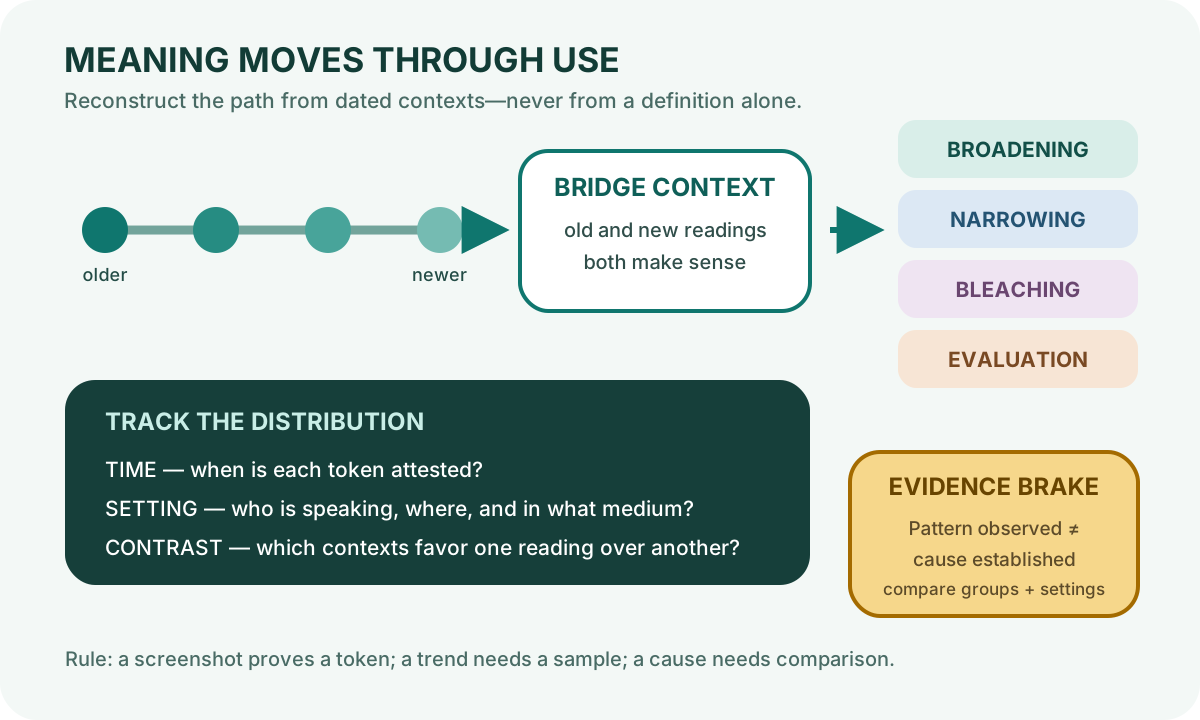
Write coexistence before replacement in your notes. New senses usually overlap older ones. Age, community, medium, and genre affect which a speaker expects.
Method: TRACK a moving meaning
Use TRACK whenever someone announces that a word “now means” something new.
T — Time-stamp examples. Save the date, full sentence, speaker or publication, and stable link or image. Search earlier examples; a viral explanation may be younger than the usage.
R — Range the sample. Collect different speakers, genres, regions, and platforms. Ten reposts of one joke are one evidence stream, not ten independent attestations.
A — Align adjacent senses. Write the older and proposed newer meanings, then find bridge contexts where either interpretation works. Ambiguous bridges often make a change learnable.
C — Check contrast. Substitute a synonym, change the audience, or move the sentence into another medium. What meaning survives? What social signal disappears?
K — Keep cause calibrated. State what the examples show, what you infer, and what would distinguish rival explanations.
Mnemonic: examples travel before explanations catch up.
Worked case 1: from evaluation to degree
Compare:
- “The storm inspired an awful fear.”
- “The room was awfully quiet.”
- “That is awfully nice of you.”
The first keeps strong negative evaluation. The second may mix ominous evaluation with degree. The third usually marks high degree while the adjective nice supplies the evaluation. That series offers a plausible bridge: a form meaning something like “to an awe-producing degree” can be reinterpreted as “to a great degree.”
Do not claim that every token follows the same path in a speaker’s mind. Historical analysis works across distributions of recorded examples, not private mental replay.
Worked case 2: punctuation grows a social voice
An ellipsis has conventional editing functions: omitted text, trailing thought, or hesitation. In messaging, the same three dots can be read as warm continuation, suspense, discomfort, irony, or passive aggression. A Way with Words presents the cross-generational friction that can arise when one person treats dots as a gentle conversational trail and another reads them as loaded silence 4.
This may be pragmatic change more than a new dictionary definition. The material mark stays the same; expectations about turn-taking and tone shift with medium and community.
Try the contrast:
- “Okay.”
- “Okay…”
- “Okay!”
- “okay”
No punctuation guide can determine the emotion without a relationship, preceding message, platform norm, and writer history. Yet interpretation is not random. Communities develop regular expectations, and mismatched expectations produce real misunderstanding.
Platform speech: treat the label as a hypothesis
People now name patterns such as a “YouTube voice,” “millennial pause,” or “Gen Z shake.” The Cat Bristle episode collects these platform-linked labels and the arguments made about their communicative effects 5. The labels can focus attention on observable timing, pitch, gaze, framing, or editing conventions. They can also leap too quickly from a handful of salient creators to an entire generation.
Analyze them with four comparison cells:
| Target platform | Other settings | |
|---|---|---|
| Target group | sampled creators | interviews or ordinary conversation |
| Comparison group | creators in the same genre | comparable speakers elsewhere |
If a feature appears across groups on one platform, genre or production technique may explain more than generation. If it appears across settings within a cohort, age-graded or community change becomes more plausible. If it disappears when a creator stops performing to camera, call it style before calling it a dialect.
Practice: build a ten-token timeline
Choose one changing item: preppy, literally, iconic, unalive, an ellipsis, or a local candidate.
- Collect ten dated uses across at least five speakers and two settings.
- Copy enough context to interpret each token.
- Code the apparent sense, audience, medium, and uncertainty.
- Sort by date; do not sort by the story you expect.
- Identify one bridge use and one clear contrast between senses.
- Draft three sentences labeled observed, inferred, and unknown.
A strong finding may be modest: “In this sample, the aesthetic sense appears repeatedly after 2022 among creators addressing a youth audience; I have not established where it began.” That sentence teaches more than a grand origin claim with no trail.
Rule of thumb
A screenshot proves a token, not a trend; a trend proves a distribution, not its cause. Follow meaning through dated contexts, keep coexisting senses visible, and apply the evidence brake before turning a memorable label into language history.
Practice
A new sense is a distributional claim. Repeated, dated uses across relevant contexts and speakers are stronger than intuition or a single post.
Practice
The older evaluative content has weakened while a grammatical or pragmatic degree function has become prominent.
Practice
The observation is real but the cause and population scope remain open until the sample and comparison groups justify them.
Lesson complete
Nice work.
Sources for this lesson
- 1Why Awfully Is Not Necessarily Awful. A Way with Words. verifiedSegment on semantic bleaching and the development of intensifiers. Cited at: segment and show notes.
- 2Semantic Change. Essentials of Linguistics 2e, eCampusOntario. verifiedOpen textbook chapter on narrowing, broadening, amelioration, pejoration, metaphor, and other paths of meaning change. Cited at: Semantic Change.
- 3The Meaning Change of Preppy. A Way with Words. verifiedSegment on a word whose newer social-media use does not perfectly match its older school-and-style associations. Cited at: segment and show notes.
- 4Ending Messages with Ellipses. A Way with Words. verifiedSegment on how punctuation can acquire different pragmatic meanings across media, communities, and generations. Cited at: segment and show notes.
- 5Cat Bristle. A Way with Words. verifiedFull episode covering platform speech, the newer preppy sense, generational video conventions, and eye dialect. Cited at: episode overview.
Previous: Can You Not? Indirect Requests, Implicature, and Politeness