Who Speaks Next? Turn-Taking, Gaps, and Cooperative Overlap
How people take turns without a referee: Sacks, Schegloff, and Jefferson's turn-taking system, projecting when a turn will end, four kinds of overlap, what a pause means in sequence, a five-part diagnostic, and mapping thirty seconds of an interview.
- 6 min
- 9 steps
- 3 questions
- Lesson 30 of 36
In this lesson
- The Word Cabinet
- A local allocation engine
- Projection: how a listener knows “now”
- Four kinds of overlap
- Gaps are actions only in sequences
- The FLOOR diagnostic
- Practice lab: map thirty seconds
- Rule of thumb
Open alongside this lesson
-
Differing Conversational Styles (opens in a new tab)
Begin with the social puzzle of one speaker hearing enthusiasm where another hears interruption.
-
A Simplest Systematics for the Organization of Turn-Taking for Conversation (opens in a new tab)
Focus on local turn allocation, possible completion points, self-selection, gaps, and overlap.
-
Conversational Style: Analyzing Talk among Friends (opens in a new tab)
See how pacing and overlap work as a cluster and how style mismatch changes interpretation.
Picking up where you left off.
Conversation feels spontaneous, yet two people routinely exchange the floor within fractions of a second. There is no visible traffic signal. Speakers project where a turn could end, listeners prepare possible responses, and everyone adjusts after a gap or overlap.
The system is not perfect—and that is why it is observable. A Way with Words describes a mismatch in which a high-involvement speaker uses overlap to show enthusiasm while a high-considerateness speaker experiences the same timing as interruption 1. The moral is not “all interruption is secretly friendly.” It is that simultaneous talk is a timing fact; its conversational action still has to be analyzed.
The Word Cabinet
- turn: a stretch of talk treated as one participant’s contribution;
- turn-constructional unit (TCU): a potentially complete word, phrase, clause, or sentence that can build a turn;
- transition-relevance place (TRP): a point where a turn could be complete and speaker change becomes relevant;
- current-speaker selection: the current speaker designates who should speak next;
- self-selection: another participant begins without being explicitly selected;
- gap: silence between turns;
- latch: the next turn begins with effectively no perceptible gap or overlap;
- overlap: two participants produce talk simultaneously;
- projection: using syntax, prosody, action, and context to anticipate how a turn may continue.
A TRP is a possibility, not punctuation read aloud. “Because…” is grammatically incomplete in isolation, but it could complete an answer in a particular sequence. A full sentence may not yield the floor if its pitch, gaze, gesture, or action projects continuation.
A local allocation engine
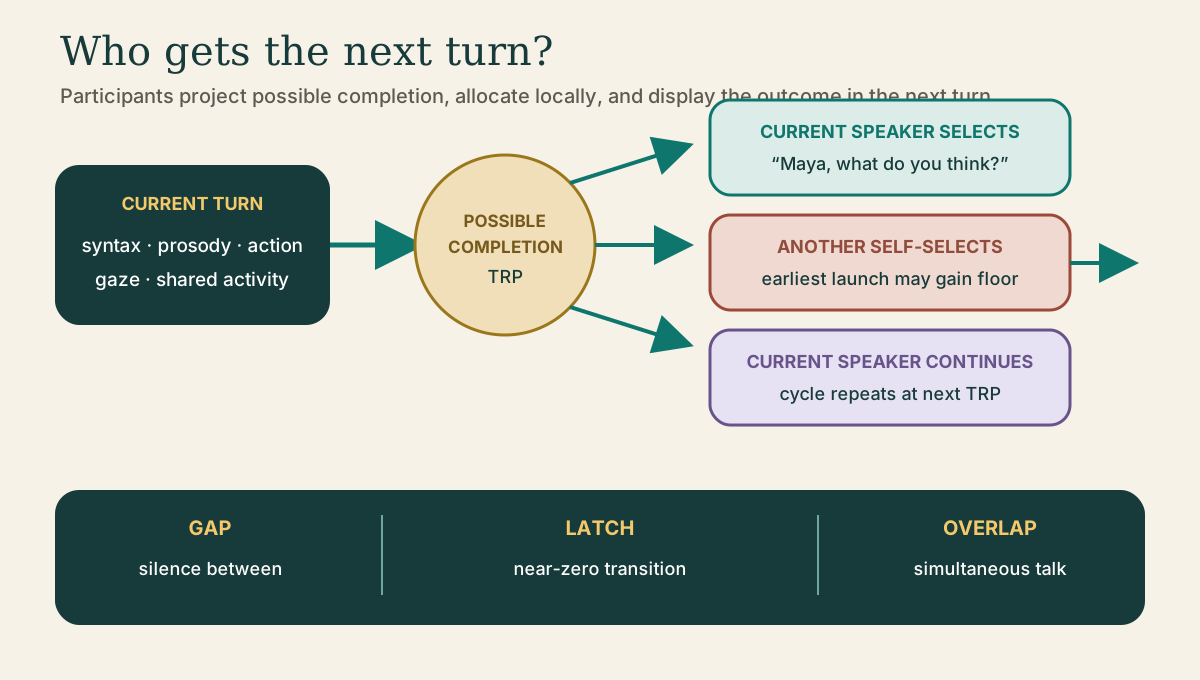
Sacks, Schegloff, and Jefferson proposed a compact organization for ordinary conversation 2. At a possible completion:
- If the current speaker selects a next speaker, that person has the first right and obligation to respond.
- If no one is selected, another participant may self-select; the earliest start often gains the floor.
- If no one else starts, the current speaker may continue.
The rules recur at the next possible completion. They do not dictate every encounter—debates, courtrooms, classrooms, ceremonies, and radio programs add institutional controls—but they explain how ordinary talk can be both flexible and orderly.
Projection: how a listener knows “now”
Listeners combine several resources:
- syntax: a clause approaches possible completion;
- prosody: pitch and rhythm sound final or continuing;
- pragmatic action: a question has become recognizable and an answer can be prepared;
- lexical formula: “and that’s why…” forecasts closure;
- gaze and gesture: a speaker looks toward a recipient or completes a hand movement;
- shared activity: placing an order or telling a joke creates expected next actions.
No cue works alone. Falling pitch can close a statement, but a list may use repeated falling contours before the final item. A listener who begins from one cue and overlaps is not necessarily inattentive; prediction is built into fast turn exchange.
Four kinds of overlap
Instead of classifying every overlap as polite or rude, describe its job:
- Terminal overlap: the next speaker starts while the current turn’s predictable final words are still arriving.
- Continuers and agreement: mm-hm, yeah, or a repeated phrase displays attention or affiliation while leaving the main trajectory intact.
- Collaborative completion: a recipient supplies a word or phrase when the speaker searches or when the completion is highly projectable.
- Competitive overlap: another participant launches a turn that redirects the topic, resists the current action, or persists until the floor changes.
The same form can move between categories. A completion welcomed by one speaker may be experienced as having words put in their mouth. The next turn matters: does the first speaker accept, repeat, reject, stop, speak louder, or explicitly ask to finish?
Tannen’s close study of one dinner conversation treats pace, overlap, topic transition, expressive prosody, and storytelling as a style cluster, not a personality essence 3. Shared high-involvement timing can build affiliation; mismatched expectations can make the same features feel intrusive or distant.
Gaps are actions only in sequences
A half-second silence has no fixed translation. After a casual story it may be ordinary processing. After an invitation, accusation, or proposal, delay can become socially meaningful because a particular response is due.
Cross-linguistic research on ten languages found pressure toward relatively quick response and limited overlap, but also reliable variation in turn timing 4. Do not convert an average into etiquette for every speaker. Hearing, processing, disability, neurotype, language proficiency, relationship, activity, and technology all matter.
Video calls add latency. Two people can repeatedly self-select during a silence that each device displays differently, then both stop after hearing the other. The failure is partly infrastructural, not a character flaw.
The FLOOR diagnostic
Use FLOOR on a short excerpt:
- F — Forecast: what cues made completion projectable?
- L — Locate: where did the second voice begin relative to a possible completion?
- O — Observe content: agreement, continuer, completion, new action, or competition?
- O — Observe uptake: how did the first speaker respond?
- R — Respect variation: what style, task, access, or technology could alter timing?
Never label intention from milliseconds alone.
Practice lab: map thirty seconds
Choose a publicly released interview with two speakers. At quarter speed if necessary:
- Mark each likely TCU boundary with a slash.
- Mark gaps as
(.)without claiming exact duration unless you measure it. - Mark overlaps with aligned brackets.
- For each overlap, name two possible functions.
- Inspect the next turn and revise the stronger analysis.
Then compare a phone or video conversation. Note latency, muted microphones, or missing gaze cues. The exercise should produce a coordination map, not a score for who is “good at conversation.”
Rule of thumb
Overlap is an event; interruption is an analysis. Locate the possible completion, inspect the action and uptake, and leave room for styles that coordinate on different clocks.
Practice
Current-speaker selection is one recurrent route for allocating the next turn.
Practice
The surface fact of simultaneous sound is insufficient; sequence and uptake reveal whether overlap affiliates, assists, competes, or derails.
Practice
Shared coordination problems do not erase community-specific timing and interpretation.
Lesson complete
Nice work.
Sources for this lesson
- 1Differing Conversational Styles. A Way with Words. verifiedSegment distinguishing cooperative overlap from interruptive overlap and introducing high-involvement and high-considerateness styles. Cited at: transcript.
- 2Harvey Sacks, Emanuel A. Schegloff, Gail Jefferson. A Simplest Systematics for the Organization of Turn-Taking for Conversation. Language. 1974. verifiedFoundational account of locally managed turn allocation, transition-relevance places, gaps, and overlaps. Cited at: foundational model.
- 3Deborah Tannen. Conversational Style: Analyzing Talk among Friends. Oxford University Press. 2005. verifiedClose analysis of conversational style, including how high-involvement features can affiliate among matched speakers and misfire across styles. Cited at: study.
- 4Tanya Stivers, N. J. Enfield, Penelope Brown, Christina Englert, Makoto Hayashi, Trine Heinemann, Gertie Hoymann, Federico Rossano, Jan Peter de Ruiter, Kyung-Eun Yoon, Stephen C. Levinson. Universals and Cultural Variation in Turn-Taking in Conversation. Proceedings of the National Academy of Sciences. 2009. verifiedComparative study of ten languages finding shared pressure to minimize silence and overlap alongside meaningful variation in turn timing. Cited at: comparative study.
Previous: What a Slip Reveals: Spoonerisms and the Architecture of Speech