Semantic Satiation: When a Word Goes Strange
Why a word goes strange after repetition: semantic satiation, a writer whose 'among' started looking fake, separating form, sound, and meaning in experiments, repetition priming versus fatigue, a practical reset, and a better metaphor than 'full.'
- 5 min
- 8 steps
- 3 questions
- Lesson 17 of 36
In this lesson
- Transcript lab: the writer’s “fake word” alarm
- From experience to experiment
- Word Cabinet
- Why repetition can help and hurt
- Use RESET
- A useful correction to the metaphor
- Rule of thumb
Open alongside this lesson
-
Semantic Satiation Is When Repeating Words Makes Them Start to Sound Like Nonsense (opens in a new tab)
Begin with the lived experience, then compare the hosts' explanation with controlled experiments.
-
Semantic Satiation in Healthy Young and Older Adults (opens in a new tab)
See how researchers move beyond “the word felt weird” to reaction-time predictions.
-
Electrocortical N400 Effects of Semantic Satiation (opens in a new tab)
Use the mixed research record to keep the mechanism provisional.
Picking up where you left off.
Repeat door quickly: door, door, door, door, door. After enough repetitions, the ordinary word may become a loose sequence of sounds. Its spelling can look counterfeit; its connection to the object can feel delayed. The temporary experience is called semantic satiation.
This is a psycholinguistic phenomenon, not the historical semantic bleaching from the previous module. Bleaching spreads through a community over time. Satiation happens to a person over seconds and then dissipates.
Transcript lab: the writer’s “fake word” alarm
In the A Way with Words transcript, a writer reports that repeated among begins to look misspelled and meaningless. The hosts supply the term semantic satiation and recommend stepping away rather than replacing a correct word with an inaccurate thesaurus choice 1.
The transcript captures the phenomenology well: familiarity reverses into strangeness. But an academic lesson must ask a second question: What changed in processing? Feeling is evidence that something happened, not a complete mechanism.
From experience to experiment
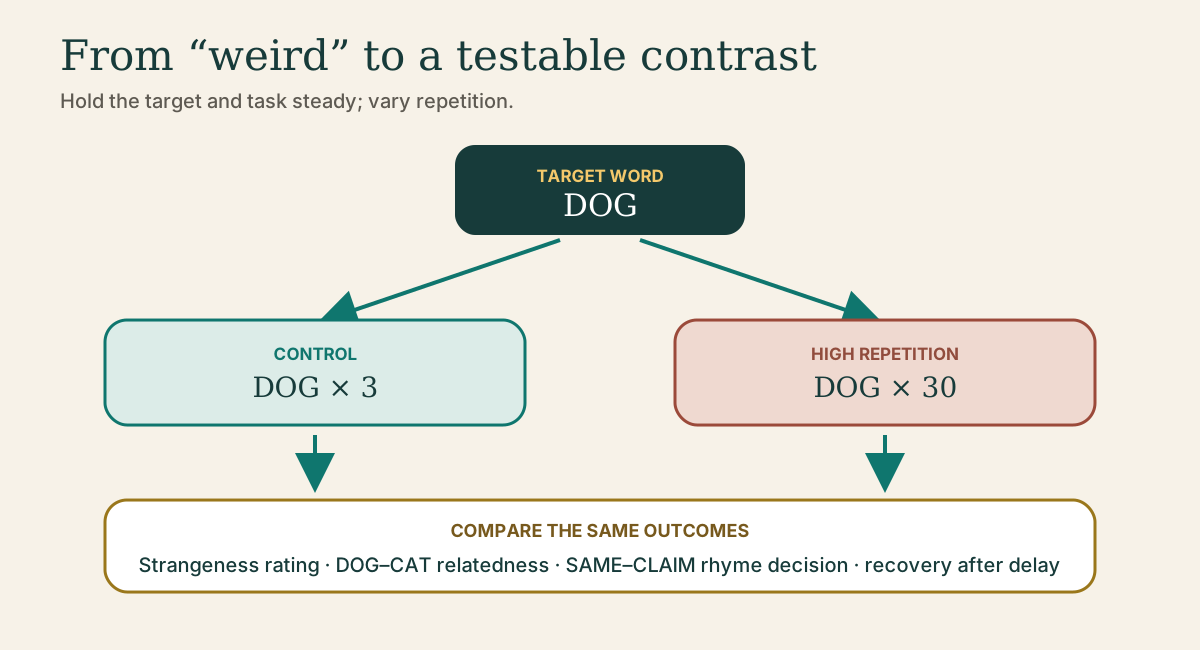
A simple experiment separates three levels:
- Form: the letters or sounds that identify dog.
- Lexical access: activation of the familiar word.
- Semantic access: activation of related concepts such as animal, pet, bark, or cat.
Balota and Black repeatedly presented a word and then asked participants whether a pair such as dog–cat was semantically related. For younger adults, heavy repetition reduced the usual difference between related and unrelated decisions. A parallel rhyme task did not show the same satiation pattern, and a control experiment argued against general fatigue as the whole explanation 2.
That does not prove meaning is stored in one place that becomes “tired.” Later work has tested competing loci: the visible or heard form, the semantic representation, and the association linking form to meaning. EEG studies using the N400—a brain response sensitive to semantic context—have produced results that require caution rather than a single settled story 3.
Word Cabinet
| Term | Working definition | Do not confuse it with |
|---|---|---|
| semantic satiation | temporary reduction in a repeated form’s felt or measured semantic accessibility | historical bleaching |
| repetition priming | faster or easier processing after prior exposure under many conditions | the slower effect of massed repetition |
| habituation | reduced response to repeated stimulation | a complete explanation of lexical meaning |
| lexical decision | deciding whether a letter string is a word | defining the word |
| semantic relatedness | deciding whether two items are meaningfully associated | phonological similarity |
| N400 | an event-related potential sensitive to semantic expectancy and integration | a direct meter of “how much meaning” a word contains |
Why repetition can help and hurt
One exposure often facilitates later recognition: that is repetition priming. Many rapid, unvaried repetitions can produce a different pattern. These are not contradictory claims because timing, task, number of repetitions, and response measure differ.
This is a general research lesson: never ask whether “repetition” has one effect. Specify how many repetitions, how quickly, through which modality, followed by what task, in which population.
Use RESET
When a word goes strange, use RESET both as a practical response and an analysis.
- R — Record the trigger: reading, writing, speaking, or listening; approximate repetition count.
- E — Exit the loop: pause instead of forcing a synonym.
- S — Shift context: put the word in a fresh sentence or pair it with a concrete example.
- E — Evaluate after delay: ask whether ordinary access returned.
- T — Test, do not diagnose: a brief experience is a phenomenon to observe, not evidence of damage or permanent word loss.
Mini-lab
Choose two common nouns. For the control, say the first three times. For the test, say the second thirty times at a steady pace. Immediately after each:
- rate strangeness from 1 to 7;
- write the first related word that comes to mind;
- decide whether three prepared pairs are related;
- wait two minutes and rate the word again.
Do not treat one person’s result as a universal finding. Change the order on a second day, because the second task may otherwise inherit fatigue or expectation from the first.
A useful correction to the metaphor
“Satiated” suggests a meaning container has become full. “Fatigued” suggests a single pathway has run out of energy. Both are metaphors. The empirical finding is narrower: under some high-repetition conditions, people report strangeness and show changed performance on later tasks. The mechanism is inferred from contrasts, not directly observed.
Rule of thumb
Name the experience, then test the level. A word feeling fake may involve access to form, meaning, or their association; only a comparison task can begin to separate them.
Practice
Subjective experience motivates the hypothesis; controlled latency or accuracy comparisons test consequences for processing.
Practice
A selective semantic effect is harder to explain as a general breakdown of the word’s sound representation.
Practice
The phenomenon is replicable under some tasks, while experiments disagree about the precise processing mechanism and boundary conditions.
Lesson complete
Nice work.
Sources for this lesson
- 1Semantic Satiation Is When Repeating Words Makes Them Start to Sound Like Nonsense. A Way with Words. 2013. verifiedFull segment transcript about a writer whose repeated words temporarily begin to look misspelled or meaningless. Cited at: full transcript.
- 2David A. Balota, Sarah Black. Semantic Satiation in Healthy Young and Older Adults. Memory & Cognition. 1997. verifiedFour experiments separating changes in semantic relatedness from phonological judgments and simple fatigue accounts. Cited at: four-experiment abstract.
- 3Kim Ströberg, Lau M. Andersen, Stefan Wiens. Electrocortical N400 Effects of Semantic Satiation. Frontiers in Psychology. 2017. verifiedOpen EEG study testing whether high repetition changes an N400 measure associated with semantic processing; results also illustrate that mechanisms remain debated. Cited at: study background and findings.
Previous: Folk Etymology: When an Opaque Word Learns Familiar Clothes